

Sexual assault prevention
program works to change
campus culture
In just more than a year of operation, the Prevention,
Outreach and Education Department is focusing
cultural change at Michigan State University around
relationship violence and sexual misconduct prevention.
In 2018 the department was created on the
recommendation of the university’
s Relationship
Violence and Sexual Misconduct Expert Advisory
Workgroup to educate the campus community on
preventing RVSM and other violence; empower
staff, faculty and students to become advocates
for a nonviolent community; and positively affect
cultural change.
The department has made significant strides in
accomplishing these goals by providing customized
in-person training and online learning to more than
72,000 campus community members, according to its
first annual report.
“This team is extremely passionate about the work
that they do, and it shows in their consistent efforts,”
says Robert Kent, the associate vice president leading
MSU’
s Office for Civil Rights and Title IX Education and
Compliance, which houses POE and also sponsors
MSU’
s Know More sexual assault awareness campaign.
Growing from one designated prevention staffer in
the Department of Student Life, POE now includes
seven full-time prevention specialists, a director and
associate director and more than 100 peer educators
who partner with campus units to provide educational
programming for employees and students. Some of
the programs include:
• Prevention programming for first- and second-year
students
• Online prevention education for third- and fourth-
year students, graduate students and employees
• Greeks Take the Lead prevention programming for
fraternity and sorority members
• Spartans Against Violence prevention programming
for student-athletes and athletic staff
• Faculty/staff and
graduate/professional
student outreach and
education
• Campus climate and
response programs
POE this year hosted the
first Creating Change
through Collaboration
Summit for MSU faculty,
staff and graduate
students to discuss the
impact of sexual assault
and violence and how
to address relationship
violence and sexual
misconduct issues within
their respective programs.
The department also partnered with multiple student
organizations to facilitate “It’
s On Us” weeks of action
in the fall and spring. This series of events creates
awareness around RVSM issues and is held during
Domestic Violence and Sexual Assault Awareness
months in April and October.
In July, MSU hosted the Big Ten gender-based
violence gathering, an event that brings prevention
and survivor service providers from multiple Big
Ten institutions together to share best practices,
challenges and ideas for programming.
Learn more at poe.msu.edu. e
MSU earns gold rating for
sustainability achievements
Michigan State University has received a gold rating
for its sustainability achievements from the leading
association for the advancement of sustainability in
higher education.
The Association for the Advancement of Sustainability
in Higher Education — an American-based
certification organization — provides a framework to
measure sustainability efforts within higher education
institutions. This Sustainability Tracking and Rating
System, or STARS, is the most widely recognized
framework in the world for publicly reporting
comprehensive information related to a college or
university’
s sustainability performance. Participants
report achievements in five overall areas: academics;
engagement; operations; planning and administration;
and innovation and leadership.
This is MSU’
s third triennial report and the first time it
has achieved the gold rating, up from silver.
“The AASHE STARS tool provides us a consistent
methodology to see the comprehensive impact
and growth of our sustainability programs. It also
identifies new opportunities and gives us the ability
to benchmark other universities for best practices.
It has been exciting to work with such a broad
representation of the MSU community and be able
to tell the great stories of how MSU has embedded
sustainability into its core mission,” says Amy Butler,
campus sustainability director.
MSU jumped 14% in the AASHE STARS system,
achieving a 70.86% and becoming one of three
gold-rated institutions in Michigan.
Areas of improvement for MSU from previous reports
were highest in academics, where the university
improved by more than a dozen points to achieve
an 86%. This is a result of MSU’
s holistic approach
to undergraduate education, where all students
are exposed to sustainability concepts through
interdisciplinary course work, research and
continuing education.
The university also achieved an 86% in the
engagement category, demonstrating MSU’
s
commitment to the campus and wider communities.
The report also features other innovations, including
MSU’
s installation of the largest solar carport array in
North America. e
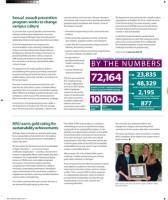
MSU Prevention, Outreach and Education Department
BY THE NUMBERS
23,835
48,329
2,195
877
1 1
+
people, overall, completed online
and/or in-person RVSM training
people completed online training
additional Athletics Department
in-person trainings completed
faculty/staff completed additional
in-person training
people completed in-person training
full-time
staff
peer
educators
00
0
72, 64
1
Mara Spears (left) and Amy Butler (right), of MSU’s Office
of Sustainability
MSU_DJNinsert_sept2019.indd 2