

I met a documentary film director. I was
suddenly fascinated with the documen-
tary because I felt it could be almost any-
thing to tell a story. I felt it was a much
more free medium and
got into it.
”
A Vanity Fair article
about Wallace, read and
retained by Belkin, delved
into how the broadcaster
became more reflective
as he aged and described
how he was fascinated
with people’
s weak spots
and very aware of his own
Achilles’
heel while posing
questions.
“I’
m an interviewer as
well because a documen-
tary filmmaker always
does interviews,
” Belkin
explains. “I was looking
for moments that revealed
Mike’
s character, where it
felt like he was talking to
himself in a way.
”
Although Belkin does
not present any segment
related to Wallace’
s Jewish
background, research left
the filmmaker with the impression that
there was pride in his religion. During
Middle East coverage, the filmmaker
says, it seemed to remain important for
Wallace to include the Palestinian point
of view.
Omitted from the film is part of a
conversation with playwright Arthur
Miller. Both men went to
the University of Michigan
and recalled times there.
“Learning about Mike
was inspiring for my
work,
” says Belkin, cur-
rently represented in an
AMC miniseries, No One
Saw a Thing, about vio-
lence in a small Missouri
town. “Watching the raw
interviews, just looking at
the craft, was school for
me.
“Mike was all about
research, relentless about
getting into the core of
his subject. There isn’
t a
moment in those hours
when he’
s drifting. He’
s so
focused and so sharp.
“The second thing I
realized was about asking
the follow-up questions.
People talk about Mike as
inventing the tough ques-
tion, and he was the master of it, but also
the master of the follow-up. The second
question is sometimes more important
than the first one.
” ■
Details
Mike Wallace is Here
will be shown Sept.
6-8 at the Detroit Film
Theatre in the Detroit
Institute of Arts. $7.50-
$9.50. (313) 833-4005.
dia.org/events.
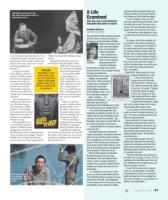
Mike Wallace featured
in an episode of CBS 60
Minutes in Mike Wallace
Is Here.
Mike Wallace interviews Ku Klux
Klan leader Eldon Edwards (1957) in
Mike Wallace Is Here.
Print journalist Charles Eisendrath had two
full-time careers. During the second, he
developed a strong friendship with Mike
Wallace and brought some
good, even light-hearted,
times to the otherwise
intense broadcaster.
After working as an
international correspon-
dent for Time magazine,
Eisendrath joined the
University of Michigan
(U-M) faculty. He went on to become
founding director of the Livingston Awards
for Young Journalists and
invited Wallace to be a judge.
Wallace, who graduated
from U-M in 1939, turned into
a major donor as Eisendrath
founded and directed the
Knight-Wallace Fellowships
and the Wallace House, a cen-
ter for journalism programs.
What a surprise — for
Wallace and spectators — as
Eisendrath gave thanks by
arranging for the 60 Minutes icon to lead
the marching band at a football halftime.
“One of the nicest things Mike said
repeatedly and publicly was that his con-
nection with me and with Wallace House
had given him back his university,” says
Eisendrath, who raised more than $60 mil-
lion during his 30 years at the school.
“I proposed Mike for an honorary degree,
and he got one.”
Eisendrath recalls many stories that
involve public figures and public events that
came his way, and they include covering
arms smuggling out of France and outright
unrest in Chile. He also has dramatic sto-
ries that tell of his life after retiring in 2016
from U-M and taking to the rural appeal of
family property in Charlevoix County.
Many of those stories are described
through the pages of his new book,
Downstream From Here (Mission Point
Press), a series of essays compiled at
Overlook Farm, where he experienced the
outdoors and entered the world of entre-
preneurship.
“I’
m a fisherman, and if you’
re a fish-
erman, you find yourself thinking that the
most interesting things are going to be just
around that next bend,” says Eisendrath,
78, who asked one of his two sons to head
up Grillworks, which markets an outdoor
grill the journalist developed before mar-
keting his maple syrup through Overlook
Farm Maple and Lake Charlevoix Maple.
“If you’
ve floated a canoe, as I often
have, [you watch for] just over there, where
the water gets a wave. The same is true
of time. The most interesting things to me
always seem to be coming in the future.
“I put those two ideas together to come
up with the book title that seemed right for
me.”
The essays, which follow subjects and
not a timeline, also reveal very personal
moments — reaching from the history of
his Jewish family and his own religious
and spiritual outlook to issues faced with
his wife, Julia, a distant cousin of the late
Supreme Court Justice Benjamin Cardozo.
“The book gave me a chance to tell my
story in terms of a place that I loved all
my life; but writing about my own life was
much harder than writing about others’
lives,” he explains.
Eisendrath’
s wrote essays over many
years and kept them in a box.
“I did not think about the
essays very much, but when
retirement [from U-M] was com-
ing, I said I’
m going to see what’
s
in that box,” he recalls. “Thinking
I would find maybe 75 pages,
I found 350, thought it all was
book length and hired an editor.
Eisendrath felt compelled to
document the emotions of coping
with a son’
s serious illness and his wife’
s
critical injuries after a plane crash.
“If you’
re going to be honest with your
reader, you have to include everything,” he
says. “It’
s a clear and balanced idea of the
life that’
s being examined.”
Now immersed in the upper reaches
of Michigan’
s lower peninsula, where he
connects with neighbors and knows vaca-
tioners, Eisendrath is thinning the woods,
experimenting with pawpaw trees and
reading Richard Powers’
The Overstory, a
novel about trees.
As he promotes the idea of the farm
staying with Eisendraths for generations
to come, the continuing writer hasn’
t for-
gotten about emerging journalists and is
thinking journalism could be at the center
of a possible next book.
“This is the best time ever to become a
journalist if you’
re young,” he says. “For the
institutions that have fallen apart, there are
new institutions that are taking shape, and
the cost of entry is very low.
“It won’
t be the same world I enjoyed,
which is to say being paid a nice salary
at someplace like Time to run around the
world and report, but it’
s an exciting time
and can be lucrative, too, as a freelancer or
founder of an organization.” ■
o
n-
s
Eisendrat
y
e
re
in
in
I
I
b
d
BEN EISENDRATH
Charles
Eisendrath
CHARLES EISENDRATH
August 29 • 2019 41
jn
A Life
Examined
SUZANNE CHESSLER
CONTRIBUTING WRITER
MIKE WALLACE’
S CONTEMPORARY
PUBLISHED NEW BOOK OF ESSAYS.