

views
B
efore rushing headlong into the new school
year, now is a good time to pause and take
stock of the trends, transitions and changes
that are facing Jewish education in Metro Detroit.
Buffeted by our changing demographics, digital
culture and a community in tran-
sition, Jewish education in Metro
Detroit is both reacting to and
innovating toward better meeting
the needs of 21st-century learners.
WHAT WE KNOW FROM
THE 2018 DETROIT JEWISH
POPULATION STUDY
There are 12,000 Jewish children
being raised Jewish in Metro Detroit.
• 63 percent of Jewish children age 0-5 who
attend a preschool or child-care program attend a
program that is Jewish.
• 82 percent of Jewish children age 13-17 have
received some formal Jewish education, including
43 percent at a Jewish day school.
• 31 percent of Jewish children age 13-17 regu-
larly participated in a Jewish teenage youth group
in the past year.
• 33 percent of respondents would very much
prefer Jewish-sponsored afterschool care, with an
additional 20 percent who would somewhat prefer
Jewish-sponsored after school care.
WHAT WE KNOW FROM THE
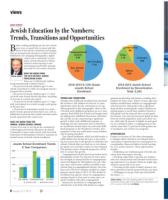
ANNUAL JEWISH SCHOOL CENSUS
As part of its role in serving as the community’
s
central agency for Jewish education, the Jewish
Community Center works closely with the Jewish
Federation of Metropolitan Detroit to maintain an
annual census of Jewish school enrollment.
TRENDS AND TRANSITIONS
Though early childhood enrollment has remained
flat at about 1,100 children for the last 15 years,
opportunity exists for the community to see sig-
nificant growth in this demographic. Most of the
10 Jewish early childhood programs are at or near
capacity. Both Hillel Day School and Temple Israel
are adding early childhood classrooms. Orthodox
day schools are also experiencing a significant
growth in their early childhood programs. A
challenge that the community faces is that there
are insufficient Jewish infant care and early child-
hood programs in the Woodward corridor. New
programs in this area could attract many children
who are going elsewhere.
Day school enrollment, which has held steady at
2,000 children for the last 20 years, is now enjoy-
ing an increase due to the growth in Orthodox day
schools. Schools that once had one or two classes
per grade now need three classes to meet demand.
The question from a financial perspective will be
how to sustain this growth.
Congregational schools have been hardest hit by
demographic trends. For the past 10 years, there
has averaged an annual decline of congregational
school enrollment by 100 students per year. This
year, there will be more children enrolled in day
schools than in congregational schools. Last year,
there were 700 fewer students enrolled in congre-
gational schools than in 2013-14. This decline in
enrollment has placed a stress on congregations,
causing schools to close and, in some cases, cre-
atively combine with other congregations.
Reasons for the decline in congregational
schools have to do both with decline in congre-
gational membership and families enrolling their
children for fewer years. Where 10 years ago more
families enrolled their children in congregational
school from first-10th grade (with a significant
drop off after seventh grade), today’
s families are
waiting longer to enroll their children (fourth or
fifth grade) and the drop off after seventh grade
has become even more pronounced. Based on data
from the Jewish population study and school cen-
sus, while only 58 percent of eligible second-grad-
ers are enrolled in either a congregational or day
school, more than 75 percent of sixth-graders are
in enrolled in one of these two programs.
OPPORTUNITIES
Despite (or because of) the above demograph-
ic changes, Metro Detroit is now blessed with a
cornucopia of opportunities for tweaking how we
conceptualize, frame and deliver Jewish learning
for 21st-century learners. These opportunities
include:
• Rethinking our traditional goal of Jewish edu-
cation from surviving to thriving.
• Working collectively to provide our students
with year-round formal and informal Jewish learn-
ing experiences in a manner which no single orga-
nization can provide on its own.
• Focusing on the needs of today’
s learners (see
above afterschool Jewish-sponsored day care data).
• Willingness to let go of the past and rethink
the future. ■
Jeffrey Lasday is the chief operating officer of the Jewish
Community Center. Data for this article was researched by the
JCC’
s summer JOIN intern Ari Nitzkin.
guest column
Jewish Education by the Numbers:
Trends, Transitions and Opportunities
8 August 22 • 2019
jn
Jeffrey Lasday
2018-2019 K-12th Grade
Jewish School
Enrollment
2018-2019 Jewish School
Enrollment by Denomination
Total: 5,343
Jewish School Enrollment Trends
6 Year Comparison