

T
hree years ago, Gov. Rick Snyder signed into
law legislation that mandated Michigan schools
provide at least six hours of instruction about
genocide to students between grades 8-12. After the
signing, Snyder stated: “Teaching the students of
Michigan about genocide is important because we
should remember and learn about
these terrible events in our past while
continuing to work toward creating a
more tolerant society.
” These are words
of wisdom about an idea that we, and
our civic leaders, should keep in mind
every day.
Of course, the Holocaust is one of
the prime topics taught within the
larger subject of genocide. In many
ways, Michigan Jews have led the
way in Holocaust studies. For example, the Holocaust
Memorial Center in Farmington Hills celebrated its
35th anniversary this year. It opened nine years before
the U.S. Holocaust Memorial Museum in Washington,
D.C. Since 1981, for another example, the University
of Michigan-Dearborn has interviewed Holocaust
survivors and preserved these oral histories in the uni-
versity’
s Voice/Vision Holocaust Survivor Oral History
Archive.
But, what about Holocaust studies outside of Metro
Detroit, which holds the largest Jewish population in
the state and the largest number of survivors? Well,
there is plenty of activity around the state, but I would
like to tell you about a Holocaust-teaching dynamo
from Battle Creek with whom I have recently become
acquainted. Margaret “Gigi” Lincoln has been teaching
about the Holocaust in Battle Creek and around the
nation for a long, long time.
Lincoln and her husband, Gary, moved to Battle
Creek in 1973. Since that time, she has been a library
media specialist with the Lakeview School District.
Lincoln holds a bachelor’
s degree in French and a
M.L.S. from the University of Michigan, as well as
other assorted graduate classes and certificates from
Arizona State University, Michigan State University,
Columbia and Syracuse universities, and a Ph.D. in
information science from the University of North
Texas. I’
ll run out of space if I list all her presentations,
articles, projects and awards for her work in informa-
tion science, media and instruction in the Battle Creek
area, as well as in state and national forums.
What stands out in Lincoln’
s rather lengthy resume,
however, is her work with Holocaust studies. Since
2002, she has been a U.S. Holocaust Memorial
Museum teacher fellow, and at least from that
time until today, Lincoln has been heavily
involved in Holocaust education.
In the July 9, 2004, issue of the JN, then-Editor
Robert Sklar wrote about her, citing an online
presentation in which Lincoln wrote: “Today’
s
high school students and their parents were not
alive at the time of the Holocaust. Through appro-
priately designed learning activities, they can be
alerted to the vigilance necessary to prevent the
reoccurrence of a similar tragedy.
”
Indeed, this is a cogent, succinct rational for
Holocaust and genocide studies. It took another
14 years before Michigan legislators reached
the same conclusion. Since this time, Lincoln
has also studied other genocidal situations
such as those in Rwanda and, most recently, in
Myanmar.
I should also mention that Gigi and Gary
Lincoln are part of a small but active Jewish
community in Battle Creek. They are mem-
bers of Temple Beth El (point of interest: Beth
El was vandalized last year. The JN ran a story about
this in its Dec. 13, 2018, issue).
It is an old adage that a single person can indeed
make a difference. Want proof of this? Spend some
time with Gigi Lincoln. ■
Want to learn more? Go to the DJN Foundation archives,
available for free at www.djnfoundation.org.
PHOTOS COURTESY MARGARET LINCOLN
66 August 22 • 2019
jn
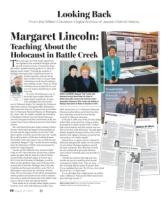
ABOVE, CLOCKWISE: Margaret “Gigi” Lincoln with
Holocaust survivor Nesse Godin, Art Center of
Battle Creek, 2003. Lincoln at the American Library
Association Conference, 2018. Lincoln and students at
Michigan Association for Media in Education in 2016.
Looking Back
From the William Davidson Digital Archive of Jewish Detroit History
Mike Smith
Alene and Graham
Landau Archivist
Chair
Margaret Lincoln:
Teaching About the
Holocaust in Battle Creek