

August 22 • 2019 45
jn
I
n Parashat Ekev, Moses is in the
midst of preparing the Israelites
to cross over the Jordan into the
land of promise.
We recently completed the
Book of Numbers, where,
toward the end of the book,
Moses has embraced his new
role as a leader who will step
aside for Joshua, and Moses
climbs up Har Ha’
Avarim
(Numbers 27:12).
Listening to Rabbi David
Wolpe’
s podcast on Parashat
Pinchas, Wolpe noted that
Samson Raphael Hirsch, a
19th-century German rabbi,
translated Har Ha’
Avarim not
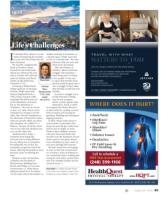
as the Mountains of Avarim,
but as “the Mountain of
Transition.” The root of Avarim
is ayin, vov, raish, which can be
translated as crossing or on the
other side. Hirsch’
s translation as
the Mountain of Transition echoes
what our ancient rabbis say about
why Abraham was called Ivri, a
Hebrew, “because all of the world
was on one side and Abraham was
aver, on the other side.
Abraham had to make a
transition from being like
everyone else to being different.
So, too, Moses has to transition;
his leadership was in flux. He
eventually accepts the end of his
tenure, allowing the people to move
forward, closer to entering the
land.
Being in a state of transition
continues into the Book of
Deuteronomy. Building from
Hirsch and Wolpe, we can read
Deuteronomy 1:1, when Moses
addresses Israel b’
ever ha-Yarden
“on the other side of the Jordan,” as
another moment in transition, in
a liminal space. Wolpe notes that
we live in a liminal state, “the state
between what you were and
what you’
re becoming.”
After the Exodus, in
Numbers, Moses and Israel
struggle with transition —
from being slaves to being
a free people. It was easy
to agree that freedom from
slavery would be good, but it
was a struggle to learn what
that freedom would look and
feel like.
It can be a struggle to not
be like Pharaoh or Balak,
who do not recognize
there’
s a power greater than
themselves. Israel is called
to recognize the Divine Presence
in their midst by creating a society
built on justice and striving for
goodness. Building and striving are
ongoing journeys.
In Ekev, Moses wants Israel to
create rituals to internalize this
lesson because life gets really busy
and it’
s easy to forget; so teach
Torah to your children; connect
with your heart and mind; and
inscribe it on the doorposts of your
houses and on your gates. Keep a
sense of holiness at your center as
you move through life’
s journey.
We don’
t know how we’
re going
to react or feel, but we know that
we can keep a sense of holiness at
our communal center, working and
caring for each other, so that when
one of us stumbles another person
can pick us up. ■
Davey Rosen is a Jewish educator based
in Ann Arbor and a rabbinic student at the
Academy for Jewish Religion in New York.
Davey Rosen
Life’s Challenges
Parshat
Ekev:
Deuteronomy
7:12-11:25;
Isaiah
49:14-51:3.
spirit
torah portion
29121 Northwestern Highway, Ste A, Southfield, MI 48034 I (248) 599-1166
WHERE DOES IT HURT?
Call to schedule a
FREE Pain Assessment
(248) 599-1166
T R AV E L W I T H W H AT
MATTERS TO you
Jet
Linx
Aviation,
LLC
FAA
Certificate
#9JLA375M
248.509.0898
JetLinxDetroit.com
Info@JetLinxDetroit.com
Jet
Linx
means
comfort
for
the
entire
family.
Contact
Jet
Linx
Detroit
today
for
information
on
our
Jet
Card
program
or
a
personal
aircraft
ownership
consultation.