

August 15 • 2019 19
jn
two miles to the entrance.
Before he left Oak Park, he told
his friends, “I’
ll meet you at the Hog
Farm,” Keller recalls. “We had no idea
there would be half a million people.”
The first night it had started pour-
ing and Keller slept under a truck.
The next day, he started walking
around and saw a van with Michigan
license plates. So, he knocked on the
door and found Dennis Miller and his
brother, Danny, who were also from
Oak Park.
“It was 1969, and we knew there
was this whole counterculture we had
a chance to be a part of,” says Keller
of Birmingham. “We were the hippies
who just wanted to listen to the best
music and amazing bands of the time
and get high.
“We’
re the generation that changed
the #@%# world,” Keller continues.
“We ended the war in Vietnam by
taking to the streets and protesting.
We were all about peace, love and
music.
“I think it was a cultural turning
point in my life and in American his-
tory because it was like-minded peo-
ple coming together at Bethel.
The experience of people
communing with each other
was the most invigorating. We
broke the barriers. Our gen-
eration definitely changed the
world. If we could only recre-
ate that now.”
MARK LONDON
London was going to be a
senior at Carnegie-Mellon
University when
he drove from
Rhode Island
with two friends
to Woodstock.
A past Newport
Folk Festival
attendee, London
went for the music.
The first night, they
slept in their car due
to the rain. After that,
they slept on the
field.
By the last day,
on Sunday, all the
concession stands
had run out of
food. Many walked
from the site of
the festival stage to
another field on Max
Yasgur’
s farm where
they were distributing government-do-
nated food.
“This was my first taste of granola,”
says London, who has lived in Michigan
with his wife since the mid-1970s. “I’
m
standing in line and a guy walks up
behind me. He was naked.
“The media reports about the wild-
ness were overblown. It was all about
the music.”
TODD JAY WEINSTEIN
Weinstein was 18 and ready to start at
the College for Creative Studies when
he hopped on a plane
to New York City. From
the Bronx, with his
homemade “Heading
up to Woodstock” sign,
he hitchhiked 81 miles
and then walked the
last two miles.
“Our tickets cost $18. I
love that 18 is a spiritual
number in Judaism,
” Weinstein says.
“But the organizers couldn’
t get the gates
and fences up quickly enough, so it
turned into a free concert.
“Woodstock was happening at a
time in our country that was a peri-
od of great unrest and protest,” says
Weinstein, a photographer who has
lived 50 years in New York City.
“Woodstock was an opportunity for
people to escape into music and spread
a message of unity and peace.”
Weinstein was lucky to find the Hog
Farm, along with its leader, Wavy Gravy.
They were brought in to help create a
safe ground for people. At Woodstock,
they set up a children’
s playground for
families and set up a free food tent.
“I would see people swimming nude
in a small lake passing by the legendary
Ken Kesey Bus called the ‘
Furthur.
’
It was
amazing to witness.
“The last day I started thinking about
how was I going to get back to Detroit? I
had no clue,
” he says.
Out of the 500,000 attendees,
Weinstein was lucky to run into fel-
low Oak Parkers Mark Keller, Saudia
Sharkey, Jeff Shine, Susan Rosensweet,
Jon Levin and Dennis Miller.
“The amazing thing was I got a ride
right to my front door in Oak Park. The
experience of Woodstock will be tat-
tooed into my soul. We had no idea how
important the Woodstock festival was as
an event in our U.S. history. I guess you
can never plan such an event. That is the
magic of it all.
”
SANDI GERBER REITELMAN
Reitelman was a 14-year-old rebel-
lious teen about to enter 10th grade
in the neighboring
borscht belt commu-
nity of Liberty, N.Y.,
which is about 12 miles
away from Bethel. She
already had her tick-
ets and the infamous
Woodstock poster
hanging in her bed-
room — the one that replaced her
Beatles and Monkees posters.
“My father essentially knew everyone,
including Max Yasgur, who was just
another Jewish farmer in the commu-
nity,” says Reitelman, who now lives in
Birmingham. “I was dying to go, but my
parents said it was going to be a ‘
bad
scene.’
We had stranded hippie people
staying at our house.”
The next best thing was flying over
the site with a family friend who kept
his plane at the nearby small airport.
“I remember looking out the window,
still disappointed I hadn’
t been able to
go, but very excited to be flying there.
In less than two minutes in the air, I
could look down at a massive crowd
with a huge stage in a very large field,”
says Reitelman, who has been back to
the site and the Woodstock Museum in
recent years.
Although Woodstock 50 was can-
celed, she has many friends from high
school who plan to descend upon Max
Yasgur’
s farm in Bethel this weekend to
attend festivities at the Bethel Center
for the Arts where Ringo Starr, Santana,
the Doobie Brothers, John Fogerty,
Tedeschi Trucks Band and Grace Potter
are slated to perform.
JON “YONI” LEVIN
Levin had just graduated Berkley High
School in June 1969 when he decided
to take a pre-college
road trip for the sum-
mer. Hearing about
the 10-mile backups to
Bethel, he parked his ’
67
Austin America within
two miles of the site and
started walking. After
about 15 minutes, a hay
wagon pulled by a tractor came along-
side him.
“
A few hippies in the wagon waved
me aboard,
” says Levin of Oak Park. “I
have a clear memory of coming around
one final curve when the entire festival
site came suddenly into view. My jaw
dropped. It was as if I were looking at
an ant colony. There were some hillsides
covered with colorful creatures.
“Spirits were high — and so were
the people,
” Levin says. “
A small group
offered me a dry corner of their blan-
ket to sit on and I shared my O.J. with
them. This is how I was slowly absorbed
into this pop-up community of nearly a
half-million.
“In retrospect, I count being a mere
audience member — one ant on those
hills of Woodstock — as a small point
of pride.
“It says something that in the year
prior to Woodstock, I was at the
Democratic National Convention in
Chicago; and after Woodstock, I was at
the largest anti-Vietnam war protest in
Washington, D.C.,
” Levin says.
“Some events are so pivotal in a his-
torical perspective that just being in the
audience, just knowing to have been
at that longitude and latitude in that
moment, shows one to have been at the
leading edge of a generation seeking
change through being a living
example.
” ■
WOODSTOCK WHISPERER/WIKIMEDIA COMMONS
Todd Jay
Weinstein
FROM TODD JAY WEINSTEIN
Jon Levin
VIA LEVIN FACEBOOK
Sandi
Reitelman
FROM SANDI REITELMAN
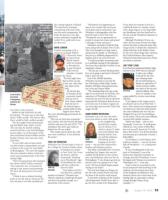
Amid the mud at
Max Yasgur’
s farm,
Woodstock’
s first
day, Bethel, N.Y.,
Aug. 15, 1969
MARK GOFF/WIKIMEDIA COMMONS
went for the
Th
slep
s to the entrance.
th
h
fi
h
fo
fr
the
ano
Y
t
th
fi
h
f
f
to t
t
f
f
f
Mark London
COURTESY MARK LONDON
A set of three-
day tickets
to Woodstock
owned by Ann
Abrams