

14 August 15 • 2019
jn
continued on page 16
BARBARA LEWIS CONTRIBUTING WRITER
J
ewish Renewal is probably the small-
est and least-well-known branch of
Judaism, but Southeast Michigan has
become an important center for the move-
ment.
SooJi Min-Maranda of Ann Arbor is
executive director of ALEPH: Alliance for
Jewish Renewal, the movement’
s governing
body. Rabbi Aura Ahuvia of Congregation
Shir Tikvah in Troy chairs the board. Linda
Jo Doctor of Ann Arbor, a program officer
for the W
. K. Kellogg Foundation, is vice
chair. Her husband, Rabbi Elliot Ginsburg,
is the spiritual leader of Pardes Hannah,
a Jewish Renewal congregation in Ann
Arbor. Hazzan Steve Klaper of Song &
Spirit Institute for Peace in Royal Oak was
ordained through the ALEPH Ordination
Program.
Those involved with Jewish Renewal
might dispute calling it a “branch” of
Judaism. ALEPH’
s website defines it as
a trans-denominational
approach to revitalizing
Judaism by combining “the
egalitarianism of progres-
sive Judaism, the joy of
Chasidism, the informed
do-it-yourself spirit of the
chavurah movement and the
accumulated wisdom of cen-
turies of tradition.”
“Reb Aura,” as Ahuvia likes to be
known, worked as a journalist before being
ordained through Jewish Renewal in 2014.
She became the spiritual leader of Shir
Tikvah, which affiliates with both Reform
and Jewish Renewal, in 2017.
What she most likes about Renewal is its
use of creativity to get people excited about
Judaism.
Jewish Renewal traces its roots to the
Chasidic movement of the late 18th cen-
tury, which turned away from the dry
pedanticism of the yeshivahs and advocated
expressing religious devotion through song
and dance. Like the original Chasidism,
Renewal uses song, movement and medi-
tation to enhance understanding of Jewish
prayer.
“I see it as empowering our whole selves
for Jewish expression, not just from our
neck up,” said Ahuvia, 52, who lives in
Huntington Woods.
Rabbi Zalman Schachter-Shalomi, who
died in 2014, is often considered the found-
er of the Jewish Renewal movement as well
as the chavurah movement of small, lay-led
prayer communities. The
Jewish Catalogue, a founda-
tional text for Baby Boomer
Jews interested in more par-
ticipatory Jewish practice,
was created by chavurah
activists in 1973.
In 1978, “Reb Zalman,”
as Schachter-Shalomi is
known, founded B’
nai Or (“Sons of Light”
in Hebrew) in Philadelphia as both a local
Jewish Renewal congregation and a national
organization. The name later changed to
the more gender-neutral P’
nai Or (“Faces of
Light”). The national organization merged
with Rabbi Arthur Waskow’
s Shalom
Center in 1993 to form ALEPH, integrating
the two principles of tikkun halev (“repair
of the heart”) and the better-known tikkun
olam (“repair of the world”).
Niggunim, wordless songs used to
enhance devotion, are a hallmark of Jewish
Renewal as they were of the original
Chasidism, Ahuvia said.
A nigun is not a mindless way of singing,
she said. “It allows people to participate in
Dance
Song,
& Spirit
Ahuvia
Schachter-
Shalomi
jews d
in
the
on the cover
s
ews
ew
ews
ew
ew
ws d
e
he
th
over
co
t
cover
er
ov
c
he c
he
the
on
o
t
r
v
o
e c
e
t
on
on
n
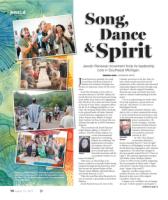
Jewish Renewal movement fi
nds its leadership
core in Southeast Michigan.
Renewal movement members in action (top to bottom) : a service at
Shir Tikvah; a close-up look at a Torah at the Song & Spirit Institute
for Peace, a Shir Tikvah men’
s outdoor service; and reading from the
Torah at Shir Tikvah.
COURTESY OF SHIR TIKVAH
SONG & SPIRIT INSTITUTE FOR PEACE
COURTESY OF SHIR TIKVAH
COURTESY OF SHIR TIKVAH