

20 August 1 • 2019
jn
M
ichigan Gov. Gretchen
Whitmer, Wayne County
CEO Warren Evans, Detroit
Mayor Mike Duggan and publishers of
the region’
s biggest ethnic newspapers
gathered at Wayne State University for
the 2019 Minority Media
Summit July 24.
The event aimed to
educate ethnic media
representatives and pub-
lications on the upcom-
ing 2020 census, during
which billions of dollars
and congressional seats
will be at stake.
“Everything from
education to, yes — the
roads — is impacted by
the dollars we draw into
the state of Michigan,”
Whitmer said.
She referenced the census count,
which will determine the federal funds
Michigan receives in the coming years.
“What I learned from knocking
on doors all those years ago was that
people respond to who they trust,”
Duggan said.
The Detroit mayor also emphasized
the importance of ethnic media for
building trust in the 2020 census to
ensure as many Metro Detroit and
Michigan residents are counted as
possible.
The event was moderated by Dr.
Hayg Oshagan, the executive director
of New Michigan Media (NMM), a
network of ethnic and minority media
outlets within the state. Oshagan noted
how important it was for minority
media to work together to have a loud-
er voice. He thanked the Michigan
Nonprofit Association for partnering
with NMM to make this event possible.
Panelists included Osama Siblani,
publisher of the Arab American
News; Tack-Yong Kim, publisher
of Michigan Korean Weekly; Donna
Murray-Brown, President & CEO
of Michigan Nonprofit Association;
Arthur Horwitz, publisher of Detroit
Jewish News; Elias Gutierrez, publisher
of Latino Press, State Rep. Abdullah
Hammoud (D-Dearborn); Detroit City
Councilwoman Raquel Castaneda-
Lopez and Detroit City Director of
Immigrant Affairs Roberto Torres.
The publishers and other represen-
tatives from more than 40 ethnic and
minority media outlets in southeast
Michigan discussed how best to reach
their individual communities and how
to combat the growing fear of repercus-
sion felt in minority communities since
the beginning of the Trump administra-
tion. The event included representation
from the Yemeni, Filipino, African
American, Latino, Arab American,
Jewish, Native American, Chinese,
Bangladeshi, Japanese, Polish, Korean,
Indian, Armenian, Vietnamese and
Albanian communities.
Gutierrez, Siblani and others said
restoring trust is a major challenge.
“People in this country believe in
their government, relatively speaking,
compared to other countries. However,
in recent years, this trust has been
shaken, sometimes destroyed,” Siblani
said about the Arab American com-
munity.
Michigan stands to lose another
congressional seat and a reduction in
the number of electoral college votes if
its population is not properly counted
in 2020. It could also lose $1,800 per
person per year of federal funding to
support programs that use census data.
Census data will be used by offi-
cials to distribute funds for Medicare,
Medicaid, education, infrastructure,
free school lunch programs, children,
housing and more. ■
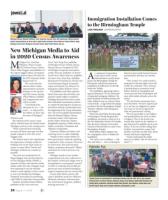
Michigan Korean Weekly Publisher Tack-Yong Kim (second from left) addresses ethnic/minority
media representatives as (from left to right) Arthur Horwitz, Elias Gutierrez, Osama Siblani, Hayg
Oshagan and former Michigan Chronicle senior editor Keith Owens look on.
jews d
in
the
New Michigan Media to Aid
in 2020 Census Awareness
Whitmer
Duggan
Immigration Installation Comes
to the Birmingham Temple
A
s a statement of opposition
to the stance of the current
administration towards immi-
grants, the Birmingham Temple for
Humanistic Judaism has placed an
installation of political art on the hill
before the Temple.
The installation, appearing under a
sign proclaiming it “for the thousands
of separated immigrant children,
” dis-
plays hundreds of stuffed animals and
other children’
s toys on a forest of bare
vertical sticks. A sign before the display
proclaims that the Birmingham Temple
“declares solidarity with immigrants
and refugees.
”
When the artist Elaine Roseborough
of Huntington Woods designed this
installation, she found a venue for it at
the First Methodist Church of Ferndale,
then the First Unitarian Universalist
Church of Detroit before it came to the
Birmingham Temple.
Rabbi Jeffrey Falick explains why
the congregation chose to display the
installation:
“We want to say to children — chil-
dren and others — who are fleeing for
their lives from South Central America
and elsewhere that they are welcome
here.
“This country was, until recently, a
proponent of human rights across the
world,” he continued. “Now America
is perpetrating an enormous moral
failure. Policies of xenophobia and
racism proceed from Washington and
meet with similar attitudes across the
nation.
“We, the Jewish community, have
seen this before. We have experienced
it; so we have an obligation to speak
out, to go on record as opposed to
what our government is doing.
“We are answerable to our children
and grandchildren for what we allow
to happen. Woe to the Jewish com-
munity that stands on the sidelines or
gets distracted by quibbles about word
choice. If you do not like calling these
facilities ‘
concentration camps,’
find
another word that you like. How about
‘
brutal, inhumane, disgusting?’
“I don’
t understand the public
silence,” he added. “But we will not be
silent.” ■
LOUIS FINKELMAN CONTRIBUTING WRITER
Patriotic Fun
Temple Emanu-El participated in Huntington Woods and Oak Park 4th of July parades.
Pictured here are Harry Onickel, Ruthanne Oakun, Dan Medow, Rabbi Matt Zerwekh and
family, Marty Leibowitz, Cantorial Soloist Kelly Onickel, Sue Stettner, Jackie Bean and
Dennis Kayes. Many more temple members participated as well.
COURTESY OF TEMPLE EMANU-EL
RABBI JEFFREY FALICK