

46 July 25 • 2019
jn
W
hen Mary Sue Schottenfels’
husband Ken Knoppow was
diagnosed with prostate
cancer in 2010, it was not only difficult
for him, but she also found herself facing
emotions of fright and isolation.
“I think the biggest challenge is bal-
ancing a full-time job and giving him
support,
” she said. “It’
s the stress of not
knowing what the future holds.
”
Schottenfels, 69, works as executive
director of CLEARCorps, a Detroit-
based nonprofit organization that pro-
motes healthy home environments to
Detroit residents. She also took on the
task of keeping track of her husband’
s
medications and doctors’
appointments,
as well as escorting him to almost every
appointment. Knoppow, 70, is being
treated by a team of oncologists at the
Barbara Ann Karmanos Cancer Institute.
“It’
s been really good in terms of his
openness to my help,
” she said of Ken, a
retired criminal law attorney.
Doctors discovered Knoppow’
s cancer
“fairly early,
” according to the couple,
and he underwent a prostatectomy and
radiation, which eliminated the cancer.
But then the prostate cancer returned
in 2016 and metastasized to Knoppow’
s
bones. He has received immunotherapy
treatments and targeted therapies and is
now receiving chemotherapy.
Knoppow is also being screened by his
primary oncologist Ulka Vaishampayan,
M.D., director of the Phase I Clinical
Trials Program at Karmanos, to deter-
mine if he is eligible to participate in a
clinical trial at Karmanos. His situation
is complicated because he has a BRCA2
gene mutation, which is common among
Ashkenazi Jews and increases an individ-
ual’
s likelihood of being diagnosed with
a variety of cancers including breast,
ovarian, pancreatic and prostate cancers,
as well as melanoma.
FINDING SUPPORT
Both Schottenfels and Knoppow, who
live in West Bloomfield, take part
in Karmanos’
support groups at the
Weisberg Cancer Treatment Center in
Farmington Hills. Schottenfels said her
participation in the Caregivers Support
Group provides her a lifeline in handling
both the practical and emotional chal-
lenges of caring for Ken.
“We focus on treatment options, how
to communicate with your doctor, lon-
gevity questions and fears,
” Schottenfels
said. “We talk about what a specific
person is going through. We laugh a lot,
too. Even situations that are horrible can
be funny.
”
Knoppow attends Karmanos’
Men’
s
Support Group and says the members
discuss their respective diseases.
“It puts things in perspective, and
it makes you feel less alone,
” he said.
“Everybody should really try a support
group. You see people in similar situa-
tions.
”
The couple say it is most helpful when
a fellow support group member is in
the same place as they are as it relates to
the disease. Talking to that person really
helps when it comes to making treat-
ment decisions.
“The Caregivers Support Group is
invaluable,
” Schottenfels said. “We feel
pretty bonded with each other. To me,
it’
s like you walk into the room and it’
s a
sigh of relief.
”
Kathleen Hardy, LMSW
, an oncology
social worker at the Weisberg center, said
the ripples of a cancer diagnosis extend
to family members who can experience
higher-than-normal stress levels. That’
s
why social and emotional support is so
important for those who care for indi-
viduals diagnosed with cancer.
“Spouses may be asked to provide
emotional support, to help with deci-
sion making, to provide medical care,
to manage financial stressors and to
live with a certain amount of fear and
uncertainty,” she said. “In a family
(support) group, you know you are not
alone. Other group members understand
the changing roles and increasing
demands and are there for your support.”
Karmanos’
various support groups,
those located in Farmington and at the
main Detroit location, are free and open
to the public, even if an individual is not
being treated at Karmanos. Caregivers
and cancer patients also can take part
in Karmanos’
Healing Arts Program in
Farmington Hills, which is free and open
to the community. The program includes
music and art therapy, massage, Reiki,
Tai Chi classes and other complementary
therapies.
LOOKING FORWARD
Both Schottenfels and Knoppow remain
active as a way to live each day with the
disease. Knoppow is involved with Meals
on Wheels, teaches chess to school-
age children and organizes a monthly
folk music concert series at the West
Bloomfield Library. Besides her day job,
Schottenfels enjoys spending time with
family, and both are involved with poli-
tics. They also attend Temple Kol Ami in
West Bloomfield and travel frequently.
“With Karmanos’
support and Ken’
s
strength, we are hoping and planning for
a great many years together,
” she said.
Schottenfels advises other caregivers to
take care of themselves as they provide
support for their ailing loved one.
“The No. 1 thing for me is to take one
day at a time,
” she said. “Seek and accept
support. Be open to new activities and
stress relievers. We do appreciate the
wrap-around services that Karmanos
provides.
” ■
Karmanos’
Caregivers Support Group is
supported by the Community Foundation for
Southeast Michigan and the Ralph C. Wilson Jr.
Legacy Funds. To learn more, contact Kathleen
Hardy at (248) 538-4712 or email hardyk@
karmanos.org.
‘One Day at a Time’
Couple fi
nd support groups offer perspective, empathy to caregivers and patients.
ELIZABETH KATZ SPECIAL TO THE JEWISH NEWS
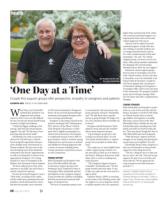
Ken Knoppow and his wife,
Mary Sue Schottenfels
SEAN COOK
health