

July 25 • 2019 39
jn
eretz
T
his year marked the 11th time an
Oakland University student group
traveled to Israel for a summer
archaeological study abroad program,
but this may have been the most histori-
cally significant.
Some of the excavation team’
s findings
included stone and metal vessels, food
bowls, jugs and jars of pottery, animal
bones, weapons and parts of building
structures. That, along with other evi-
dence gathered in recent years, led expe-
dition leader Professor Yosef Garfinkel
from Hebrew University in Jerusalem to
call a press conference. He declared to
the world media that his team had found
the biblical town of Ziklag at modern
day Khirbet al-Ra’
i.
Ziklag is known in the Bible as the
site that was given to David by the
Philistines before he was king and had
fled from King Saul. The city was a gift
to help the Philistines raid to the south
of the land. The Book of Samuel records
that after King Saul was killed in battle
with the Philistines, David left Ziklag
and traveled to Hebron to be anointed
king of Israel.
Biblical references about Ziklag can be
found in the Hebrew Bible at: I Samuel
30:1, II Samuel 1:1, I Chronicles 12:1, I
Samuel 27:6 and Joshua 19:5.
Anthropology professor Michael
Pytlik, director of Judaic Studies at
OU, director of the Cis Maisel Center
for Judaic Studies and Community
Engagement and faculty leader of the
OU group, said, “The site fits the biblical
stories associated with Ziklag since it
shows signs of having been a Philistine
settlement, then a Judean settlement
with probable mixed populations. It
then remained Israelite until later events
caused it to be destroyed.
“For the first time, the occupation
layers, the geographical location and the
references to the site all overlap. Some
12 other areas have been proposed for
the site of Ziklag, but none of them con-
tain the necessary dating, occupations
or material finds to confirm the site’
s
identity.
”
This year’
s study abroad program last-
ed 3½ weeks, and the 13 students and
their advisers spent weekdays working at
the dig site from early in the mornings
till late in the afternoons. Weekends were
spent immersing the students in the
culture and history of the region with
travels throughout the country.
Veronica Russell, a fifth-year senior
from Ortonville majoring in anthropol-
ogy, said, “It was three weeks of hard
work, and I am not sure the significance
of this year’
s trip has hit me quite yet.
”
Sydney Wendling, a second-year
student majoring in anthropology and
political science from Saginaw, added,
“We heard something was happening
around the dig site, but it was ‘
hush-
hush’
for a while until we heard they
were calling a press conference to
announce they found this biblical city. It
was magical. I hope I can go again next
year.
”
Jerad Inman, a fifth-year electrical
engineering major from Birch Run,
said he hoped to gather some new data
and artifacts for the dig leaders but was
surprised by the magnitude of news the
group would make. “I never expected it
to be this huge. We actually contributed
to something that made national and
international news.
”
Over the years, Oakland students,
under the direction of Pytlik, co-leader
Dr. Jon Carroll and professor emeritus
Richard Stamps, spent five years working
at Khirbet Qeiyafa, another city from
the time of David. They then moved
their dig site for four years to the site of
Lachish, the second city to Jerusalem in
the Judean monarchy. This year marked
the second season working at Khirbet
al-Ra’
i.
Oakland University’
s study abroad in
Israel program is supported by the Nina
and Bernie Kent family, other dona-
tions to OU’
s Judaic Studies’
program
and research grants from the Provost’
s
office. ■
Learn more about the Oakland University
Archaeology in Israel group and their recent trip
by vising facebook.com/Oakdigs.
COURTESY OF MICHAEL PYTLIK
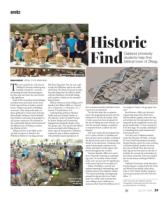
The team from Oakland University
BRIAN BIERLEY SPECIAL TO THE JEWISH NEWS
Historic
Find
Oakland University
students help fi
nd
biblical town of Ziklag.
Oakland University
students work at
the dig site.
An aerial
view of
the dig site