

moments
SUZY FARBMAN SPECIAL TO THE JEWISH NEWS
Love, Devotion & Tenacity
A new lung lets Loretta and Sy Ziegelman celebrate their 60th anniversary and beyond.
G
enerations of Detroit women
revere Dr. Sy Ziegelman, an
OB/GYN for more 40 years.
Along with active careers, Sy and
Loretta, a retired social worker, raised
three children. They led, Sy says, “ful-
filling and exciting lives.”
In November 2008, this fun-loving
couple vacationed in St. Petersburg,
Fla., and marched, costumed, in the
Key West Fantasy Fest (along with
thousands, many wearing only body
paint).
“Marching in parades would soon
become unthinkable,” Sy says. Two
months later, Loretta developed trou-
ble breathing.
This began an ordeal of bouncing
from one doctor to another, from
Beaumont Hospital in Royal Oak to
Henry Ford Hospital in Detroit to
University of Michigan Hospital in
Ann Arbor. A frustrating and bewil-
dering experience for a husband whose
life’
s work was in medicine.
Loretta was eventually diagnosed
with IPF, idiopathic pulmonary fibro-
sis — what Sy calls “a fancy name for a
deadly disease.” Sy says as many people
die from IPF as die from breast cancer
each year. The only hope of surviving
is to obtain a new lung.
So, Sy swung into action. As his
wife deteriorated and developed other
complications, he read all the journals,
contacted professionals and checked
his wife’
s blood counts and sent
reports. “Being a physician helped me
to navigate the minefield of medicine,”
Sy says.
In March 2009, a lung biopsy con-
firmed the diagnosis.
Though IPF is a fatal disease, Sy
says, “No one uses those words. They
say there is no recognized treatment as
opposed to the fact the disease is fatal.
I refused to accept it.”
The next months were a succession
of transfusions, iron infusions and
pulmonary rehab. “Every minute was
devoted to some medical issue,” Sy
says. “There was no end to the hurdles.
For six days, I saw my beloved wife
unconscious in the ICU on a ventila-
tor. Would she live or die?”
That crisis necessitated Loretta
spending several weeks in the hospital
and many hours in rehab. Still, she
made it past that hurdle as well.
“
And then it was like someone turned
a switch,” Sy says. “The simplest activity
required oxygen.” Realizing his wife
needed him full time, Sy retired from
his medical practice. He recalled a
Yiddish proverb his father taught him:
“You can’
t dance at two weddings with
one rear end.”
One of their twin grandsons, Evan,
then 10, made a DVD about his
Gramma, his “most admired person.”
Ultimately, the video would be shared
with the lung transplant team at the
Cleveland Clinic. Nurses, doctors and
PAs watched it, Sy reports, “all teary-
eyed seeing the disease and his grand-
mother through Evan’
s eyes.”
U-M refused to consider a transplant.
At 70, they said, Loretta was too old.
Sy’
s senior associate and mentor Dr.
Mort Lazar, 96, advised him to take
Loretta to Cleveland’
s Cleveland Clinic.
There the transplant process began.
Physical exams, blood tests, X-rays,
CT scans, social workers, psychiatrist,
financial counselors, cardiac catheter-
ization, endoscopy, pulmonary function
tests and medical records. “You don’
t
get an organ transplant without turning
over every pebble. Some I didn’
t even
know existed,” he says.
By Thanksgiving 2009, Loretta’
s
breathing became more labored. “We
were consumed with the preliminaries
leading to winning the ‘
lung lottery,’
”
Sy recalls. The paperwork was endless.
Loretta’
s myriad of test results would be
programmed in a computer that would
produce a score. “The challenge is to
survive until the score puts you at the
top of the list.”
That December, Sy says, he and
Loretta were sitting in their bedroom
watching TV
. “I was really watching
Loretta, as I did every day. Did she have
enough oxygen? How could I help her?
The phone rang. We screamed and we
cried. She was listed!”
But time dragged on. Loretta’
s oxygen
needs grew. The Ziegelmans packed a
bag in their car, kept the gas tank full.
If the call came, they’
d have to race to
Cleveland.
They drove back and forth to
Cleveland for testing. Loretta’
s lungs
worsened. She was raised to No. 1 on
the transplant list. After many weeks, a
call came, and they sped to Cleveland.
The lung wasn’
t healthy enough. “We
had no concept that a dry run happens
at least 30 percent of the time,” Sy says.
Back to waiting.
“When would we get the call? The
winter was snowy. Would we make
it to Cleveland in time?” Four snow
tires on his front-wheel drive Avalon
were his insurance. “Would Loretta’
s
lungs hold out until we got the call.
I forgot how to sleep as I listened to
each breath she was still able to take.”
Several weeks later, another call.
Another race to Cleveland. Another
lung that wasn’
t OK.
They drove home in silence,
“exhausted and without hope. When
hope vanishes in the transplant race,
the race is lost. The challenge was to
get through the day and the next and
the next until it was Loretta’
s turn. We
had to believe,” he says.
On April 9, 2010, they met with the
director of the transplant group in
Cleveland. The doctor was “kind and
honest.” Loretta’
s need was “critical.”
They drove home again in silence.
“The silence of acknowledgement that
life as a couple would end if Loretta
didn’
t get her call,” Sy says.
At 4:30 a.m. the next morning,
the phone rang. There was a lung.
“I sobbed uncontrollably,” Sy says.
“Would the third time be a charm? I
had to believe or I’
d die of a broken
heart.”
After the surgery, Dr. Ken McCurry,
Loretta’
s surgeon, reported Loretta had
received a right lung transplant and he
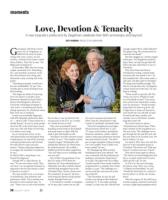
Sy and Loretta Ziegelman
36 July 25 • 2019
jn