

32 July 25 • 2019
jn
We Need to Talk …
and Listen, Too
Federation launches podcast as latest channel of
communication in youth mental health program.
T
he power of talking about mental
health … just think about how
often it starts with a single con-
versation: between parents and their
children, between teens and their peers,
between teachers and health profession-
als. Think about having those conver-
sations; stop and listen; see how voices
can raise awareness and change minds
at home, in school and in the social
landscape of a community.
WE NEED TO TALK
So, let’s talk … about peer pressure and
the anxieties we see in our students.
Let’
s talk about helicopter parenting.
Let’
s talk about the use and abuse of
social media.
Let’
s talk about resiliency and finding
support networks.
What started as the Youth Mental
Health Initiative in Jewish Detroit is
a vibrant communitywide program
today. We Need to Talk, sponsored by
the Jewish Federation of Metropolitan
Detroit, grew out of a community
“needs assessment” survey in 2016
revealing an alarming prevalence of
mental health issues among the youth
in the Jewish community. In 2018,
Federation launched We Need to Talk
— a website — with videos and links
to resources as a first step: to reduce
stigma, to raise awareness about youth
mental health, and to provide ready
access to resources for those in need of
care.
A portal for storytelling and insights
shared by teens, parents and family
members, teachers and mental health
professionals — the website (wn2t.
org) has recently expanded its video
library to include easy-listening and
browsing in podcast.
Tune in and join Todd Krieger,
senior planning director at the Jewish
Federation, as he and guests explore
some of the hottest topics of the day,
underscoring reasons for youth mental
illness. In the first nine episodes in the
series, Krieger is joined by Julie Fisher,
an educator with more than 25 years
of experience working with parents
and students around the country
on topics related to 21st-century
relationships and youth mental
health. Fisher is the author of The
Resiliency Puzzle, a handbook
for understanding how kids can
develop the skills they need to
cope with adversity and persevere
to gain character and fortitude to
succeed.
In future podcasts, Krieger
will be joined by other experts
and community members who
will share their personal stories,
providing insights and tools for
young people and their families
struggling to achieve mental
well-being. While some segments
will cover topics in brief, others
are expected to be more in-depth
profiles and conversations.
WHY A PODCAST?
Krieger explains: “During our conver-
sations with agency executives — and
in keeping with our promise to deliver
programs and tools most beneficial to
the agencies — we learned that many
parents were seeking helpful informa-
tion in short chunks. In particular, in
those precious few minutes in a busy
day when parents might be waiting to
pick up their children at school or other
activities, there are opportunities for
teaching moments — spaces for listen-
ing and learning, finding a piece of the
puzzle or a tool that is useful to better
understand the complex challenges that
our kids face today.
”
AMBASSADORS FOR MENTAL HEALTH
“We see our role as advocates for our
kids and ambassadors for reducing
the stigma still associated with youth
mental illness,
” says Dr. Lilly Jacobson,
a clinical psychologist in private prac-
tice at Children’
s Hospital of Michigan
and chair of Federation’
s Youth Mental
Health Advisory Committee. “We Need
to Talk is our community call to action.
Our goal is to educate the community
about current mental health issues and
the warning signs of mental illness, and
to reach young people (and those who
love and influence them) with positive
messages of self-worth.
”
To date, We Need to Talk has touched
the lives of hundreds of families in
Jewish Detroit. In collaboration with
Friendship Circle’
s UMatter, Jewish
Family Service, Jewish day schools,
BBYO and Tamarack Camps — and
with the generous support of the com-
munity — the program has launched:
• “FRED Talks” — parlor meetings
for parents
• Community-wide events including
an evening with best-selling author
Frank Bruni (Where You Go is Not Who
You’
ll Be) and Julie Lythcott- Haims
(How to Raise an Adult)
• Suicide prevention training
(safeTALK) and Applied Suicide
Intervention Skills Training (ASIST) for
more than 600 professionals who work
with youth in the community
• Additional staffing and resources
for existing mental health programs at
Tamarack Camps and Jewish Family
Service.
There’
s so much more to learn, so let’
s
keep talking … visit the website, watch,
listen … and stay tuned. ■
Vivian Henoch writes for myjewishdetroit.org,
where this story first appeared.
jews d
in
the
VIVIAN HENOCH SPECIAL TO THE JEWISH NEWS
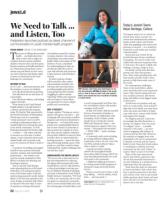
TOP: Educator Julie Fisher joins Todd Krieger for the
first nine podcasts. BOTTOM: We Need to Talk events,
such as “How to Raise an Adult” with Julie Lythcott-
Haims, have touched the lives of hundreds of families
in Jewish Detroit.
JOHN HARDWICK
Today’
s Jewish Teens
Value Heritage, Culture
The largest study ever on American
Jewish teens paints a picture of a
cohort that simultaneously embraces
family, Jewish culture and friends,
while also grappling with anxiety and
pressure to succeed — in a world per-
meated by social media and constant
communication.
Researched and written by the
Jewish Education Project and Rosov
Consulting, the survey results were
culled from interview responses from
17,576 teens. The report is filled with
findings covering a range of areas.
On family: Jewish teens like their
parents and value their perspec-
tives. Teens enjoy spending time with
their family and often look to their
parents to help them make sense of
the world.
On contemporary challenges:
Teens in the study believe adoles-
cents need help with social-emotional
issues. They named coping with anx-
iety, academic pressure, self-esteem
issues and failure as the biggest needs
of their peers.
Jewish teens see positives and neg-
atives to social media. Teens acknowl-
edge that social media can cause them
stress, but many also believe it helps
cope with stress, connect with friends
and organize for change.
On religious practice: Americans
increasingly describe themselves as
having “no religion.” But even many
“no religion” teens — a sizeable
minority in the study — are inter-
ested in engaging with Judaism at
certain points in their life. Moreover,
the majority of engaged teens who
responded to the survey unequivocal-
ly identify as Jewish and also report
belief in God. Teens feel Jewish culture
is something to celebrate and most
commonly use the word “culture” to
express what it means to be Jewish.
Many of the teens interviewed
report anti-Semitic experiences but
do not feel personally threatened or
see anti-Semitism as a primary lens to
understand their life experience.
Teens from the study are interested
in Israel and believe that as Jews they
have a special connection to the land
and country. They want to ask trusted
adults questions about Israel, and most
teens who have not traveled there yet
hope to do so one day.