

14 July 25 • 2019
jn
and ’
90s, in general. With the beginning
of the Trump administration, ICE began
sweeping these people up for deportation
to Iraq.”
In spring 2017, the Trump administra-
tion pressured Iraq to accept about 1,400
deportees in exchange for dropping Iraq
from the list of nations under a travel ban.
According to Levin, “The Iraqi nationals
with standing deportation orders come
from all Iraqi communities: Sunni, Shia,
Yazidi and Chaldean,” in addition to mem-
bers of smaller Christian groups. In the
Detroit area, most belong to the Chaldean
Catholic community.
Levin observes: “Many of these people
do not speak Arabic; many have no family
in Iraq or no community in Iraq. Yazidis
and Chaldeans may come from villages
that no longer exist.”
In summary, he says: “I have not found
a single person who can explain why it is
in the national interest of the United States
to kick these people out.”
NO GOOD NEWS TO REPORT
Levin recounts the circumstances of “a
man deported to Iraq who had literally
never been there. He was born in a
refugee camp in Greece to Iraqi parents,
so technically he was an Iraqi national.
He has multiple problems: diabetes,
bipolar disorder, drug addiction. Maybe
he isn’
t the most appealing person: He
has problems. He was deported literally
without being given a chance to make
a phone call or pack a suitcase. He
showed up in Iraq without any money
and without papers showing his right to
be there. He had to borrow a cell phone
from another passenger in the airport to
call his family in the States to let them
know where he was.”
He is not the only one. Margo
Schlanger, professor at the University of
Michigan Law School, says, “There are a
couple deportations to Iraq most weeks
at this point. We continue to try to help
individuals facing imminent deportation.
For many of these folks, there are no legal
maneuvers left. But others are successful-
ly getting stays of removal.
“For most of the Iraqis who might
be deported at some point, it remains
available to try to reopen their cases and
keep fighting. We’
re continuing to try to
facilitate that and to keep people out of
detention while they fight.”
A member of the Chaldean community,
attorney Nora Y. Hanna, says, “I wish we
had good news to report but that is not
the case. Everyone, at this point, is fight-
ing individual cases in immigration court.”
Miriam Aukerman, senior staff attorney
with the ACLU of Michigan, advises immi-
gration attorneys how to protect targeted
clients. “Given that we no longer have a
stay of removal, we wanted to share infor-
mation about how to explore immigration
relief options in Canada,” she says.
Levin has been pressuring the exec-
utive branch to reconsider its policy and
has introduced bipartisan legislation to
protect these immigrants.
“I chose to lead in this effort for two
reasons: I represent the Ninth District of
Michigan, which has the largest Iraqi-born
population of any district in America. I am
simply representing my constituents. And
this is a basic human rights issue. Human
beings are entitled to seek asylum. We
need to ‘
love the stranger as yourself’
(Leviticus 19:34). We need to see each
person as worthy of dignity and respect.
It is part of a larger web of commitments
[as Americans and as Jews].” ■
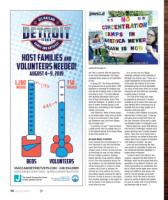
Signs referencing the Holocaust were prevalent at the anti-ICE protest on July 12.
LOUIS FINKELMAN
jews d
in
the
continued from page 13
MACCABIDETROIT2019.COM 248.934.0889
MACCABI@JCCDET.ORG @MACCABIDETROIT2019
Host Families and
Volunteers NEEDED!
august 4–9, 2019
750
NEEDED
volunteers
50
250
150
350
450
550
650
1,200
NEEDED
beds
100
300
200
400
500
700
600
800
900
1,000
1,100