

8 July 18 • 2019
jn
views
W
hen I packed my suitcase for
this year, I didn’
t know where
I would end up, whom I
would meet or what I would learn.
I knew that I came from a strong,
mid-size Jewish community in Detroit. I
also knew, or thought I
knew, that I had a strong
Jewish identity, and that
exploring identity and
community were two
things I was interested
in on a global scale. In
reality, however, I didn’
t
really know what any of
that meant.
Since January, I’
ve danced with seniors
in Odessa, shared pizza with Latvian
teens, spent Passover in Kiev and Purim
in Budapest. I attended a gathering of
more than 100 Russian-speaking Jewish
young adults, while being one of three
English speakers present. I’
ve visited
countless synagogues and attended a
Shabbaton in Mallorca — yes, Mallorca
— the fabled Spanish island in the
Mediterranean. I’
ve had the chance to be
curious, to ask questions and to consider
the past, the present and the future of
Jewish communities around the world.
These experiences have allowed me to
grapple with core questions and issues
facing Jewish communities today, and
I continue to explore these questions
during my time as the 2019 Ralph
I. Goldman Fellow in Global Jewish
Leadership. The Fellowship is an initia-
tive of the Joint Distribution Committee
(JDC).
Spending time with people in Eastern
Europe and the former Soviet Union,
especially the elderly, I found it impos-
sible not to think about my own grand-
parents, who came from this part of the
world. I so clearly saw how profoundly
my own journey was impacted by the
fact that my grandparents (or their par-
ents) left and the parents of these people
did not or could not.
I absorbed the gravity of the impact
of WWII and communism on each
community and its people. In each place,
many seniors would share their stories
of growing up, surviving and living their
lives. Each time I sat down to listen,
someone would say, “We’
ll tell you our
stories, but this is not what we want you
to remember. Remember our smiles
today, not just our stories of the past.
”
In Riga, Latvia, I was privileged to
spend time with some local teens who
were involved in their community youth
group. These teens, who each spoke at
least three languages — Latvian, Russian
and English — showed up only know-
ing they would be meeting a woman
from America who wanted to chat.
Yet, they stayed for more than three
hours, opening up and talking about
everything from Jewish life in Riga, my
own community in Detroit, summer
camp, anti-Semitism, whom they want
to marry and where they feel like they
belong. The Latvian Jewish community
is home to about 14,000 people. It was
overwhelming for the teens to hear that
in my home community we have 70,000
Jews, and hundreds or even thousands of
teens involved in Jewish life.
In speaking with these teens, I learned
about their options for Jewish life in
Riga, which would feel limited by our
standards. Indeed, they gushed about
the fact that when some teens in their
community have opportunities to attend
international conferences or camps, they
feel privileged to do so and have their
lives changed because of these experi-
ences, but these opportunities are not
always plentiful.
Coming from a large, established
community, we find it easy to leave it to
others to build and carry the commu-
nity. After all, we can access a variety
of Jewish programs and not worry that
there will be plenty of people around
to carry them forward. We can show
up late, or not at all, and Jewish life will
continue.
That these Latvian teens are so inter-
ested in Jewish life is all the more pow-
erful because unlike in much of the U.S.,
their parents are not pushing them to
show up.
I came into the year thinking I might
have an impact on these communities,
and instead I find myself wondering
what we can learn from them. Can we
look to the communities of Eastern
Europe where young Jews are thinking
creatively and sharing a vigor for Jewish
life that is not always as common in
North America? How does their history
impact their identity? How does our
own ancestry impact our identities and
Jewish communities?
This year I’
ve realized just how big the
world truly is, and I’
ve discovered the joy
in how small it can become as we con-
nect and engage with one another. It will
still take time and commitment to con-
tinue these connections for the next gen-
erations, but these young Jews are bright
and excited to “do Jewish.
” They proudly
carry the torch of Judaism where it was
once almost extinguished.
The opportunity before us then is to
learn our history, connect with our pres-
ent and look to build the future together.
Sometimes, the most powerful lessons
we can learn about how to be Jewish,
about how to build Jewish community,
is by kindling our own torch with sparks
from places we never dreamed of. ■
Jessica Katz has served in various capacities with
numerous Jewish organizations, both locally in
Detroit and nationally. She is the JDC Ralph I
Goldman Fellow in Global Jewish Leadership for
2019. This essay was first published at
ejewishphilanthropy.com
essay
A Detroiter’s Journey of Jewish
Community Explored and Expanded
Jessica Katz
WWW.JKATZCONSULTING.COM/BLOG
of anti-Semitism coming from out-
side.
Yet even though they were wrong
about an end to anti-Semitism, the
machers of two decades ago were
right in turning the discussion to
how to embrace more Jews who
acknowledge only a tenuous con-
nection to Judaism. That was the
original thought behind Birthright
Israel.
Today, as I interview people
whose connection to Judaism is
strengthened through the rise in
anti-Semitism, it is still the case
that many are unaffiliated with
synagogues. Twenty years ago, they
would have been counted as lost to
Judaism — and these “cultural Jews”
are still not counted in many official
surveys or in institutional decisions.
I was an odd choice for manag-
ing editor of JTA. I knew very little
about the organized Jewish world,
having grown up primarily in small
communities, often one of only a
handful of Jews in town. The way
I practice Judaism is very personal
and not at all communal. The pub-
lisher at the time hired me for my
news judgment first, connection to
Judaism second. I guess you could
say that I was JTA
’
s own private
Birthright experiment.
After the breakdown of talks
between Ehud Barak and Yasser
Arafat and the beginning of the sec-
ond intifada, I left JTA, moved back
to Michigan and pivoted my career
to cover science and technology.
Sixteen years later, I began writing
about Jewish issues again after I
noticed more swastikas in my social
media timeline following a decade
and a half of being relatively swasti-
ka-free.
I never wanted anti-Semitism
to define the way I write about
Judaism. But the rise in anti-Semi-
tism can perhaps help us see clearer
than we did 20 years ago. We can
see who is with us and who is not.
Jews are standing up to be counted.
I would be more optimistic for the
future if we found a way to embrace
them. ■
Howard Lovy is a freelance writer based in
Traverse City. He is the former managing
editor of the Jewish Telegraphic Agency and
served as a writer and copy editor for the
Detroit Jewish News.
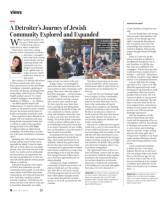
A shabbat gathering led
by Jewish young adults in
Riga, Latvia, one of the many
locations where Jewish life
is being reimagined by the
rising generation.
continued from page 6