

40 July 18 • 2019
jn
PHOTO CREDIT
Mug Cutline
continued from page XX
continued on page XX
OBITUARY CHARGES
The processing fee for obituaries is:
$100 for up to 150 words; $200 for
151-300 words, etc. A photo counts
as 30 words. There is no charge for a
Holocaust survivor icon.
The JN reserves the right to edit
wording to conform to its style
considerations. For information, have
your funeral director call the JN or you
may call Sy Manello, editorial assistant,
at (248) 351-5147 or email him at
smanello@renmedia.us.
soul
of blessed memory
Journalist/Author
Lucette Lagnado
ANDREW SILOW-CARROLL JTA
L
ucette Matalon Lagnado, a
Wall Street Journal reporter
whose 2007 memoir of her
Egyptian-Jewish family won
the Sami Rohr Prize for Jewish
Literature, has died. She was 63.
The Jewish Book Council,
which awarded the prize for
The Man in the White Sharkskin
Suit, did not specify a cause in
announcing her death.
Described as “stunning” by
Michiko Kakutani in a New York
Times review, Lagnado’
s memoir recalls
the lost, cosmopolitan world of Cairo’
s
Jewish community before and after
World War II and her high-living father,
a prosperous clothier. She would later
devote another memoir, The Arrogant
Years, to her mother’
s story.
After leaving Egypt in the turmoil
that followed the rise of the dictator
Gamal Abdel Nasser, the family even-
tually moved to Bensonhurst,
Brooklyn.
Lagnado graduated from
Vassar College and started her
reporting career at a commu-
nity paper in Brooklyn. She
served an internship with the
investigative reporter Jack
Anderson, as a columnist for
the Village Voice and as exec-
utive editor at the English-
language Forward newspaper.
A story she worked on about Dr.
Josef Mengele helped rekindle global
interest in his macabre experiments
at the Auschwitz concentration camp
and the search for justice for his
victims. That was also the subject of
Children of the Flames, her 1991 non-
fiction book with Sheila Cohn Dekel.
At the Wall Street Journal, which she
joined in 1996, Lagnado was a cultural
and investigative reporter, most recently
covering health care, health delivery for
the poor and uninsured, and new treat-
ments for cancer.
Among her awards are the Columbia
University Graduate School of
Journalism’
s 2002 Mike Berger Award
for a story about the aging residents of
an Upper West Side apartment building
and three Newswomen’
s Club of New
York Front Page Awards for her report-
ing on hospital billing and collection.
The 2008 Rohr Prize came with a check
for $100,000.
In a blog post from 2011, Lagnado
revisited the subject of exile and return
— this time about her old neighbor-
hood of Bensonhurst, where she would
eventually buy one of the apartments
where she grew up.
“My trips to Bensonhurst always
have a ritual quality to them, like a
religious pilgrimage. I must go to this
block, I tell myself, I must pay my
respects to that building,” she wrote.
“There are no people left there that I
knew, not a single familiar face — my
community long moved out — yet I
keep returning.”
She is survived by her husband,
Douglas Feiden, with whom she lived in
Bensonhurst and Sag Harbor, N.Y. ■
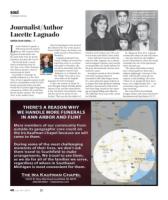
Lucette Lagnado
Lucette Lagnado, then 6, and her
family pose for a family portrait
on the eve of their exodus from
Egypt in the 1960s.