

16 July 18 • 2019
jn
jews d
in
the
STACY GITTLEMAN
CONTRIBUTING WRITER
N
ot many recent college graduates get to launch
astronauts to the moon for their first job. But
that’
s just what Michael Liebowitz did in the
summer of 1969.
On the 50th anniversary of the famed Apollo 11
mission, Liebowitz, who enjoyed a career afterward in
the automotive industry and is a dedicated member of
Congregation B’
nai Moshe in West Bloomfield, looks
back at this time of his life with nostalgia and pride.
When Liebowitz graduated from New York Institute
of Technology in 1964 with a degree in
mechanical engineering, he landed a contract
job with Boeing and spent the next four years
working at NASA on its Apollo missions.
Working alongside men with mostly military
backgrounds, he said he was the youngest
person in the famed Firing Room 1 at the
Kennedy Space Center in Florida, where engi-
neers like him oversaw launches of the Apollo
missions all the way through the first space
shuttle mission in 1981.
Sometimes he worked the midnight to noon
shift; his work included testing the switches
that moved the five 42,000-pound pneumatic
arms that held the 363-foot, 6.2 million-pound
Saturn V in place on the launch pad and then
released them at just the right second as it lift-
ed off into space to send Neil Armstrong, Buzz
Aldrin and Michael Collins to the moon. The
arms had to withstand the upward thrust of
9.5 million units of horsepower. Compare that
with a typical racecar, which has 500 horsepower.
Apollo 11 was a mission first proposed by President
John F. Kennedy in 1961. On July 20, 1969, humans first
set foot on the moon. The astronauts explored the Sea of
Tranquility site for more than two hours. They collected
soil and rock samples, set up experiments, planted an
American flag and left behind medallions honoring the
fallen Apollo 1 crew and a plaque saying, “We came in
peace for all mankind.
”
Though engineers were not in the limelight, he had
some encounters with well-known icons of the age,
including taking an elevator ride with TV newsman
Walter Cronkite. He also spied Alan Shepard — the first
man to orbit Earth in 1961 and who, in 1971, went on
the Apollo 14 mission where he hit a golf ball on the
moon — high atop the launch pad in a red Corvette
with a blond woman.
“Shepard had sweet-talked the guard into letting him
take the Corvette and that woman up on the launch pad
to take some pictures,
” Liebowitz recalls. “
And we all
knew damn well that was not his wife!”
Liebowitz said space engineering contracts dried up
during the Nixon administration, so he took nearly a
year off sailing and scuba diving around the Bahamas
with a friend.
“I would have done it a lot longer, too, if my father
hadn’
t called me and reminded me to get a job and a
haircut,
” Liebowitz says.
He spent the rest of his career in the automotive
industry, retiring from Ford in 2005. It’
s his time at
NASA that Liebowitz reminisces about the most, giv-
ing talks about his experience with schoolchildren as
well as congregants at B’
nai Moshe. You can find him
there at morning minyan where he davens and has
prepared breakfast for the last 14 years. He also volun-
teers as a docent for the Holocaust Memorial Center in
Farmington Hills.
Liebowitz says while history focuses on the crew of
the space missions, it is also important to remember the
thousands of engineers on the ground, like him, who
contributed to designing and engineering the mission.
“The astronauts got all the media attention,
” he says,
“but if it weren’
t for the work of the thousands of engi-
neers, Saturn V would have never gotten off the
ground.
” ■
Blast Off!
At the 50th anniversary
of Apollo 11,
a local
engineer recalls his
contribution.
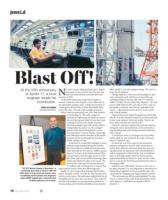
TOP LEFT: Michael Liebowitz in Firing Room 1 at
the Kennedy Space Center in Florida in 1969. TOP
RIGHT: Saturn V on the launch pad secured in place
by scaffolding and the hydraulic arms designed by
Boeing. ABOVE: Liebowitz gave a recent talk about
his NASA experiences at B’
nai Moshe.
PHOTOS COURTESY MICHAEL LIEBOWITZ