

12 July 11 • 2019
jn
STACY GITTLEMAN CONTRIBUTING WRITER
The local Jewish community is doing what it can to help.
Crisis at the Border
H
earing accounts of the
overcrowded, unsanitary
detention centers where
asylum-seeking migrants are being
warehoused and separated from their
children, who also are being held
in similar conditions, can be over-
whelming and frustrating.
On July 4, some in the Jewish
community joined a protest against
U.S. Immigration and Customs
Enforement (ICE) at its office in
Detroit. Many chanted the new slo-
gan: “Never again is now.” And in
New Jersey and Boston,
a total of 54 Jewish
protesters were arrested
June 30 at ICE offices.
Sarah Allyn, execu-
tive director of Repair
the World, said her
organization on June 22
worked with Detroit Jews for Justice
(DJJ), We the People - MI, Rapid
Response and MIRC to mobilize 150
volunteers in more than 300 hours of
service ahead of a potential ICE raid.
Although the raid was delayed, vol-
unteers were able to distribute infor-
mation in both English and Spanish
so vulnerable populations will know
their rights in the event of an ICE
raid.
One participant was Dana
Kornberg, a sociology graduate stu-
dent at the University of Michigan
who is active in DJJ. She said the
images of the mistreated children and
news of them being separated from
family members are “too familiar and
scary” to her as a Jew.
Kornberg said in the long term,
advocating for sanctuary cities can be
effective in stopping the harsh depor-
tations and detentions.
However, this spring in Lansing,
House Bills 4083 and 4090 were
approved by various committees. If
passed into law, they would punish
cities, counties and local government
entities that limit cooperation and
information sharing with federal
authorities on immigration mat-
ters, effectively requiring local law
enforcement to act as immigration
enforcement agents.
Rabbi Jen Lader of
Temple Israel in West
Bloomfield said though
it is difficult to direct-
ly help those in the
detention centers, she
was able to find a way
to bolster relief efforts
with Congregation
Albert of Albuquerque, N.M. Since
the early spring, ICE has brought
busloads of migrants daily to this
southwestern city. These migrants
have been cleared to enter the coun-
try and now await their asylum hear-
ing, but they have been stranded with
no provisions; and their host families
may be hundreds if not thousands of
miles away.
“We (at Temple Israel) have tried
for weeks, but we cannot find any
way to get anything or any (health or
law professional) into these detention
centers directly at the border,” Lader
said. But, she found another way for
her community to help.
“At Temple Israel, we are kicking
off an emergency campaign to help
asylum-seeking families. The inhu-
mane … treatment of children and
adults who are seeking refuge in the
‘
Land of the Free’
is abhorrent, and
we, as Jews, have to take action today
in whatever way we can.”
Temple Israel is looking to raise
$6,000 or more to support the
efforts of Congregation Albert. This
amount will cover one busload of
50 people with lodging, meals and
snacks, clothing, basic medical care
and transportation to wherever their
sponsor is located. Each family is also
given $15-20 transportation allow-
ance, which is often a three-day bus
ride to their destination. For more
information, go to temple-israel.org/
helpfromafar.
“We are proud to be partner-
ing with Congregation Albert in
this holy work,” Lader said. “While
we can’
t be on the ground in
Albuquerque, we can provide finan-
cial relief to support these people and
truly live our Jewish values.”
Finding ways to help at a grassroots
level — be it sending needed supplies
or donating one’
s legal or medical
services to our far-away southern
border — are being blocked.
According to news reports, border
guards, due to federal regulations,
are turning away offers of diapers
and toiletries. To offset the severe
conditions, Congress recently sent
President Trump a $4.6 billion bipar-
tisan humanitarian aid package,
which he signed. The bill did not
contain stronger protections for the
migrant children in overcrowded
border shelters that some House
Democrats wanted.
LASTING HARM BEING DONE
While Jewish organizations and con-
gregations are finding ways to help
as best they can, mental health care
professionals are concerned about the
damage family separations can be to
children in detention centers.
Child psychology professor and
researcher Ericka Bocknek of Wayne
State University said she and her col-
leagues are doing their best to edu-
cate politicians on the harsh, lasting
impact the detention and separation
jews d
in
the
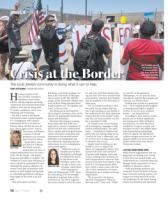
June 27 protest against
child detention outside
of a border facility in
Clint, Texas, where chil-
dren were found living
in filthy conditions.
CREDIT: SUSAN BARNUM, WIKIPEDIA
Sarah Allyn
Rabbi Jen Lader