

June 27 • 2019 5
jn
I
magine this: You’
re sitting on
a bus that’
s traveling out of the
city, minding your own business,
when without any warning, the
bus creaks to an early demise and
refuses to go any farther. Soon, you
and all your fellow
disgruntled passen-
gers are standing by
the side of the road
while an irate driver
is desperately calling
for reinforcements.
Everyone’
s grum-
bling about having to
move their schedules
around, phoning their families to let
them know they’
ll be late … when
suddenly a passenger comes over to
you, looks at you carefully and says,
“Let’
s hope we won’
t be wandering
in the desert as long as we did last
time!”
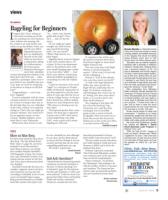
Congratulations — you’
ve just
been “bageled!”
If you’
re unfamiliar with the term,
it means someone in your immedi-
ate vicinity is trying to alert you to
the fact that they, too, are a Member
of the Tribe, without ever explicitly
stating so. That’
s why you might get
random “shaloms” and “mazel tovs”
for no apparent reason, or even
a hearty “Shabbat Shalom!, never
mind that it’
s only Wednesday.
Others have been known to ask,
“So… what’
s your favorite
gefilte fish recipe?’
(True
story … and so’
s the bus
story.)
Or you might get asked
straight out, with no beat-
ing around the burning
bush: “Are you Jewish?”
(That’
s what’
s known as a
plain bagel.)
Bageling always seems to happen
in the most random places. On
a plane. In line at an amusement
park. In the dentist’
s chair, with
your mouth hanging open, unable
to say more than “uhhh” … And
there’
s your dentist, reminiscing
about his bubbie’
s mandelbrot or
serenading you with old Yiddish
songs.
Credit for invention of the word
“bagel” as a verb goes to Doodie
Miller of Montreal. Apparently, he
was first inspired to coin the term
about 27 years ago when he was in
a dreary college lecture. As the pro-
fessor droned on, a fellow student
leaned over and whispered to him,
“This class is as boring as my zay-
die’
s seder.”
Word spread quicker than cream
cheese. The first time it appeared
in print was in 2007 when Jessica
Levine Kupferberg of La Jolla,
Calif., wrote a great article about
bageling for Aish.com.
In response to her article, peo-
ple posted comments about times
they’
d been bagled or when they’
d
bagled someone else.
One story took place mid-flight:
Woman 1 (clearly testing the
waters): “What a day I’
ve had with
all this schlepping …”
Woman 2: “And at this altitude,
who cares how much we kvetch?”
As well as the bagel definition,
Miller also came up with the
Bagel Theory, explaining why we
bagel. It’
s all about connection
and belonging, that “you’
re one of
us” feeling. Jews have each other’
s
backs, so we need to know who
those backs belong to!
Plus, bageling is just plain old
fun. Once the knowing “Yup,
I’
m Jewish, too” smile has been
exchanged, you’
re inevitably
going to play a round of Jewish
Geography. Who hasn’
t had one of
those discoveries that the person
behind you in line at the post office
is second cousins with your
views
for openers
Bageling for Beginners
letters
Rochel Burstyn
Contributing Writer
More on Moe Berg
For those who found the story about
Moe Berg, “The Spy Behind Home
Plate” (June 13, page 36), and Aviva
Kempner’
s recent documentary
about Berg of interest, you should
also consider Nicholas Dawidoff’
s
1994 biography of Berg, The Catcher
Was a Spy. Dawidoff is a Henry Luce
Scholar and has written for the New
York Times, Sports Illustrated and the
New Republic.
Dawidoff’
s book tells the story of a
complex, enigmatic sports non-hero
who wound his way into the OSS.
According to Dawidoff, in his 16-year
career in baseball’
s Major League,
Berg portrayed himself as an intellec-
tual while outside of his player role,
he was a baseball pro; and, although
he was also a lawyer, Berg refused
to discuss the law. Perhaps it was his
secretive persona that was his most
compelling qualification as a spy.
The book is a good read.
Harold Gurewitz
Detroit
Soft Anti-Semitism?
I found Professor Howard
Lupovitch’
s
comments on soft anti-Semitism in
the June 13 edition alarming (“An-
ti-Semitism,” page 10). He expresses
the left’
s anti-Semitism as “softer and
more political.” Is this to excuse Con-
gresswomen Ilhan Omar and Rashida
Tlaib’
s anti-Semitic comments?
Would you consider the anti-Sem-
itism that perpetuated in Europe
before Hitler came into power “soft”?
The Jews made excuses and tolerat-
ed it while hoping it would end soon.
However, it didn’
t, and it led to the
political Nazi party.
Professor Lupovitch contended
“that if the Israel-Palestinian conflict
were resolved, much of the anti-Sem-
itism on the left would dissolve.”
Omar’
s comment, “it’
s all about
the “Benjamin’
s,” had nothing to do
with the conflict. I believe it was pure
anti-Semitism. The American Jews
need to wake up and speak up before
soft anti-Semitism becomes hard-
core.
Doreen Lichtman
Orchard Lake
continued on page 8
EDMON RODMAN, JTA
My
Story
My
Story
Click. Call. Give Now.
www.hfldetroit.org 248.723.8184
Hebrew Free Loan Detroit
6735 Telegraph Road, Suite 300 Bloomfield Hills, MI 48301
@HFLDetroit
Brooke Bendix is a West Bloomfield
native who knew she wanted a career
involving children and families because
of the tragedy that struck her family
during Brooke’
s junior year of high
school when her father passed away.
“My father was an internal medicine
physician with a specialty in addiction
medicine,” Brooke said. “Helping others
was a personal passion of his. He
was so dedicated, and he left a legacy
of caring. I had a good support system,
but at that time, getting help for grief
and loss wasn’
t as pervasive as it is now.
I decided to use Dad’
s life and loss
as a motivator to help others cope with
their own grief, particularly high school-
age kids, because I could relate.”
After graduating from Michigan
State University, Brooke attended the
University of Chicago School of Social
Work. She graduated, put in a few years
of clinical practice, and was ready to
move back to Michigan and start her
own practice. “I moved home with no
plan and no idea of what the future
would hold for me, but I knew this was
the next step in my life,” she said.
Brooke quickly began to make local
connections. “I reached out to family
and friends, people who had their own
practices, met anyone and everyone for
coffee, lunch, ideas, advice and referrals.”
Her uncle, Paul Hooberman, pointed
her toward the Marvin I. Danto
Small Business Loan Program at
Hebrew Free Loan.
“With the help of HFL I began to
build my dream,” Brooke said. “When
I applied for my loan, I had a five-year
business plan. At year two-and-a-half
I’
ve met many of those goals, and now
the question is, where do I go from
here?”