

32 June 20 • 2019
jn
books
arts&life
continued from page 31
A
s a Pulitzer-Prize winning jour-
nalist, biographer and observer
of social history, David Maraniss
says he has spent his career “trying
to understand the forces that shape
America and to measure individuals
by the whole pattern of
their lives.”
He has usually
focused his sharp
reporting and research-
ing skills on strangers.
Now, he turns to his
late father, trying to
understand what hap-
pened when his father
was spied upon by
the FBI while living in
Detroit, called before
the House Un-American
Activities Committee
(HUAC), fired from his
job at the Detroit Times, blacklisted for
five years and later vindicated.
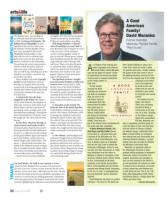
A Good American Family: The
Red Scare and My Father (Simon
& Schuster) is a personal story and
a portrait of the McCarthy era. The
author’
s father, Elliott Maraniss, was
born in Boston, grew up in Brooklyn
and left the East Coast to attend the
University of Michigan, where he met
his wife. (For their honeymoon in 1939,
they hitchhiked from Ann Arbor to
Madison to attend a convention of the
American Student Union.) Elliott, known
as Ace, commanded an all-black
company in the Pacific during World
War II, loved baseball and his favorite
essayist was George Orwell. According
to his son, he was “a newspaperman
first and foremost” and an American
optimist.
David Maraniss has said in a printed
interview: “The story for the book has
been slowly building for years, but I
knew that I would not write it while
my parents were alive. I finally realized
the scope of the book when I was at
the National Archives and saw for the
first time the original copy of the HUAC
subpoena of my father
and of the statement
he wrote to the com-
mittee that he was not
allowed to give unless
he repented and named
names.”
He explains that his
father, who died in
2004, was not falsely
accused of being a
Communist, as he was
one, for a time. Drawing
on his father’
s essays,
letters and unclassified
FBI files, Maraniss cre-
ates a compelling narrative going for-
ward and back in time, and also pres-
ents the stories of George Crockett,
his defense lawyer; playwright Arthur
Miller; Charles Potter, an outspoken
war veteran and anti-Communist; and
informant Berenice Baldwin, a grand-
mother who was recruited to infiltrate
the Michigan Communist Party.
Maraniss, an associate editor at
the Washington Post and a distin-
guished visiting professor at Vanderbilt
University, writes of his father with
respect, admiration and empathy. In
fact, he was inspired by his father to
go into journalism. He reflects on what
it means to be an American, as issues
of race, democracy and freedom are
as still timely as ever. This is his 12th
book, after biographies of Bill Clinton
and Barack Obama, a trilogy about the
1960s and other titles.
— Sandee Brawarsky
A Good
American
Family/
David Maraniss
Former Detroiter
Maraniss Plumbs Family,
“Red Scare”
LUCIAN PERKINS DAVID
NONFICTION
The detailed story surrounding an
act of brutal international terrorism
in 1985, An Innocent Bystander: The
Killing of Leon Klinghoffer by Julie
Salamon (Little, Brown) delves into
the destinies of three families whose
lives were upended by this event.
Klinghoffer had boarded a cruise
ship with his wife to celebrate their
anniversary and was shot and then
thrown overboard in his wheelchair.
Researching the events, repercussions
and the search for justice, Salamon
interviews most of the participants
who are still living, including one of the
hijackers, and creates a powerful and
provocative narrative.
Nancy Kalikow Maxwell’
s Typically
Jewish (Jewish Publication Society)
provides an original, down-to-earth,
earnest look at pressing questions about
identity and culture faced by the Jewish
community, looking at the way Jews
live their lives.
In Edna’
s Gift: How My Sister
Taught Me to Be Whole (She Writes
Press) Susan Rudnick, the daughter of
Holocaust survivors, looks back at her
family history and the experience of
growing up with a younger sister with
developmental challenges. Throughout
their intertwined lives, Rudnick’
s sister
has taught her the most important life
lessons.
In This Hour: Heschel’
s Writings in
Nazi Germany and London Exile by
Abraham Joshua Heschel, foreword by
Susannah Heschel (Jewish Publication
Society) is a collection of early writings
by the great rabbinic figure and import-
ant Jewish thinker, written before he
found refuge in the United States. The
pieces — about Jewish education, the
rabbis of the Mishnaic period, a biogra-
phy of a medieval Jewish scholar, reflec-
tions before the holiday and reflections
on issues like prayer and suffering
— haven’
t been previously published
in English. The foreword by Susannah
Heschel and notes by scholar Helen
Plotkin are particularly compelling.
Mah Jongg Mondays: A Memoir
About Friendship, Love and Faith by
Fern Bernstein (JAG Designer Services)
is the true story of five suburban
women coming together weekly to
play an ancient Chinese game, forging
deep friendship around the table and
supporting the author through diffi-
cult times. Those who play the game,
or remember their mothers playing,
will be touched by this first book by
Bernstein, who teaches in her syna-
gogue’
s religious school and teaches
yoga in the preschool.
The Spiritual Gardener: Insights
from the Jewish Tradition to Help Your
Garden Grow, a first book by Andy
Becker (Tree of the Field Publisher)
includes gardening tips, stories from
the author’
s garden, quotations and
teachings from Jewish texts and reflec-
tions on the bitterness of horseradish
and sweetness of raspberry jam and
more.
In Jerusalem on the Amstel: The
Quest for Zion in the Dutch Republic,
Lipika Pelham (Oxford) provides a por-
trait of 17th-century Amsterdam, with
its prosperous Sephardi community
during the Dutch Golden Age, when
the seeds of Zion were nurtured. The
author, a journalist and documentary
maker for the BBC and other broad-
casters, also sought out the descendants
of this community in the present-day
city.
In The Plateau, anthropologist and
performer Maggie Paxson (Riverhead
Books) probes ideas about human
goodness, selflessness and sacrifice as
she closely studies an area in south-cen-
tral France, where villagers have a long
tradition of providing refuge to strang-
ers, particularly during World War II
and continuing today.
On God’
s Radar: My Walk Across America is Robert
Schoen’
s (Stone Bridge Press) account of his journey on
his own across the country on foot, from the Pacific to the
Atlantic, across more than 1,600 miles and 14 states. He sets
out after the death of his 96-year-old father and makes con-
nections in unusual places, finding generosity, compassion
and some great stories. The book is in the form of a travel
journal, highlighting his adventures and spiritual pathways.
TRAVEL