

June 13 • 2019 5
jn
T
hose in the news biz are required
to have a “nose for news.” They
must be alert to goings on so as
to bring to the fore that which the public
must know. As they nose around, we are
brought up to snuff (oy!)
and begin to sense that the
facial protuberance has
nosed its way into our talk.
Some of us are so limited
in our awareness that we
can’
t see beyond the ends
of our noses. Even then,
we can be accused of not
finding something that is
right in front of our noses or of not under-
standing something that is as plain as the
nose on a face.
At one time, people could be so
engrossed that they seemed to always
have their noses in a book. E-readers
and advanced phones have all but
replaced tomes. If you should try to
interrupt a user of one of those devices,
you may get your nose out of joint by
being ignored. Well, keep in mind that
some folks have probably paid through
the nose to be able to be so unaware.
It is not usually a good idea to stick
your nose into someone’
s business. It is
best that you keep your nose clean; keep
your nose to the grindstone. It is also not
a good idea to look down your nose at
anyone or to keep your nose in the air
since none of us can afford to thumb our
noses at anyone. That might lead to cut-
ting off our noses to spite our faces.
Ever been to a horse race?
Maybe you ended up in the
nosebleed section but you were
still able to see your favorite
win by a nose.
To make sure that party
invitees are all in atten-
dance, you could count
noses (or count legs and
divide by two; math was
never my forte).
If you did not care for
this set of observations, I
will not rub your nose in
the fact that you are in a
minority; your lack of enthu-
siasm is no skin off my nose.
■
continued on page 8
views
for openers
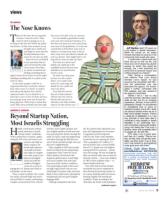
The Nose Knows
Sy Manello
Editorial Assistant
publisher’
s notebook
Beyond Startup Nation,
Most Israelis Struggling
H
ardly a week passes without
proud references to Israel’
s
“startup nation” credentials.
With a potent brew of smarts, capital,
chutzpah, IDF active and reserve con-
nections and daily-ex-
istence urgency, the
Jewish state improves
our health and nutri-
tion, helps us navigate
our roads, protects our
physical and digital
assets and, with the
smallest of budgets,
comes oh-so-close to
joining the U.S., Russia and China as
soft-landers on the moon.
There is much to admire. Yet, scratch
the surface of Israel’
s high-tech sector
and you’
ll find a country confronting a
complex socioeconomic brew of haves
and have nots; English speakers and
non-English speakers; Jewish men and
boys pursuing their dreams through the
study of science, math and engineering
and others through the full-time pur-
suit of Torah; beachfront high-rises and
dirt-poor neighborhoods.
Data compiled in 2018 and recently
shared in Detroit by the independent,
nonpartisan Taub Center for Social
Policy Studies in Israel show that
despite its global impact, Israel’
s high-
tech sector employs just more than
8 percent of the country’
s workforce.
Not surprisingly, people in this sector
are high-wage earners who are over-
whelmingly Caucasian, male, and most
likely to have math/science educational
backgrounds and very good English-
language skills.
Utilizing comparative data from
the 30 countries that collectively com-
prise the Organization for Economic
Cooperation and Development
(OECD), the Taub Center identifies
trends that are eye-opening for Israel.
With a population of 9 million (74
percent Jewish) and a current fertility
rate of 3.11, Israel’
s rate is the highest
among all OECD countries — almost
twice the average. Of note, the high fer-
tility rate already takes into account the
dramatic decline — from nine children
in 1965 to three children today — in
Israel’
s Muslim birth rate.
Part of the shift in Israeli-Muslim
household size may be explained by
data showing the growing number of
its women studying math and science,
learning English and entering the
workforce. Today, according to the
Taub data, the Israeli-Arab population
Arthur Horwitz