

arts&life
While his older brother Sam ful-
filled Dad’
s wishes and went to med-
ical school, Moe signed a contract
to play pro ball. He acceded to his
father’
s demands up to a point by
attending Columbia Law School in
the off seasons, earning his degree
and passing the New York bar in
1929.
It was a false bargain: Moe despised
the idea of being a lawyer while
Bernard Berg never accepted a base-
ball career as a legitimate pursuit. In
fact, the old man refused to go the
park and see his son play.
From an athletics standpoint,
Bernard wasn’
t missing much. A
knee injury early in Moe’
s career,
compounded by primitive diagnosis
and treatment, severely slowed him.
Over 15 years as a backup catcher,
Berg notched exactly 441 hits in 663
games.
What set Moe apart were his charm,
charisma and erudition. He studied
Sanskrit at the Sorbonne one off sea-
son and read multiple newspapers
every day. When he went to Japan on
a barnstorming tour with Babe Ruth
and other Major League stars, he
made a point of learning Japanese.
Berg carried a movie camera every-
where on that trip and, wearing a
kimono and on the pretense of visit-
ing a patient, he made his way to the
roof of a tall Tokyo hospital to shoot
a 360-degree panorama of the city. It’
s
not clear if he was already working
officially (albeit surreptitiously) for
the U.S. government, but his film of
Tokyo’
s layout was of significant help
when the U.S. went to war with Japan
after Pearl Harbor.
In fact, in early 1942, Berg recorded
a radio segment in Japanese that was
broadcast in Japan and drew on the
good will he’
d accumulated over two
pre-war visits and a mutual love of
baseball.
Berg had been sent on research mis-
sions to South America, but that was too
far from the real action. It appears he
found a home in 1943 in the newly cre-
ated Office of Strategic Services (OSS),
the intelligence branch that evolved into
the CIA after the war.
His primary and crucial assignment
was to ascertain how close the Germans
were to having a nuclear weapon and
to sway Italian scientists from the Axis
to the Allies. To successfully carry off
his cover story, Berg was briefed on the
science and strategy of the Manhattan
Project.
One biographer recounts, “The OSS
had given the Manhattan Project its
own spy, in effect, its own field agent to
pursue questions of interest wherever
he could in Europe. And that was Moe
Berg.
”
Kempner accords a great deal of
screen time to this episode in Berg’
s clan-
destine career as a professional spook.
It’
s a great story, in which the solidly
built ex-catcher is assigned to attend a
conference in Switzerland and determine
— from the keynote speech by visiting
German scientist Werner Heisenberg —
if the Nazis are within reach of perfect-
ing the bomb.
Berg carries a pistol to the symposium,
with orders to use it on Heisenberg if he
deems it necessary. He did not.
Kempner leaves us wanting to know
more about Berg’
s later years. By the
weirdest of coincidences, Sam Berg
headed a group of doctors sent to
Nagasaki to study the effects of radiation
poisoning. Incredibly, the brothers never
knew about each other’
s exploits.
That lone fact reveals there’
s still more
to know about Moe Berg’
s story. ■
“My mother, who was a great
abstract expressionist painter [who
had a one-woman show at the Detroit
Institute of Arts], was an influence in
pursuing an artistic career after I left
a legal career,” she said. “
And my step-
father gave me a great appreciation of
history.”
In Detroit, Kempner says the family
did not formally belong to a shul, but
that she attended High Holiday ser-
vices with her father at the Isaac Agree
Downtown Synagogue.
“I fondly remember seeing Fiddler
on the Roof with Pops every year
in Detroit,” she said. “We went to
many activities at the Detroit Jewish
Community Center, which was the cen-
terpiece of my Jewish identity growing
up. I continued that delightful child-
hood JCC experience by being very
active with the re-establishment of the
Washington, D.C., JCC and by starting
the Jewish film festival in D.C. as an
adult.”
Still, Detroit’
s influence is inescapable.
“I always say you can take the girl
out of Detroit but not Detroit out of
the girl. I have kept in touch with many
of my high school and college friends
as well being close to my brother
and Detroit cousins, who also live
in Washington, D.C., area. We have
had seders together for over 65 years.
“I still call soda ‘
pop’
and drink Diet
Vernors. I love meeting new people
who are from Detroit and instant-
ly compare notes about growing up
here. And my favorite music remains
Motown tunes.”
So, how do her two films about
Jewish baseball heroes fit into her career
goals?
“Life-size wall hangings of my three
favorite Jewish baseball players — Sandy
Koufax pitching to Hank Greenberg
and Moe Berg as catcher — adorn the
curved wall of my home’
s staircase,” she
said. “I was so proud of making The Life
and Times of Hank Greenberg because
he was a Jewish hero during times of
teeming anti-Semitism in America and
while the Nazis were raging in Europe.
“I jumped at businessman William
Levine’
s generous offer to support a
Moe Berg bio film. The Spy Behind
Home Plate fits perfectly into my goal
to make historical documentaries about
under-known Jewish heroes and my
career focus on exploring courageous
tales about those who fought the Nazis.”
Her nonprofit, the Ciesla Foundation,
is based on those goals: to produce
documentaries that investigate non-ste-
reotypical images of Jews in history and
to celebrate the untold stories of Jewish
heroes.
“For decades, different writers and
directors have tried to tell the story
of the thrilling life of Moe Berg. I am
proud to have made the first fact-based,
feature-length documentary that does
his life justice.” ■
For Aviva Kempner’
s “love letter” to Detroit in
the Forward, go to bit.ly/2QTC7tV.
for our country — all of things we might not have today.
The man had the right values.”
His first Moe Berg collection piece was a canceled
check for $100 signed by Berg in 1951. After years of
gathering Berg memorabilia, Matthews now has hun-
dreds of collectibles, both at the JCC exhibit and at his
Farmington Hills home.
Matthews hopes this exhibit, the most complete exhib-
it in the country accessible to the public, can provide
educational insight for two different generations — the
first being his generation, the ones who are nostalgic and
can reflect on the impact of these stellar athletes from
their childhood. Yet, the most important generation to
Matthews is the younger generation. He wants them to
be informed and learn more about the substantial contri-
butions from Jewish ball players.
He has a hard time picking a favorite of his collect-
ibles. “Asking me to pick a favorite is like asking a par-
ent to pick their favorite child,” he says.
However, his first pick is Winston Churchill’
s book
on World War II, The Hinge of Fate, from Berg’
s private
library. Secondly, he loves looking at Berg’
s personal
income tax return from 1934.
The rarest piece of memorabilia is the only article Berg
published, “Pitchers and Catchers,” which was printed
in the Atlantic Monthly. This article detailed how pitchers
and catchers would work together to deceive the batters
of the opposing team.
Matthews says he is looking forward to the sneak
peek of The Spy Behind Home Plate at 7 p.m. Thursday,
June 20, at the Maple Theater in Bloomfield Township. At
the event, he will introduce filmmaker Kempner.
“Of all of the days they could have picked, coinciden-
tally, it’
s my birthday,” he says. “This is one of the best
birthday presents I could have asked for.” ■
38 June 13 • 2019
jn
Aviva Kempner continued from page 36
The Spy Behind Home Plate continued from page 36
Bob Matthews continued from page 37
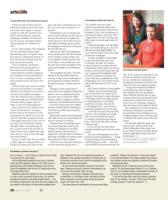
Aviva Kempner with Brad Ausmus