

May 30 • 2019 45
jn
continued on page 46
ED NAKFOOR SPECIAL TO THE JEWISH NEWS
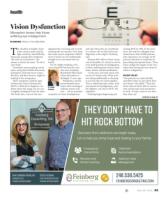
Vision Dysfunction
Microprism lenses help those
suffering eye misalignment.
T
he checklist is lengthy: head-
aches, nausea, panic attacks,
light sensitivity and difficulty
balancing, among other symptoms.
The tests are inconclusive. The
answer is always the same: “It’
s all in
your head.”
Frustrated, some people go on for
years, seeing their health deteriorate,
looking for relief that never comes.
But they, and their doctors, might be
looking in the wrong place.
Those symptoms could be signs
of Binocular Vision Dysfunction
(BVD), a difficult-to-diagnose con-
dition where the image one eye sees
is slightly misaligned from the other.
The body, then, corrects this mis-
alignment by overusing and severely
straining the eye muscles. Over time,
this strain causes symptoms of BVD,
most of which are not traditionally
thought to be associated with eye
health.
For Dr. Debby Feinberg, O.D.,
correcting BVD has been her mis-
sion since founding
Bloomfield Hills-based
Vision Specialists of
Michigan 15 years ago.
“Headaches, anxiety,
uncoordinated move-
ments when running or
walking, motion sick-
ness … all are potential
symptoms of vision misalignment
and only when they are considered
as a cluster will we find vision mis-
alignment is the culprit,” Feinberg
said.
Because BVD affects at least 10 per-
cent of all adults, it’
s critical to test for
even small amounts of misalignment
in those suffering from chronic head-
aches, anxiety and discoordination.
“In the past, we’
d only check each
eye for its visual acuity. What we’
re
now doing additionally is checking
to see how the eyes work together.
This is called binocular vision. And
any amount of misalignment, even
the slightest, can lead to BVD,” she
explained.
Feinberg began diagnosing and
treating BVD in 1995. In the years
since, she and her colleagues have
treated more than 10,000 patients,
who experience, on average, an 80
percent reduction in symptoms by
prescribing microprism lenses. These
lenses realign the images to the eyes,
rather than having the eyes strain to
achieve realignment.
PATIENT RELIEF
“Our patients are, quite literally,
speechless when we give them their
new lenses,” she added. “They feel
better and are better able to concen-
trate and become more productive
at work. ‘
If only I came to you first,’
they often say.”
DAVID TRAVIS
Dr. Debby
Feinberg
health