

10 May 30 • 2019
jn
jn
BARBARA LEWIS CONTRIBUTING WRITER
W
alk into almost any Jewish home and
you’
ll see books. Maybe there will be
just a single shelf, maybe the shelves
will line an entire room.
Jews have always thought of themselves
as “people of the book.” After all, since the
destruction of the Temple, Jewish religious life
has centered around study of texts: the Torah,
Talmud, the Kabbalistic Zohar and more.
The term “people of the book” originated in
Islam. Although non-Muslims were considered
infidels, Jews and Christians were called “peo-
ple of the book” in the Quran because they fol-
lowed texts that embraced monotheism.
Adam Kirsch, author of The People and the
Books (W.W. Norton & Co., 2016) says texts
often became turning points in Jewish history,
and they weren’
t always religious writings. The
rise of the Yiddish language press, for example,
was transformative for Jewish women, who
could read the language they spoke. Theodore
Herzl’
s books ignited the Zionist movement.
Stuart Matlins, founder of Jewish Lights
Publications (now part of Turner Publishing),
said many in the book business feel Jews buy a
disproportionate number of books considering
they make up only 2 percent of the U.S. popu-
jews d
in
the
on the cover
People
Book
of the
Despite modern conveniences,
Jews still cherish their books.
JEFF AISEN
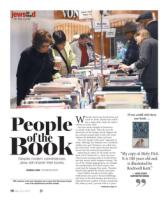
TOP: Customers at this year’
s Bookstock sale at Laurel Park Mall browse through
some of the 300,000 books and DVDs available.
If you could only have
one book …
”
“My copy of Moby Dick.
It is 100 years old and
is illustrated by
Rockwell Kent.”
— DAVID SCHEY,
HUNTINGTON WOODS
continued on page 12