

20 May 9 • 2019
jn
DAVID SACHS CONTRIBUTING WRITER
A
fter teaching constitutional
law for more than a half-cen-
tury, Wayne State University’
s
nationally renowned law professor
Robert Sedler has had a giant impact
not only in the classroom but also on
society.
A veteran of integration struggles
in the South, Sedler, 83, has champi-
oned civil rights and civil liberties in
Michigan and across America.
On Saturday, May 11, he will be
honored with the “Champion of
Justice” award at the annual dinner of
the Michigan Association for Justice,
a statewide organization of trial attor-
neys.
Before coming to Detroit in 1977,
Sedler taught law at the University of
Kentucky in Lexington, where he used
his knowledge and wits to fight anti-
black segregation in the city.
Lexington, at the time, had a small,
longstanding Jewish community whose
members were prosperous but who
“knew their place” in the midst of the
prevailing white gentile establishment,
Sedler said. But in the 1960s, out-
spoken “Jews from the East” (Sedler
is a Pittsburgh native) came to town
and boldly sought to remedy racial
discrimination. In 1966, he served as
a volunteer lawyer for the American
Civil Liberties Union (ACLU).
“The local Jews were very upset
about the visibility of people like me,”
Sedler said. “They feared this would
bring down the wrath of the so-called
‘
goyim.’
But if you look at the history
of the Civil Rights Movement, you will
see that Jews have played a very prom-
inent role.”
FAIR HOUSING LAWS
Lexington, like most American cities,
had rampant housing discrimination.
There was, however, a local civil rights
commission, and a Jewish dentist on it
asked Sedler to help bring about a fair
housing law.
At the time, discriminatory real estate
agents professed the view that home-
owners could sell or not sell their houses
to whomever they wanted — and the
government couldn’
t compel otherwise.
Sedler realized that to achieve a fair
housing law, he had to provide politi-
cal cover to those local politicians who
wanted to enact it.
Sedler’
s strategy was to have the pol-
iticians not contest that homeowners
were free to choose who would buy their
houses. The only exception would be if
a real estate agent were involved in the
sale, then no discrimination would be
permitted. Under this theory, about 99
percent of all sales would be covered by
the fair housing law.
Thus, instead of labeling it a “Fair
Housing Act,
” Sedler called it “
A Bill
to Regulate Commercial Real Estate
Transactions.
” It was enacted — making
the Lexington area the first locale in the
South to pass fair housing legislation.
A year later, the Kentucky legislature
adopted the law statewide.
“I’
m very proud of that,
” Sedler said.
“That was my brainchild.
”
Sedler also helped successfully
desegregate the merged Louisville and
Jefferson County, Ky., public schools
with suburban-city busing. (In contrast,
at about the same time, cross-district
busing was rejected for Metro Detroit.)
“Today, the most integrated state in
the country is Kentucky,
” Sedler said.
During his time in Kentucky, Sedler
said he became “notorious” for defend-
ing draft resisters and anti-war protes-
tors. He even argued two cases before
the U.S. Supreme Court.
When he came to the Wayne State
Law School in 1977, his social activism
didn’
t cease. He said he felt right at home
in Detroit — this area being similar to
his rustbelt origins in Pittsburgh.
LIFELONG ADVOCACY
Sedler has been married to Rozanne
Sedler, a social worker, for 59 years,
and they have two grown children and
four grandchildren. The couple live
in Southfield and belong to Temple
Emanu-El in Oak Park, a Reform con-
gregation.
“Social action is a very important part
of my Jewish identity,
” Sedler said. In
turn, he served as an at-large member of
Reform Judaism’
s Joint Commission on
Social Action from 2003-2009. He’
s still
on its Amicus Brief Committee, provid-
ing supportive legal briefs in cases before
the U.S. Supreme Court.
In the early 1980s, Sedler began
jews d
in
the
Champion of Justice
Fighting for the underdog defi
nes Professor Robert Sedler’
s career.
continued on page 22
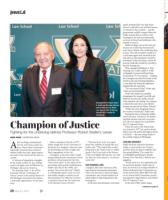
Distinguished Professor Robert
A. Sedler and Michigan Attorney
General Dana Nessel, Wayne
Law class of 1994, at the Law
School’
s 2017 Treasure of
Detroit Gala
COURTESY OF WAYNE STATE LAW SCHOOL