

34 April 18 • 2019
jn
A
s families and friends gather
for Passover, they look for-
ward to seders with familiar
customs, food and participants. But
sometimes circumstances take us far
from home, and we share a seder with
strangers that creates long-lasting
memories.
IN THE LAND OF KALASHNIKOVS
Rabbi Shneur Silberberg, outreach
director of the Sara and Morris
Tugman Bais Chabad Torah Center
in West Bloomfield, was a 19-year-
old yeshivah student in New York
City when he was chosen to organize
a seder in Russia. He was one of 100
students assigned by the Chabad
Federation to travel in pairs to Jewish
communities that had no rabbi.
“We were sent to Izhevsk in the
Udmurt Republic, where Kalashnikov
rifles are made,” Silberberg recalls.
“We went a week in advance to pre-
pare the meal. We had to kasher
a kitchen and rented a bar for the
seders. We brought grape juice and
other supplies and bought local fish
for the meal. We had a young transla-
tor as we didn’
t speak Russian.”
The first night drew 100 people,
most of whom were inexperienced
with seders. “We had to pick out a few
things for an abbreviated seder. They
quickly ate the matzah on the table,
and we had the sense that we were
feeding them. The one song that they
knew was ‘
Hevenu Shalom Aleichem’
— not a Passover song — but we sang
it together.”
Silberberg had traveled widely by
then but remembers this Pesach as
“the one time I recall missing home.
We were in the middle of nowhere and
we couldn’
t communicate.”
Closer to home, this year Silberberg
hopes to visit Jewish prisoners in two
local jails, bringing them Passover
foods if allowed by correctional offi-
cials.
A WAR-TIME SEDER IN CAIRO
Murray Green, a young podiatrist
from Detroit, served in the U.S. Army
Medical Corps during World War II.
Around Passover one year, he was
stationed in Cairo. As there was no combat in the
area, his work duties were light and one day he
roamed the dusty, narrow streets of Cairo. “I saw a
Jewish star above a doorway, and a man inside the
building invited me in,” he said.
Communication was limited as neither spoke
much of the other’
s language. However, the
Egyptian man was able to invite Green to a seder
at the synagogue that night. After returning to his
base, Green recalled, “I took a pillow case and put
all of the Passover food and other items that had
been sent by American Jewish agencies to Jewish
soldiers. They (the Cairo congregation) were
amazed at the American matzah — how white and
clean it was, compared to theirs. They
were as poor as church mice.”
The memories were still strong
when he told the story to family
members in the late 1960s. (Green
passed away in 1997.)
EUROPEAN SEDERS WITH ARMY BRASS
Naomi Levine’
s father, the late Rabbi
Alan Blustein, was an army chaplain,
and the family moved every three
years as he was transferred to new
posts. She was born in France and
remembers seders during the late
1960s and early 1970s in Nuremberg
and Stuttgart. “It was challenging
being an observant Jew, especially for
Passover,” she said.
The family relied mainly on lim-
ited Passover foods from the Army
base store and kosher butchers in
Munich and Strasbourg. “We could
get chicken, salami, matzah and gefilte
fish. There wasn’
t any kosher ketch-
up or potato chips,” said Levine of
Farmington.
“Usually the first seder was a com-
munal seder with the Jewish soldiers
in the area. The very top brass would
come to these seders,” said her moth-
er, Judy Blustein, who now lives in
Florida. Sometimes the seders were
held in the Officers Club, which had
to be kashered.
The second seder was mainly family
members and friends. During the late
1950s and early 1960s, she remembers
including Holocaust survivors at the
table. “The rotating chaplains would
tell us, ‘
Take care of this family.’
”
Once a large group of North African
Jews who had recently immigrated to
France came to the Blusteins’
seder
when they lived in Orleans, France.
However, their Sephardic Passover
customs were quite different. Blustein
says that they ate beans, rice and
other foods that are prohibited for
Ashkenazi Jews during Passover.
When another army rabbi was
responsible for the communal seder one year, the
Blusteins spent Passover in Lugano, Switzerland, at
a kosher hotel with Jews from all over Europe. “On
Yontif, they would parade in their finery on the
boardwalk. Any place we were was very different,”
Blustein remembers. ■
v
-
w
y
19
an
be
Pa
ite
ba
M
ge
g
fi
i
f s
up
p
Fa
a
m
in
Far from
Home
SHARI S. COHEN CONTRIBUTING WRITER
passover
In new places, seders are familiar but also
very different.
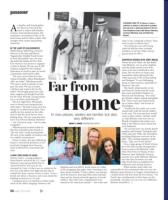
CLOCKWISE FROM TOP: Dr. Murray J. Green, a
podiatrist, in uniform in 1942 with his grandpar-
ents and aunt; Lt. Rabbi Alan Blustein of the U.S.
Army Chaplaincy Corps; Rabbi Shneur Silberberg
and Zeesy Silberberg; Judy and Rabbi Alan
Blustein.