

36 April 11 • 2019
jn
F
amed Russian composer Dmitri
Shostakovich read the “Babi Yar”
poem of famed Russian writer
Yevgeni Yevtushenko and made a deci-
sion. The words should be joined with
music to memorialize more fully peo-
ple killed in the Nazi mass atrocities at
the Babi Yar ravine near Kiev.
James Forger, dean of the Michigan
State University (MSU) College of Music,
heard a Baltimore Symphony Orchestra
concert that brought words and music
together with Symphony No. 13 and
made a decision. The concert should
be performed as part of MSU program-
ming.
The dean discussed his idea with
Michael and Elaine Serling, known
through the Michael and Elaine Serling
Institute for Jewish Studies and Modern
Israel at the university, where Michael is
chair of the advisory board.
They all agreed the concert merited an
audience that reached beyond the uni-
versity and formed a planning commit-
tee that included Ann Marie Lindley of
MSU, Sarah Saltzman of the Holocaust
Memorial Center and Judy Loebl of the
Jewish Community Center.
Programming, after years of plan-
ning and gaining the support of
community organizations, is coming
together with two events that build on
the Shostakovich piece performed by
the MSU Symphony Orchestra under
the guest direction of Christopher
James Lees, resident conductor of the
Charlotte Symphony Orchestra.
Both presentations of “Shostakovich
Babi Yar: Remembering the Holocaust”
— April 27 at the Wharton Center for
the Performing Arts in East Lansing
and April 28 at Orchestra Hall in
Detroit — also will feature “I Never
Saw Another Butterfly,” a choral song
cycle by Charles Davidson, who set
to music poems by children at the
Theresienstadt ghetto and concentra-
tion camp.
While the University Chorale and
State Singers vocalize Russian lyrics,
supertitles will provide English trans-
lations.
“We’
re grateful for the many part-
nerships that have come together to
make this possible,” says Forger, who
also calls attention to the talents of
guest baritone soloist Mark Rucker,
appearing in the Shostakovich seg-
ment, and conductor David Rayl, MSU
music professor and director of choral
programs, leading the song cycle.
“The Shostakovich piece is a
five-movement, very emotional
work. It’
s so important to under-
stand the words because the poetry
of Yevtushenko was an indictment
of the Soviet Union’
s tacit approval
of anti-Semitism. Shostakovich said
his music would be the monument to
these souls, and the words are reflected
in the music.”
MUSIC AND ANTI-SEMITISM
About 150 MSU students are par-
ticipating in the concert, which is
preceded by a panel discussion that
goes beyond the history of the memo-
rial tribute and explores the rise in
anti-Semitism being experienced in
the United States and beyond.
Joining Lees on the panel will be
Dr. Amy Simon, William and Audrey
Farber Family Chair in Holocaust
Studies and European Jewish History;
Dr. Matthew Pauley, associate profes-
sor of history; and Dr. Kevin Bartig,
associate professor of musicology, all
of MSU.
For the Serlings of West Bloomfield,
the program and its messages have a
very personal connection and impact.
“I had many cousins murdered in
the same way as the people at Babi
Yar,” says Michael Serling, who grad-
uated from MSU. “They never even
made it to death camps. They were
children in open pits.
“I also have relatives who escaped
barely and made it to Israel. Elaine
and I lived in Israel when we were first
married, and we became very close
with Holocaust survivors who settled
there. They became like family to us.”
Elaine Serling, a composer and per-
former periodically appearing at the
JCC and elsewhere, has researched the
life of Shostakovich.
“This very talented composer,
continued on page 38
music
arts&life
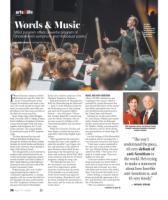
The MSU
Symphony
Orchestra under
the direction of
guest conductor
Christopher
James Lees.
MSU supporters Elaine and Michael Serling
headed a planning committee to bring the
program together.
“Th
e way I
understand the piece,
it’
s very defi
ant of
anti-Semitism in
the world. He’
s trying
to make a statement
about how horrible
anti-Semitism is, and
it’
s very timely.
”
— MICHAEL SERLING
SUZANNE CHESSLER CONTRIBUTING WRITER
Words & Music
MSU program offers powerful program of
Shostakovich symphony and Holocaust poetry.
PHOTOS COURTESY OF MSU