

10 April 11 • 2019
jn
BARBARA LEWIS CONTRIBUTING WRITER
Congregational schools
fi
nd innovative ways to
keep kids engaged.
jews d
in
the
on the cover
I
f there’
s one thing that unites the Detroit area’
s congrega-
tional religious schools, it’
s their willingness to try new
approaches. This is not your father’
s Hebrew school!
After-school sports and other activities killed the traditional
religious school programs of previous generations, said Elissa
Berg, education director at Congregation Beth Ahm in West
Bloomfield. Now religious education is just one choice among
many for children not enrolled in Jewish day schools; it’
s no
longer something most Jewish children are expected to do.
COMBINING FORCES
Sometimes, declining enrollment is the impetus for innova-
tion. Congregation Beth Shalom in Oak Park was down to
just a few dozen students in its religious school four years
ago when it decided to merge
with the school at Temple
Emanu-El, a nearby Reform
congregation, which was also
shrinking.
The result was Yachad
(Hebrew for “together”),
which started in the 2015-
2016 school year and has
grown to 95 students this
year. Students attend class at
Emanu-El on Sunday morn-
ing and at Beth Shalom on
Wednesday afternoon.
Director Abi Taylor-Abt has no problem running an
inter-denominational school. “There’
s no right or wrong
way to practice Judaism,” said Taylor-Abt, who grew up
Modern Orthodox. Yachad teachers present the Orthodox,
Conservative and Reform approaches to various practices
as equally valid. For example, Conservatives do their daily
morning prayers in Hebrew, while Reform congregations use
English, so Yachad alternates between the two languages.
She looks for ways to help the students learn by doing.
They’
ve made challah and mezuzah cases, both of which they
were able to use at home.
Parents have told her their children are happy they can go
to religious school with their friends who belong to a different
congregation, Taylor-Abt said.
Staying
Relevant
BETH EL’
S JOURNEY
The school at Reform Temple Beth El in
Bloomfield Township has grown slightly this
year, to about 200 students. The temple com-
pletely revamped its religious school program
four years ago when Deborah Morosohk started
as director of education.
They no longer call it religious school. The
program is named Masa, Hebrew for journey. It’
s
based on a curriculum developed by Cleveland
educator Nachama Skolnik Moskowitz.
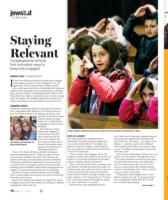
Masa, which meets on Sunday mornings, starts
with Hebrew Through Movement for grades K-6.
Students jump, spin, point and more in response
to directions from their teacher, all in Hebrew.
They also learn Hebrew through everyday vocab-
ulary; at Masa, it isn’
t “third grade,” it’
s “kita gim-
mel,” and teachers praise their pupils by saying
“tov m’
od,” rather than “very good.”
Students join in age-appropriate prayers,
which they learn by listening, singing along and
discussing their significance, Morosohk said.
They don’
t start “decoding” — learning to read
Hebrew — until they join the B’
nai Mitzvah
Club in fifth grade. By then, she said, they have
an “ear” for Hebrew and recognize many of the
words they read.
Jessica Gertner of Rochester Hills says her son
Daniel, 10, loves Hebrew Through Movement.
“The weekly repetition of words becomes famil-
iar without the kids having to be drilled like I
had to so many moons ago,” she said. “Every
once in a while, Daniel will recall the Hebrew
word for something like ‘
door,’
‘
chair’
or ‘
pencil’
in our everyday conversation.
“Things have surely changed since I was in
Hebrew school,” she said. “If my program had
been anything like Temple Beth El’
s, I would
have actually enjoyed going!”
more on page 12
Younger students respond to Hebrew words through music and movement in Temple Beth El’
s chapel.
ANTHONY LANZILOTE
Julia Duchan and Celia Rubin are
happy Yachad students.