

April 4 • 2019 41
jn
understand his father who died of
a nitrous oxide overdose when JJ
was 4.
“It helped me connect to my dad
in a way I had not been connected
before. Almost everybody I spoke
to had a Barry Kramer story,” JJ
says. “He was an incredibly brilliant
visionary, but also a provocateur.
He had a lot of volatile relation-
ships. He would push people’
s
buttons on purpose, reate chaos
and then try to control and rein
it in. Not everyone left on good
terms with him, and some still had
residual regret and hard feelings.”
He says the interviews were often
“therapeutic” for all involved.
A Michigan native, JJ grew up
in Franklin and West Bloomfield,
becoming a bar mitzvah at Temple
Israel before graduating from
Andover High School in 1994 and
Michigan State University in 1998.
After attending Emory Law
School in Atlanta and working in
New York, he moved to Columbus,
Ohio, where he has been vice
president and associate general
counsel for Abercrombie and Fitch
for a decade. He lives in suburban
Bexley with his wife and two young
children.
LEGACY GIFT
When Barry died in 1981, he left
the magazine to JJ, so, at 4, “I
became the chairman of the board
of my own rock ‘
n’
roll maga-
zine,” he quips. His mom, Connie
Kramer, then associate publisher,
became publisher to keep it going.
Over the decades, CREEM had
its ups and downs, moving to Los
Angeles, being sold and going
out of print, and, after a lengthy
court battle, a group headed by JJ
regained control of its brand and
archives in 2017.
Connie, 72, lives in Commerce
Township and is founder and
director of RetroDoggy Rescue,
devoted to finding homes for aban-
doned and lost animals.
“Before I rescued animals, I res-
cued errant rock ‘
n’
roll writers,”
she says.
She went to Mumford High
School in Detroit; and her parents,
Harold and Cylvia Warren, were
active Jewish community members.
Connie and Barry were married
in Las Vegas in 1973 after attending
an Elvis concert and she still tells
people Elvis sang at their wedding.
They were also married in a Jewish
ceremony by Rabbi Jacob Siegel of
Adat Shalom at her parents’
home.
Reached by phone with dogs
barking in the background, she
sounds high-energy, but pauses a
moment as she recalls the times.
“You don’
t get to do all the ups
in life without all of the downs,”
she says. “I look back at things
now with a lot of love and a lot of
melancholy. I would do most of it
again, but I’
d have to be young.”
Asked how she sees things with
the benefit of hindsight, she says,
“Every generation has its time, and
I’
m a bit partial to the generation I
lived in and grew up in. So many
young people with so much to say
came out of a subdued upbringing
to live with an explosion of creative
thought. It’
s not so different from
what is happening today, but it was
so much rawer.”
LOOKING BACK
While not directly involved in the
film’
s production, she has seen the
almost-final cut and approves of its
warts-and-all storytelling.
“It is damn accurate. Watching
it with an aged eye, the first feel-
ing I get is I don’
t know if I want
to live this again,” she says. “We
were loud. We were loud in our
thinking, in our speech and in our
music. The music was everything.
“Barry and I shared ideas and
concepts,” she says of their working
together. She handled the adminis-
trative end of the business — sub-
scriptions, promotions, advertising,
sales — as well as being a cook and
self-described “house mother.”
“He was not the easiest person
to deal with,” she shares. “Success
immobilized him. Nothing could
happen without Barry’
s OK, and
he wasn’
t okaying anything. The
magazine was super-demanding,
and nothing was giving him peace
and joy. It was the perfect storm for
Barry — we were getting a divorce
though it wasn’
t because we didn’
t
love each other.
“The day after Barry died, I real-
ized somebody had to take hold
of the reins,” she says. “I just knew
this was JJ’
s.” She says she kept
it alive with the vital help of Sue
Whitall — who became CREEM’
s
editor before becoming a writer for
the Detroit News in 1983 — and
her father, “a brilliant businessman”
who headed Paragon Steel.
“I’
m incredibly proud of JJ. He
spent about 10 years of his life to
put every block in place to make
this film. I’
m not just proud of how
he has handled the details, but how
he handled the people involved.”
Surprisingly, not only was
CREEM a product of Detroit, it was
also a product of West Bloomfield.
“Cass Avenue was the original
communal space,” Connie says,
but due to safety concerns after a
robbery and need for more space,
the magazine moved to largely
undeveloped West Bloomfield. Its
original farm was on the northwest
corner of Haggerty and 14 Mile,
housing on the southeast corner.
“I spent most of my time at Cass
Avenue and the farm dancing — it
was the best emotional outlet ever,”
Connie says.
Affirming lyrics from the song
“Rock ‘
n’
Roll” by The Velvet
Underground’
s lead Lou Reed,
later given a local twist by Detroit’
s
own Mitch Ryder, she says, “I truly
do mean it when I say my life was
saved by rock ‘
n’
roll.” ■
Films With Jewish Ties
A handful of films in this year’
s Freep Film Festival, April
10-14 at various venues, have Jewish elements to them.
• Who Will Write Our History: In November 1940,
days after the Nazis sealed 450,000 Jews in the Warsaw
Ghetto, a secret band of journalists, scholars and commu-
nity leaders decided to fight back, vowing to defeat Nazi
lies and propaganda not with guns or fists but with pen
and paper.
Featuring the voices of Joan Allen and Adrien Brody, the
film honors the Oyneg Shabes members’
determination in
creating the most important cache of eyewitness accounts
to survive the war. 11 a.m. Sunday, April 14, Detroit
Historical Museum.
• A Thousand Thoughts: This groundbreaking live
documentary event combines a musical performance
by the legendary Kronos Quartet with an immersive film
experience that explores the contemporary classical
group’
s career. Oscar-nominated Jewish filmmaker Sam
Green was born in Detroit and attended University of
Michigan.
Green’
s film tells the story of the Grammy-winning
Kronos Quartet, one of the world’
s most celebrated string
ensembles, who will be performing live. Newsweek
described the performance of A Thousand Thoughts as
“easily the most mind-blowing performance” at last year’
s
Sundance Film Festival. Michigan premiere. 7 p.m. Friday,
April 12, Detroit Film Theatre, DIA.
• Mike Wallace is Here: For more than 50 years,
Jewish broadcast journalist Mike Wallace went head-to-
head with the 20th century’
s most influential figures and
became massively influential and widely feared. Avi Belkin
examines Wallace’
s career and life using archival footage
showing him on either side of the interview microphone
as he rose to host of CBS’
s long-running 60 Minutes.
Michigan premiere. 8:15 p.m. Saturday, April 13, Emagine
Royal Oak.
• What She Said: The Art of Pauline Kael: Pauline
Kael, the daughter of Polish Jewish immigrants, was likely
the most powerful and personal movie critic of the 20th
century. She ruthlessly pursued what made a movie or an
actor’
s performance work or not. The film looks at what
made Pauline’
s work so influential. Michigan premiere.
Noon, Sunday, April 14, Marvin and Betty Danto Lecture
Hall, DIA.
• Untitled The Amazing Jonathan Documentary: This
documentary about the Amazing Johnathan, the uniquely
deranged Detroit magician/comedian who built a career
out of shock and deception in the 1980s, becomes a
bizarre story. Jonathan survives a terminal heart condition,
and documentarian Ben Berman films the illusionist on an
epic comeback tour where Jonathan drops a bombshell
that sends the film spiraling into uncertainty. Michigan
premiere. 4 p.m. Sunday, April 14, Emagine Royal Oak.
• An Armenian Triology: Local composer Dan
Yessian’
s life takes a turn when he is asked to write a
classical composition to commemorate the 100th anni-
versary of the Armenian Genocide. The film, produced
by Detroiter Ohad Wilner (whose mother, Niva, teaches
at Hillel Day School), follows Yessian’
s creative path and
the piece’
s triumphant debut by the Amenian National
Philharmonic Orchestra in his ancestral homeland. World
premiere. 12:30 p.m. Saturday, April 13, Emagine Royal
Oak, 3 p.m. Sunday, April 14, Patriot Theater at the War
Memorial.
For a full schedule, go to Freepfilmfest.com.
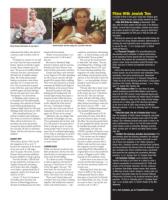
Barry Kramer died when JJ was only 4.
Connie Kramer and her young son, JJ, back in the day