

20 April 4 • 2019
jn
continued on page 22
JACK LESSENBERRY SPECIAL TO THE JEWISH NEWS
Metro Detroit sent two Jewish
representatives to Congress in 2018.
T
here’
s nothing new about Michigan
having two Jewish members in
Congress at the same time. As a mat-
ter of fact, that was always the case for almost
a third of a century, from 1983 to 2015.
Except, as most people know, those were
the brothers Levin, Carl in the U.S. Senate
and his older brother Sandy in the House.
Carl got to Washington four years before
Sandy, and Sandy stayed four years after his
brother. Each of the Levins served 36 years
— and retired from Congress undefeated.
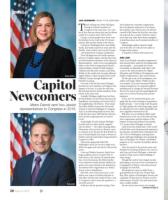
Now, Michigan has two Jewish represen-
tatives in Congress again, and this time they
are both freshman members of the House of
Representatives: Andy Levin, succeeding his
father in the Ninth Congressional District,
which includes a chunk of both southern
Oakland and Macomb counties, and Elissa
Slotkin in the nearby, but not-quite adjacent
Eighth District, which stretches from north
Oakland County through Brighton and
Howell to Lansing.
Not only is this the first time Michigan
has had two new members of Congress who
happen to be Jews, it is also the only time
the state has had two Jewish members of the
House at the same time.
Actually, Michigan might have had three
Jewish freshmen in the House this year, had
Republican Lena Epstein not lost her bid in
the neighboring 11th District. That meant
that Elissa Slotkin became the first Jewish
woman to represent Michigan in Congress.
And, in an interesting historical twist, this
is the first time since 1885 that the state has
had a Jewish congressperson not named
Levin!
Surprisingly, records indicate Michigan
has had only one other Jewish congress-
man in history — the rather amazing Julius
Houseman, who was born in Bavaria, came
to America at 19, became the first Jewish cit-
izen of Grand Rapids and made a fortune in
lumber and real estate before being elected to
Congress in 1882.
Houseman apparently didn’
t like
Washington much; he served a single term,
didn’
t run again and went back to the private
sector.
Levin and Slotkin, however, clearly have
longer political careers in mind. They’
ve
both drawn a fair amount of national atten-
tion. Levin has become the third member
of an impressive family dynasty. Slotkin has
gotten even more attention; she defeated an
incumbent GOP congressman in a district
drawn to favor Republicans.
But with a new census next year, a com-
pletely new system of redistricting due to
take effect and the state certain to lose a seat
in Congress in three years, the question is —
can both survive?
Both have hit the ground running. They
drew important committee assignments,
have the pleasure and power of serving in
the majority, since Democrats won decisive
control of the House the day they were elect-
ed, and each has a variety of diverse experi-
ences that may make them better equipped
to lead than many newly minted members of
Congress.
Interestingly, neither missed a single
one of the first 123 roll call votes taken in
Congress this session.
A snapshot of where both stand now:
ANDY LEVIN
Andy Levin landed committee assignments
that seemed tailor-made for his background
and strengths — principally, the House
Committee on Education and Labor, with
a seat on the subcommittees for Higher
Education and Workforce Development, and
Health, Employment, Labor and Pensions.
He also got a seat on the prestigious com-
mittee on Foreign Affairs. Within his first
two months, Levin also introduced bills to
require transparency in corporate political
spending and to change the Internal Revenue
Service tax code to provide equal dignity for
same-sex as well as heterosexual married
taxpayers.
Levin, now 58, insisted during his cam-
paign that he wasn’
t running to perpetuate a
family dynasty — but to help reach his goals
of “high-quality jobs with living wages, qual-
ity education for every child, and health care
and a dignified retirement for all.
”
Still, there was no doubt he didn’
t mind
being known as the son of the beloved long-
time congressman and the nephew of the
longest-serving and perhaps most popular
U.S. senator from Michigan in history.
Andy Levin has indeed had a wide variety
of both labor and entrepreneurial experience;
his jobs have included stints working for the
AFL-CIO in Washington, assisting immi-
grants with legal challenges and running the
state of Michigan’
s No Worker Left Behind
program in Gov. Jennifer Granholm’
s admin-
istration.
Later, he turned to the private sector and
founded Levin Energy Partners LLC and cre-
ated Lean and Green Michigan, a statewide
market to help convert older buildings to
clean energy.
Though he’
s said he had a largely secular
upbringing, Levin has served as president of
Congregation T’
chiyah, a Reconstructionist
synagogue in Oak Park.
But despite his name, he didn’
t have a
guaranteed lock on the seat. Former State
Rep. Ellen Lipton of Huntington Woods, also
a graduate of Harvard Law School, won the
endorsement of Emily’
s List and raised more
than a million dollars.
He also faced a bare-bones, low-budget
Capitol
Newcomers
jews d
in
the
Andy Levin
Elissa Slotkin