

26 March 28 • 2019
jn
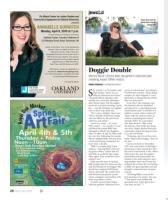
Doggie Double
Monni Must clones late daughter’
s beloved pet,
creating exact DNA match.
S
he turned 1 in November with
little fanfare. There was no
official celebration for Gunni,
a beautiful black Labrador with
soulful eyes, owned by photogra-
pher Monni Must. But the puppy
posed for a portrait wearing a party
hat — and her birthday was signifi-
cant in more ways than one.
“She is just a delight,” Must says.
“She’
s a bundle of monster energy
who has filled my life and house
with love and smiles.”
Gunni is a clone — an exact
DNA match — to a nearly 15-year-
old black lab named Billy who
belonged to Must’
s late daughter,
Miya. In 2007, at age 28, Miya took
her own life. Following the suicide,
Monni adopted Billy, who has been
a loyal and loving companion for
more than a decade.
“Billy is a unique dog,” Must
explains. “Having Billy is like hav-
ing part of Miya. I knew that if I
lost Billy, it would be like losing
Miya again. That would be devas-
tating to me.”
Must says the idea of cloning
Billy popped into her head one day
and she decided to investigate. She
found the company PerPETuate,
which calls itself “the world’
s first
and foremost pet genetic preser-
vation company,” and worked with
them to produce a clone.
“Genetic preservation begins
with the painless collection of tis-
sue by a veterinarian,” according to
PerPETuate’
s website. “These tissue
samples are then shipped to [our]
laboratory in Massachusetts where
they are processed.”
From there, the company says
the desired cells are identified
and placed in a controlled growth
environment until “a cell line of a
million or more cells is achieved.”
Those cells are used to create an
embryo containing the cloned
animal’
s DNA. It’
s a procedure
that dates back to 1996, when
the famous clone Dolly the sheep
was born. Singer Barbra Streisand
reportedly cloned her dog last year
at a cost of $50,000.
“[Cloning a pet] is not for every-
body,” Must acknowledges. “But, it’
s
for me.”
Gunni was born in November
2017 and came home to Michigan
last January. Must named her after
the town of Gunnison, Colo., where
Miya lived. She says the puppy’
s
personality and mannerisms are
similar to the older dog but, most
importantly, Must says Gunni has
reduced the anxiety she was feeling
as Billy was growing older and has
brought a renewed sense of peace
and joy.
“[Cloning Billy] is one of the
best decisions I’
ve made,” she says.
“I feel much more settled and
grounded now. It has given me a
new lease on life.” ■
jews d
in
the
ROBIN SCHWARTZ CONTRIBUTING WRITER
Monni Must with the
cloned Gunni and the
original
Billy
April 4th & 5th
Thursday + Friday
Noon - 10pm
Royal Oak Farmers Market
55 Jury Selected Artists
Live Entertainment
Food Trucks
Craft Beer & Wine
Official Craft Beer
Sponsor
Live Entertainment
Sponsor
Produced By
P
J
Co
COURTESY OF MONNI MUST