
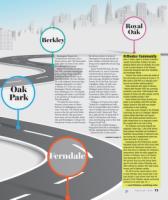

Oak
Park
Berkley
Royal
Oak
Huntington Woods City
Commissioner Jeff Jenks, also a
former mayor, said, “My house deed
didn’
t allow my home to be sold to
Jews although I’
m Jewish.
”
Rabbi Dan Horwitz, 35, directs
The Well, an award-winning pro-
gram serving young, sometimes
unaffiliated Jews. He grew up in
West Bloomfield. His wife, Miriam,
38, a self-employed American Sign
Language interpreter, is a native
of Albany, N.Y. They, too, chose
Huntington Woods, relocating
from Washington, D.C. The family,
including sons Jonah, 4, and Micah,
2, are members of Temple Israel in
West Bloomfield.
“To make the move from a
dynamic urban center to Metro
Detroit was challenging in many
ways,
” Dan said. “We wanted easy
access to the city and to the Metro
Detroit suburbs with great down-
town areas, such as Ferndale, Royal
Oak and Birmingham. Living in the
Woodward Avenue corridor became
the obvious choice. In terms of
Huntington Woods specifically, we
had a number of friends who were
living in the neighborhood and sang
its praises.
”
Jaimie Powell Horowitz, 40, and
Jeff Horowitz, 41, met at University
of Detroit Mercy School of Law
and moved to Huntington Woods
nine years ago. Members of Temple
Emanu-El in Oak Park, they have
a daughter, Aidan, 10, and a son,
Asher, 6. Jaimie heads the Fair
Michigan Justice Project, a part-
nership with the Wayne County
Prosecutor’
s office. Jeff is a partner
at Honigman, Miller, Schwartz and
Cohen.
Seeking a new home, the couple
“looked for a neighborhood with
lots of young families that would be
close to temple and in between our
places of work,
” Jaimie said. They
put a high priority on being able to
walk to a downtown with restau-
rants and shopping, such as they had
living in Royal Oak.
She says she wouldn’
t change a
thing about their life in Huntington
Woods, praising Burton Elementary
School, the Rec Center and its
Ferndale
Orthodox Community
Irwin J. Cohen, author of Echoes of Detroit’
s
Jewish Communities: A History, has been
studying Detroit Jewry for decades. He is part
of and a careful observer of the Orthodox
community throughout Oak Park, Southfield
and Huntington Woods.
“Anyone who wants to know [the health of
the community] can just look at Lincoln or 10
Mile roads in Oak Park on a Saturday morn-
ing and see families walking together.”
Cohen observes other signs of vibrancy.
“Yeshiva Beth Yehudah (YBY) has a growing
enrollment, now above 1,000 students. Add
students at Farber and other schools, and the
number probably exceeds 1,800.”
Farber Hebrew Day School recently com-
pleted a new building, while YBY and Bais
Yaakov School for Girls both have started
construction on new buildings.
Cohen says some changes in the Orthodox
community are due to in-migration. National
authors Rabbis Berel Wein and Paysach
Krohn have touted suburban Detroit’
s com-
plete infrastructure for an observant Jewish
life, coupled with a low cost of living.
The Orthodox community footprint has
expanded, Cohen says. “Look at Mt. Vernon
Road between Greenfield and Southfield in
Southfield. Young families of observant Jews
are moving into a neighborhood where few
Jews have lived in recent years.”
Comparing the 2018 Detroit Area Jewish
Population Study with the 2005 study (both
sponsored by Federation) provides num-
bers that seem to challenge the historian’
s
observations.
While the data suggest the
number of Orthodox Jews in the Detroit
area decreased from 15,400 to 10,700,
the primary drop occurred among those
age 65 and older whose Orthodoxy was
often defined by whether they kept kosher
homes and lit Sabbath candles.
The 2018 survey reports about a third
of area Orthodox Jews moved here in the
past decade. It also shows more than 40
percent of the Orthodox Jewish community
continue to be under age 18. ■
— Louis Finkelman, contributing writer
continued on page 14
March 28 • 2019 13
jn