

22 March 21 • 2019
jn
W
hen a fellow physician
asked Brett Ehrmann if his
failing kidneys made him
less sympathetic to patients with rela-
tively minor woes, he quickly realized
he views it differently.
“It is actually the opposite — every-
one has their own crosses to bear and I
have been able to relate to people bet-
ter because of my experience,
” said the
West Bloomfield native, who practices
medicine and instructs at Weill Cornell
Medicine in New York.
Ehrmann, 31, was in middle
school when his mother, Robin, was
diagnosed with polycystic kidney
disease. But since there was little to
be done about the genetic condition
at the time, he decided to wait until
he was in medical school to find out
for sure.
“I had been prepared for the diag-
nosis, so it was more of a confirma-
tion; but it was a still whirlwind of
emotions. I knew what my mom had
been through,” he said. “Since it is
genetic, it is going to progress how it
will progress and, in my experience, it
is wasted energy to focus on things I
can’
t control.”
And energy is not something he has
a lot to spare; as the disease progress-
es, Ehrmann’
s chief symptom is a lack
of energy.
Now he and his family, including
parents, Robin (who received a trans-
plant from a living donor 16 years ago)
and Paul Ehrmann of West Bloomfield
(both physicians and members of
Congregation B’
nai Moshe), are hoping
to find a person willing to give a kid-
ney in a living donor procedure.
The waiting list for a kidney from a
deceased donor has more than 100,000
people on it, which translates to at
least five years. And a living kidney
donation generally lasts longer and
functions better.
The alternative would be dialysis, a
grueling process that is usually three
days a week for four hours at a time.
“It would certainly help my kidneys
do their job and keep me alive, but it
is associated with a high risk of com-
plications and poor long-term results,
”
Ehrmann explained in an email he’
s
circulated to friends and family. “
A
transplant would offer me much more
freedom and the ability to live a longer,
healthier, more normal life.
”
More than 50,000 people have given
a kidney as a living donor, according to
the National Kidney Registry.
“Donating a kidney not only helps
the person who receives the kidney,
but also shortens the deceased donor
wait list, helping others get a deceased
donor kidney sooner,
” says the groups’
website (kidneyregistry.org). “
Also, all
living donors are awarded points for
their donation so if they ever need a
kidney later in life, they will be given
priority on the deceased donor list.
”
People need only one of their two
kidneys to live a long, healthy life.
Most donor surgery is done laparo-
scopically through a tiny incision near
the belly button, has a very small risk
of complications and requires about
two weeks of recuperation. Medical
costs are covered by the recipient’
s
insurance.
It is unclear at this time if Brett’
s
brothers, Daniel and Zachary, are suit-
able donors.
“We want to keep the word out,”
noted Paul Ehrmann, who practices
family medicine in Royal Oak. “The
idea of an organ donation is such
a mitzvah and such a wonderful
thing someone could do for another
human.” ■
Learn more about the living donor process,
which begins with a blood test to determine a
match, at cornell.donorscreen.org.
JOYCE WISWELL CONTRIBUTING WRITER
The Gift of Life
West Bloomfi
eld native seeks kidney donor.
jews d
in
the
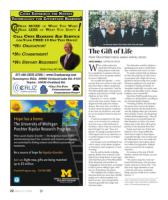
The Ehrmann family: Zach, Robin, Brett, Paul and Daniel.
Hope has a home:
The University of Michigan
Prechter Bipolar Research Program
What causes bipolar disorder — the dangerous manic highs
and devastating lows? Our scientists and research participants
are committed to finding answers and effective personalized
treatments.
Be a source of hope for bipolar disorder.
Join us:
Right now, gifts are being matched
up to $5 million.
PrechterProgram.org 734-763-4895