

10 March 14 • 2019
jn
After
Pittsburgh …
Local security
policies may vary, but no one is
talking about who might be packing at shul.
A
aron Tobin does not widely
advertise his gun safety and
training courses. Since the
Pittsburgh shootings Oct. 27, 2018, when
a lone gunman killed
11 workshippers, his
business, about 95 per-
cent word of mouth, has
spiked. He trains many
in the Jewish community,
including rabbis, how to
handle a weapon. After
they complete their train-
ing, they ask him not to
tell anyone they took the course or own
a gun.
He has no problem with Jews carry-
ing guns to synagogue; but only if they
have been granted permission from
rabbis or the board, are highly trained in
active-shooter situations and then only
if they think they can keep a cool head if
the unthinkable arises.
“
A gun is like an instrument you
must practice on a regular basis,
” Tobin
cautioned. “If you are not trained for an
active-shooter situation, or if you do not
know or do not think you are going to
react in a calm responsible manner, it is
best to leave your gun at home.
”
Around the country, many Jews are
taking up this conversation about the
unthinkable, about being targeted in a
space where they should feel safest: the
sanctuaries of their synagogues.
While most sources would not give
a definitive answer if they are allowing
congregants to carry to services — lead-
ing to a “don’
t ask, don’
t tell” climate —
the response to the presence of guns in
synagogue ranged widely.
While some said they would not mind
and would welcome the presence of a
gun in the hands of a CPL owner, others
adamantly said they did not want any
guns in their building or, at the very
most, only to be carried by trained and
paid professionals.
Though no specific synagogue would
disclose, there are some worshipers
packing heat in Detroit’
s synagogues.
Tobin’
s eight-hour training course,
given at private locations at a client’
s
request, is far more thorough than the
standard two-hour classes typically given
to new gun owners. To Tobin, 57, who
attends Congregation Shomer Israel in
Oak Park, two hours is not good enough;
neither is infrequent practicing.
Safety and responsibility are of the
utmost priority for every gun owner, he
said.
“People like to say that nice Jewish
boys don’
t own guns, and I say, ‘
Have
you been to Israel?’
” said the nationally
certified Concealed Pistol License (CPL)
instructor. “I believe that every Jewish
person needs to know how to defend
himself or herself. There is a stigma
among Jews about owning and carrying
a gun.
”
MICHIGAN LAW
Gary Sikorski, who heads the commu-
nity-wide security department of the
Jewish Federation of
Metropolitan Detroit,
explained that under
Michigan state laws it is
up to the individual lead-
ership of each house of
worship to work out their
own policy of allowing
congregants to carry.
If a synagogue does
allow members or trained profession-
als to carry, Sikorski said they are not
mandated to inform Federation who
these people are. But if a synagogue
does permit congregants to carry, he
advises they should create a well-word-
ed written policy to be signed by the
CPL congregant.
Ultimately, Sikorski said best practices
include strengthening preventative secu-
rity measures to avoid a gunfight, such
as hardening access to the building and
extra surveillance in lobbies and other
areas of the building.
“I am aware of synagogues and other
jews d
in
the
on the cover
continued on page 12
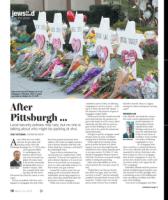
Some of the memorials outside Tree of Life
Synagogue in Pittsburgh, where 11 people
were killed on Shabbat, Oct. 27, 2018
OFFICIAL WHITE HOUSE PHOTO BY ANDREA HANKS
Aaron Tobin
Gary Sikorski
STACY GITTLEMAN CONTRIBUTING WRITER