

W
hen Jewish teen Leah was
diagnosed with atten-
tion-deficit/hyperactivity dis-
order (ADHD) last year, she finally had a
name for the debilitating anxiety, mental
distraction and stomach aches she expe-
rienced daily. She said she missed a lot
of school because of these emotional and
physical symptoms.
When her grades began to plummet,
her mother asked school administrators
what she should do to help her daughter.
“Having ADHD was awful,
” said Leah,
15, a high school sophomore. “I had
constant anxiety over everything. In my
school life, it was paralyzing. The com-
petition at my school is insane. Basically,
you’
re setting yourself up for the rest of
your life based on your ACT and SAT
scores.
”
Before she began getting professional
help, Leah (who did not want her real
name used) turned to vaping as a way to
alleviate her feelings of crippling anxiety.
“It’
s hard to stop vaping,
” she said.
“It’
s just knowing you could use it” that
serves as a comfort.
Leah is part of a concerning trend
to those in the medical profession who
have seen a significant increase in young
people using e-cigarettes. According
to the Centers for Disease Control, use
of e-cigarettes — also called vaping —
jumped 78 percent among high school
students and 48 percent among middle
schoolers between 2017 and 2018.
Medical experts note that individuals
with attention deficit disorder (ADD),
more commonly referred to today as
attention-deficit/hyperactivity disorder,
are at an even higher risk of engaging in
this health-threatening activity.
Leah said that many of her classmates
vape, despite flyers peppered on the walls
of her school threatening suspension to
anyone caught vaping. She also said it’
s
easy to get e-cigarettes through friends.
WHAT IS ADHD?
ADHD is a brain disorder marked by
an ongoing pattern of inattention and/
or hyperactivity-impulsivity that inter-
feres with functioning or development,
according to the National Institutes of
Mental Health. NIMH reports that most
children have the combined type of
ADHD versus ADD.
Because of a lack of impulse control,
teens with ADHD are at greater risk
of becoming addicted to substances,
including the nicotine in vaping.
“It’
s really staggering the numbers
of teens vaping and how vaping has
become so commonplace,
” said Dana
Cohen, Ph.D., a clinical psychologist
with the Beaumont
Center for Human
Development in
Southfield. “Vaping is
popular in general and
when you add the ADHD
component, primarily
because of the poor
impulse control, they
tend to be risk takers.
”
Cohen said those with ADHD have
three core deficits, including not being
able to sustain attention to work tasks,
hyperactivity and reduced impulse con-
trol.
“Whereas most people [have the
strategy of] ‘
ready, aim, fire,
’
those with
ADHD are ‘
ready, fire, aim,
’
” she said.
“They act without thinking things
through.
”
Young people with ADHD struggle
with social interactions, cope with inse-
curity issues, worry about the things
they say and, in general, try to impress
others, according to Brooke Weingarden,
D.O., MPH, a child/adolescent psychia-
trist with the Birmingham Maple Clinic
in Troy.
“There’
s so much going on in their
brain and they can’
t focus on one thing,
”
she said. “It’
s like a marching band in
their head.
”
VAPING DEFINED
Many types of electronic cigarettes are
sold (legally to those age 18 and older)
on the market today, including Juul and
Eleaf as well as e-cigarettes sold in inde-
pendent vape shops. Manufacturers have
marketed the product as a way for smok-
ers to quit the habit, but e-cigarettes still
deliver nicotine, which is vaporized in
a heated oil. Oils come in “flavors” such
as bubble gum, candy and gummy bears
as well as food flavors like chocolate,
cheesecake and caramel.
The oil itself, according to medical
experts, contains harmful, cancer-caus-
ing chemicals, including butane, and can
lead to lung disease.
“Somehow, when vaping first started,
there was this misconception that it’
s
safer,
” Cohen said.
One pod of oil contains the same
amount of nicotine in a single pack of
cigarettes, according to Daniel Schnaar,
M.D., a general pediatrician with Child
Health Associates, with offices in Troy
and Novi. He is also a
member of Beaumont
Health’
s Department of
Pediatrics. Schnaar said he
asks all his young patients
if they vape, though many
try to conceal the fact
they do.
“E-cigarette companies
claim nicotine can help ADHD symp-
toms,
” he said. “The vaping industry
has taken parents, pediatricians, health
departments and the FDA flat-footed.
These companies have been ahead of the
curve with marketing the products.
“We’
re worried about kids getting
addicted to nicotine. Vaping makes them
Dr. Dana Cohen
Dr. Daniel
Schnaar
health
Signs of Vaping
Beaumont Health professionals provide these warning signs:
•
Increased secrecy or an unwillingness to discuss or answer
your questions.
•
Increased irritability and mood changes due to a nicotine
addiction.
•
Disappearing money.
•
An increased unwillingness to stay at home.
•
Increased thirst — vaping dehydrates the skin around the
mouth and throat.
•
A desire for flavor because of a dry mouth. Notice if your child
is using more salt or requesting spicy foods.
•
Nosebleeds. Vaping also dries the skin of the nose, which can
lead to bleeding.
•
Finding vaping paraphernalia around the house.
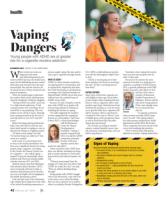
PHOTO ILLUSTRATION
ELIZABETH KATZ SPECIAL TO THE JEWISH NEWS
Vaping
Dangers
Young people with ADHD are at greater
risk for e-cigarette nicotine addiction.
42 February 28 • 2019
jn