

18 February 28 • 2019
jn
Traveling Trunk
T
o acquaint young students
with the stories of the first
Jewish settlers in Michigan,
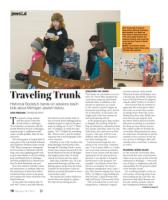
Tova Schreiber, an educator with the
Jewish Historical Society of Michigan,
unpacks props: a cardboard model
canoe, wooden paddles, false fur hats
and more.
The sixth-graders at Temple Beth El
enact parts of the trip Ezekiel Solomon
and Chapman Abraham made around
1760. Those young men, immigrants
from Germany to Montreal, took the
long canoe trip supplying goods such
as guns and whiskey to the fur-trading
posts and British forts in Michigan,
and then paddled back to Montreal in
time for Rosh Hashanah each year.
Every few minutes, Schreiber varies
the instructions, so students reflect on
the experiences of those first settlers
and present their stories to the group
and compare the stories with their own
family histories.
At one point, the students play “Iz
mir! Nu?” Given a card with informa-
tion about an early Jewish settler in
one of several dozen Michigan places,
students prepare to reply to the place
name by calling out “Iz mir!” (“That’
s
me!” in Yiddish), to which the class
replies, “Nu?” (Yiddish for something
like “Tell me more”), and the student
responds with a brief biography of his
or her character.
Schreiber is one of five teachers who
bring Michigan Jewish history alive
through the Traveling Trunk, a series
of four class sessions sponsored by the
Jewish Historical Society of Michigan
and taught at more than 10 Jewish
schools in Detroit and Ann Arbor.
After class, Schreiber says, “It is all
experiential learning: activities, role
playing, games, props from the trunk,
costumes for the teachers. Each stu-
dent has a journal that points to sourc-
es for further study.”
The journal also invites students to
involve their own family to explore
how they fit into the big picture.
DEVELOPING THE COURSE
That hands-on orientation is no acci-
dent. Dr. Cheryl Blau designed the
curriculum using top educational
methods. Blau, in addition to her
decades of experience as a teach-
er, has earned a master’
s degree in
humanistic psychology and a doctor-
ate in education. At one point, she
taught each of the four sessions in
each participating school.
As the program grew, Blau needed
to delegate the teaching. With the
help of enthusiastic, talented teachers
Lori Lasday, Schreiber, Ilene Lee and
Dalia Keen, she could serve as their
resource. This year, with her own
children older, Blau has resumed a
part-time teaching role.
Each presenter brings her own
talents to the curriculum. Schreiber
says: “I am a music addict, so I make
sure to provide musical accompani-
ment to each session with the music
appropriate for the time period in
question. I use Spotify to bring the
period music to the program. For
example, I use Klezmer from Dave
Tarras to accompany the Eastern
European immigration story. Later, I
play Nina Simone singing Eretz Zavat
Halav” (a Hebrew song extolling the
land of Israel, “a land flowing with
milk and honey,” Deuteronomy 26:9).
This curriculum has its own inter-
esting history. Catherine Cangany,
executive director of the Jewish
Historical Society of Michigan, says
a decade ago, the JHSM curated bus
tours of Jewish Detroit for religious
schools called “Settlers to Citizens.”
They learned that for students to
appreciate the actual places where
the events occurred, they needed
to already know about the events.
Wendy Rose Bice, then JHSM exec-
utive director, got support from
the Metro Detroit Board of Jewish
Educators to develop a curriculum
for these pre-tour history lessons.
Bice called on Blau to develop the
curriculum. Blau prepared an exten-
sive repertoire of materials to involve
students in four sessions on the his-
tory of Jews in Michigan. Blau still
considers this a work that “continues
to evolve.”
RECURRING JEWISH VALUES
As she wrote the curriculum, Blau
discovered that a few central Jewish
values recur in each period of Jewish
settlement in Michigan — Jews took
care of their co-religionists and took
responsibility for the general welfare
of the broader society.
For a striking example, in the sec-
ond session, retrieving events from
years leading up the Civil War, stu-
dents learn that Mark Sloman and
his wife, Amelia, hosted a stop on
the Underground Railroad, help-
jews d
in
the
LOUIS FINKELMAN CONTRIBUTING WRITER
Historical Society’
s hands-on sessions teach
kids about Michigan Jewish history.
LEFT: Temple Beth El
Students
Ruby Gelncer, Michaela Kolchinsky,
Max Golembek, Luca Mollo and
Victor Davis re-enact from around
1760, when Ezekiel Solomon and
Chapman Abraham made round-trip
canoe trips from Toronto to Detroit
to sell goods.
BELOW: Tova Schreiber teaches
about Michigan Jewish history using
Traveling Trunk materials.
continued on page 20
PHOTOS BY JESSICA BARRIS