

January 24 • 2019 5
jn
W
hat’
s the difference between
a national park during the
government shutdown and
a dresser drawer filled with rows of
meticulously roll-folded T-shirts?
One is a picture of
human fallibility, the
precarious nature of
our social contract,
the conspicuous con-
sumption of disposable
goods and the nega-
tive consequences of
under-regulation and
over-production.
The other is probably out of toilet
paper.
These interrelated images from
these first weeks of 2019 — spritely
Marie Kondo bringing her popular
joy-through-tidying method to untold
American households through Netflix
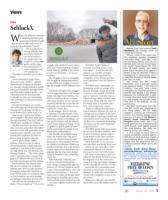
and litter-laden national parks — are
a Rorschach test for how narrowly
or broadly we view our relationships
with and impact on the environment
around us.
Is it disconcerting to see a scenic
vista with paper goods and plasticware
flowing out of a garbage can like so
much molten lava? Spork yeah, it is.
And are my T-shirts now folded
and arranged so the prints smile up at
me each morning? They don’
t call me
World’
s Best Grandpa for nothing.
But like an invasive species in a deli-
cate ecosystem, more than 100 million
pounds of waste still materialize in our
national parks annually, even when
federal park employees are there to
ferry it away at regular intervals.
And to get to Kondo-caliber
tidiness, most of us have to shed a
mound/mountain of shirts that just
might get a new lease of life as paint-
ers’
rags (50-lb. box, $42.50 from ERC
Wiping Products … “We make wiping
easy!”) and that create a vacuum beg-
ging to be filled by the next round of
joy-inducing fan gear and fast fashion.
It’
s abundantly clear that we can’
t
rely on our current crop of elected
officials and CEOs to make any kind
of strategic, sustainable decisions up
river. Which makes it incumbent upon
us to do whatever we can to manage
and mitigate what flows downstream.
We can’
t just ask ourselves of an
object, “Does it spark joy?” We need to
struggle with whether it causes others
pain, even if the sweatshop, slaughter-
house, refinery, landfill or incinerator
is not in our backyard — or on our
continent.
The struggle is real. I’
m struggling.
The struggle of trading disposability
for durability, the struggle of carpool-
ing, the struggle of how delicious meat
is.
But there’
s strength in the struggle.
I’
m not suggesting that we all become
hemp-clad vegan wind turbines. We
live in a consumer-driven economy
with many varieties of Oreo and our
ancestors labored day in and day out
with only one variety of Oreo so we
could have a better life.
In the struggle, there’
s a striving
to innovate. Consider StockX. If you
don’
t traffic in sought-after sneakers,
streetwear, watches or handbags, you
may not be familiar with the Detroit-
based “Stock Market of Things.” It has
catapulted to global repute by confi-
dently connecting the supply of and
demand for niche products.
Like StockX, our problem begins
where the market ends. The price I
pay for gas includes taxes for road
maintenance (theoretically), but not
for inhalers for asthmatic children in
Southwest Detroit. Nor is the environ-
mental impact of my Styrofoam cup
imputed into the price Dart charges
Tropical Smoothie Cafe or what they
charge me.
Enter SchlockX. SchlockX.com
is not an evironmonumental cli-
mate-change-changing killer app. At
least not yet. To start, maybe it can be
a space where people like us, who care
about the environment — but some-
times want to order via the app rather
than bring our reusable cup to every
newly opened Tropical Smoothie Cafe
— can come together to deal with our
schlock …
SOCRRA, South Oakland
County’
s recycling center, is my
Graceland — much like the fair’
s
detritus is a veritable smorgas-
bord-orgasbord-orgasbord for
Templeton in my favorite and the
most important scene of Charlotte’
s
Web.
SOCRRA rocks. Nationally, con-
tamination sends an average of 25
percent of single-stream recycling
contents to the landfill; SOCRRA’
s
goal is 5 percent. And they have a
whimsical app, Waste Wizard, who
will let you know with the wave of
his wand, what is recyclable and
how: socrra.org/waste-wizard.
There is a physical and psycho-
logical distance between the ease of
carting your recyclables to the curb
and the effort of getting yourself and
your stuff to your local drop-off cen-
ter. But even a beautiful, brimming
bin misses out on some important
ecopportunities.
SOCRRA, along with most materi-
als recovery facilities (MRFs!), can’
t
process Styrofoam, plastic bags or
scrap metal on the same conveyor
belts as all our boxes, bottles, etc.
Enter SchlockX so we can have
our smoothies and drink them, too.
Here’
s my very real offer: I will
schlep your schlock. Fill out the
form on the very real website and
I will come to your house, pick up
whatever the Waste Wizard says can
be dropped off at the center and
truck it to Troy. No charge, though I
accept virtually all varieties of Oreo.
Here’
s the very reasonable catch:
We need a critical mass of Schlock
Blockers to make this sustainable, so
recruit some neighbors to get in on
the action.
Shimmy to schlockX.com and let’
s
spark some joy in this untidy world. ■
views
jewfro
SchlockX
Ben Falik
My Story
My Story
Click. Call. Give Now.
www.hfldetroit.org • 248.723.8184
Hebrew Free Loan Detroit
6735 Telegraph Road, Suite 300 • Bloomfield Hills, MI 48301
@HFLDetroit
Hebrew Free Loan entered Joel
Hechler’s life through word of
mouth from friends.
“Where I lived a few years ago,
the neighbors regularly socialized
with each other,” Joel said, “and
we remained friends even as our
families grew and we moved away.
So when I heard about HFL from
two of those friends, who were
then active members of the agency’s
Board, it had my attention. I have a
background in accounting, and I
really liked the idea of helping people
get back on track.”
Joel looked into HFL, made
donations and eventually joined
the agency’s Board. “I find this so
fulfilling,” Joel said, “and I enjoy
leveraging my financial acumen to
directly help people. I say directly
because I’m working with a team
of really dedicated Board members
to help people we actually meet.
This isn’t in the abstract, it’s our
community.”
Joel also appreciates that HFL
has loan funds and programs for
so many needs. “We are really
adaptive, looking at community
trends, and helping people where
they are. I’m part of the Marvin I.
Danto Small Business Loan
Program review team, and I truly
enjoy watching the entrepreneurial
spirit flourish, and helping people
live their dreams. We really are
looking out for one another.
“I want people to know what a
caring, empathetic, positive agency
HFL truly is. And you know, there’s
also a rebound for me. I enjoy helping
others, and the experience has a
profound positive effect on my life
as well.”
Community donations help HFL
give interest-free loans to local Jews
for a variety of personal, health,
educational and small business
needs.