

14 January 24 • 2019
jn
LOUIS FINKELMAN CONTRIBUTING WRITER
E
rwin and Esther Posner traveled
to the Netherlands in 1976 to
visit Enschede, the village where
Christian families had hidden Esther
(then called Marianne Rose) and her
family during the Nazi occupation.
There they met the heroic police officer
Dick Mos, who, while officially serving
the Nazi regime, secretly cooperated
with local Dutch Reformed Minister
Leendert Overduin to find homes to
conceal 5-year-old Marianne, her par-
ents, four of her aunts and her grand-
father.
The Israeli government issues
a medal for those individuals, the
Righteous of the Nations, who saved
Jews during the Holocaust. Each tree
in a grove at Yad Vashem in Jerusalem
commemorates a rescuer, who risked
his or her life and the lives of their fam-
ilies to save Jews from murder.
Posner learned that Dick Mos and his
wife, Rie, had not yet been recognized.
So, she submitted the extensive paper-
work describing their efforts to Yad
Vashem, the world Holocaust remem-
brance center.
At the bar mitzvah of Aryeh, the
Posners’
eldest son, on Thanksgiving
Day in 1977, Dick and Rie Mos came
from Holland to Detroit to join the
celebration. As Rie Mos remarked, “We
had to save you because you are Jewish.
We are glad to see you living your lives
as Jews.” The rescuers were surprised on
that occasion to receive the medal for
the Righteous of the Nations from the
Israeli government.
Hiding Jews in Holland took courage
and ingenuity. During the Nazi occu-
pation, each hiding place could become
a dangerous trap at any moment. The
Underground needed contingency
plans to move concealed people again
and again. During nearly two years in
hiding, Marianne had stayed with five
different families, sometimes with her
parents, but usually separated from
them. Two additional families con-
cealed her parents and other relatives.
Three years ago, Posner discovered
three of the families had never received
recognition for their heroic deeds. She
was determined to gain them that rec-
ognition.
After WWII, Posner’
s parents moved
to New York. Her mother, Ellen Rose,
had kept in touch with the families,
exchanging letters and sending gifts to
help during those years when the Dutch
economy failed. Looking through her
late mother’
s effects, Esther pulled
together photographs, letters and doc-
uments to prepare applications to Yad
Vashem to gain recognition for the
three families.
Ruth Joaquin of the Dutch desk of
Yad Vashem replied, thanking Posner
for the application, but asking, “What
was the reason that this request was not
made earlier, for example, with the sub-
missions for the Mos family?”
Posner replied she had been unable
to locate the families on trips to
Holland in 1976 and 1992. The Tilsma
family house was gone, replaced by a
toy store. The Spit family, “deeply dis-
appointed with the Dutch government’
s
reaction to the collaborators,” had
moved to South Africa; Posner’
s parents
had lost track of them, and also of the
Morssink family. She hoped “I would be
able to repair the error of not applying
earlier.”
SEARCHING FOR OTHERS
Posner could provide extensive infor-
mation about the Spit and Tilsma fam-
ilies, who had hidden her. She did not
have as much information about Fritz
and Bep Morssink, who had concealed
her parents.
Joaquin of Yad Vashem conducted
extensive research to locate the missing
families, contacting historians, examin-
ing the municipal records of Enschede
and nearby Delden. She succeeded in
finding an address for the Morssink
children and sent them letters, but got
no response, until, on Sept. 6, 2016,
Joaquin received a letter from Willy
Morssink, a daughter of the rescuers.
Born in 1942, she was too young to
remember much of the war, but she had
“heard the stories from her parents and
was witness to the warm correspon-
dence between the two families.”
Posner had an unexpectedly hard
time finding another family. Though
jews d
in
the
Holocaust Remembrance Day
Fulfilling A Wish
Survivor gains Righteous Among the Nations
status for three rescuing families.
Esther Posner and her family with members of the Spit family who hid them during the Holocaust:
Anne Spit, soldier, her parents Ellen and Fritz Rose, grandfather Rudolf Rose, Spit grandmother,
soldier, Tante Ulla; seated: Esther Marianne Rose and two Spit sons.
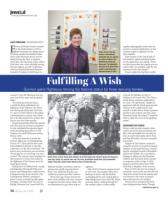
Esther Posner with her
mother’
s embroidered
tablecloth that she worked
on while in hiding in the
Netherlands during the
Holocaust. The tablecloth
was part of an Anne Frank
exhibit at the Holocaust
Memorial Center in 2017.
JERRY ZOLYNSKY
continued on page 16