

12 January 24 • 2019
jn
real-life Holocaust survivor Maria
Altmann, who sets in motion a long legal
challenge to recover her family’
s cher-
ished Gustav Klimt painting, Portrait
of Adele Bloch-Bauer I — also known
as The Woman in Gold — from the
Austrian government.
“This artwork, some of it by famous
Jewish artists, is part of our Jewish iden-
tity, as much as Jewish humor, literature
and food. Denying the return of iden-
tified Jewish artwork stolen during the
Holocaust is outrageous, and we cannot
be silent when the clock is ticking for
recovery under U.S. law,
” said Schwartz,
JBAM president and the immediate for-
mer chairperson of ACES.
RECOVERY PLAN
With major art recovery cases cur-
rently being litigated in New York and
California, Schwartz said he wants to
achieve success stories like Altmann’
s for
survivor families living in Metro Detroit.
Schwartz, who has an entertainment
practice and more than a decade of
experience in art law, explained the
local Holocaust Art Recovery Initiative
through the acronym “
ART.
”
“The ‘
A
’
is for Awareness of the scope
and continuing nature of the problem,
”
Schwartz said. “
A million pieces of art
were confiscated from the Jewish people
and about a third of it — 300,000 miss-
ing pieces — have still not been returned
to the rightful owners and their descen-
dants. Many people do not realize that
this is the largest displacement of art in
human history.
”
He also wants to bring awareness that
the HEAR Act “makes it possible for
descendants to go to court to recover art
and property lost to the Nazis during the
World War II period.
”
“The HEAR Act helps those who
know that certain works were taken
from their family in Europe during
the Holocaust and not returned, and
addresses some of the statutes of limita-
tion that prevented families from getting
their works back,
” he said.
JBAM and its partners will help poten-
tial claimants by connecting them with
scholars and researchers. The latter can
help piece together “provenance,
” or
proof of art ownership, for the rightful
heirs. JBAM members and other vol-
unteers are prepared to litigate owner-
ship claims in Michigan federal courts,
relying upon the HEAR Act. This must
happen prior to the “sunset provision”
of Jan. 1, 2027, the deadline to file such
lawsuits under the law.
“The letter ‘
R’
is for Research,
”
Schwartz continued. Establishing prov-
enance is the way for tracing a family’
s
art claim. It’
s still possible for experts
to recover looted artwork because of
documentation kept by Nazis and others
during the war.
“
A lot of evidence remains to be waded
through in different repositories, includ-
ing at the Holocaust Memorial Center in
Farmington Hills,
” said Schwartz, who
speaks publicly and writes about the
problem of looted art.
“We want to help people who had
art stolen or their descendants. We
put them in touch with genealogists,
art experts and others to get as much
evidence and documentation as pos-
sible to help people with their art
claims,” Schwartz said. He noted that
in addition to individual families, “we
are exploring new ways to help much
larger groups of Holocaust victims and
their descendants.”
As part of the local effort to help
descendants seeking recovery of
looted art, Schwartz said they’
ll be
looking for “T,’
” as in Triable cases.
Questions for attorneys to consider
will include: Where is the artwork? Is
it with private parties, displayed on
museum walls or sitting in vaults? Do
we have the proof to seek recovery?
Can we establish a chain of owner-
ship? What is our litigation process?
How well have we done before seek-
ing artwork from certain govern-
ments, museums and institutions?
“We must keep putting pressure on
foreign countries holding the stolen art-
work. It’
s an international problem,
” said
Schwartz, noting that “the Hungarian
government has been particularly recal-
citrant in returning art.
”
A pending case, now in appeals, deals
with the Herzog Collection that Hungary
is refusing to return.
“Russia is another difficult country for
getting cooperation,
” he said, explaining
that it regards the looted Jewish-owned
artwork as being “spoils of war.
’
’
Poland,
Spain and Italy have also been slow to
address the problem of unreturned Nazi-
looted artwork within their borders.
Seeking the return of important art-
work goes beyond the dollars they’
re
worth.
“This is an alarm bell for the global
Jewish community,
” Schwartz said. “We
must put pressure on countries that
refuse to disclose evidence or turn over
artwork, who stand in our way of recov-
ering our Jewish cultural identity.
“We should not be quiet about it.
We can’
t recover all 300,000 pieces that
are missing, but we have the resources
available to make significant progress if
people are aware and resolve to pursue
their family claims, and the global Jewish
community speaks with a united voice.
”
Schwartz is glad that the U.S. decid-
ed to “shine a spotlight on this issue by
passing the HEAR Act but acknowl-
edged that there is much that should
be done.
He encourages others to join in
the effort with JBAM. “Our goal is
helping to recover as many pieces of
artwork as possible. This is so import-
ant for a variety of reasons, and there’
s
limited time.” ■
“Denying the return of identifi
ed Jewish
artwork stolen during the Holocaust is
outrageous; we cannot be silent when the
clock is ticking for recovery under U.S. law.”
— JONATHAN SCHWARTZ
details
Jonathan Schwartz is available to
further discuss this initiative, how
the Michigan legal community is
prepared to help and share insight
into how people can reach out
and receive assistance. He can be
reached at jschwartz@jaffelaw.
com or (248) 727-1497.
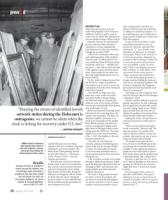
ABOVE: Dwight D. Eisenhower,
right, inspects stolen artwork in
a salt mine in Merkers, accompa-
nied by Gen. Omar Bradley, left,
and Gen. George S. Patton, center.
continued from page 10
NATIONAL ARCHIVES AND RECORDS/PUBLIC DOMAIN
jews d
in
the