

SHARI COHEN
It Doesn’t Have to Cost A Fortune . . .
jews in the d
Only Look Like It!
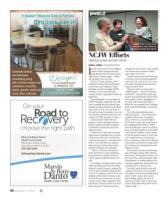
Jeannie Weiner, co-chair of Fall
Focus; Sharon Leider, NCJW vice
president; and speaker Dina Charnin
NCJW Efforts
Helping Israeli women thrive.
SHARI S. COHEN CONTRIBUTING WRITER
Complete kitchen
and bathroom
remodeling along
with furniture design and
installation including
quartz, granite, wood and
many other materials.
Designs
IN DECORATOR WOOD
& LAMINATES, LTD.
Marvin & Betty Danto
Health Care Center
6800 West Maple Road
West Bloomfield, MI 48322
248.788.5300
IChoseHeartland.com
40
December 6 • 2018
jn
248.851.6989
Lois Haron, Allied Member ASID
I
sraeli women have diverse religious
beliefs, ethnic backgrounds and
educational levels, but they increas-
ingly share a common goal — achiev-
ing a greater voice in society.
Dina B. Charnin, director of the
National Council of Jewish Women’s
Israel Policy and Programs, visited
Michigan recently to update NCJW
members on the status of Israeli
women and the organization’s efforts to
help them.
Susan Rollinger, a vice president of
NCJW Michigan, explained at its Fall
Focus meeting that the national orga-
nization has been involved in Israel for
more than 70 of its 125-year history.
She said an Israel Committee was creat-
ed recently to introduce the local com-
munity to NCJW activities in Israel.
Charnin leads NCJW efforts to
empower women and girls, advance
gender equality, and help strengthen
civil liberties, democracy and peace
efforts in Israel.
While many Israeli women increas-
ingly seek an expanded role in society,
Charnin says they don’t use the term
“women’s movement” to describe their
efforts. They find the term inappro-
priate because of their diverse back-
grounds and goals, she explained.
“There is a MeToo movement in
Israel and there are many challenges
facing Israel from inside. We have a
role to support Israeli feminists,” she
said.
According to Charnin, Israel women
make up 28 percent of the elected leg-
islators in Israel’s Knesset, compared to
21 to 22 percent female representation
in the U.S. Congress, prior to the recent
midterm election here. During recent
local elections in Israel, twice as many
women ran for office compared to the
last election. Eleven women won local
office among 257 electoral contests,
compared to five in 2013. This includes
one woman who overthrew Haifa’s
male mayor of 15 years.
“Israeli women earn only 68 percent
as much as men and many people live
in poverty,” she said. In the U.S., wom-
en’s salaries average 80 percent of the
wages earned by men.
Charnin cited a current trend of
“religionization — the rise of extreme
Orthodoxy” in Israel that is affecting
society and constricting women’s roles.
For example, “there is segregation in
the army with women-free bases,”
which she says resulted from “making
deals to get the Orthodox to enter the
Army.”
Two Orthodox political parties —
Shas and Agudat — have bylaws that
prohibit women from running for
office. However, a recent lawsuit by
the Women Lawyers for Social Justice
has challenged those bylaws. While
the Israeli Supreme Court has ruled in
favor of women’s right to run for office,
one Orthodox rabbinic council stated
it will not permit women to run in any
case. Despite barriers, Charnin says
there is feminism within the Orthodox
community and funds are being invest-
ed to enhance the educational level of
religious women.
Some Israeli women are promoting
peace through a group called Women
Wage Peace, formed after the 2014 con-
flict with Gaza, which promotes “polit-
ical solutions, no violent solutions and
advocates negotiation should always be
considered first,” Charnin said.
Recently, Israeli feminists met with
a group of American women leaders
and funders to discuss potential shared
goals. “Israeli women who want to
make change support the work of
American women. They welcome alli-
ances to help them lift up their voices,”
Charnin said. ■