

Jewish Contributions to Humanity
# in a series
food to the Jewish needy in Warsaw.
However, during his visit to Yad Ezra,
he said he has much to learn about
creating a system.
“I knew I had a lot to learn and Yad
Ezra could teach me,” said Schudrich.
“It is amazing the system and organi-
zation they have developed to identify
the poor, how to locate sources of
food and how to coordinate volun-
teers. We have no such system in
place yet, and that was why I thought
this visit to Detroit was so essential to
my efforts back in Warsaw.”
During the visit, he explained that
Holocaust survivors live on about
$400-$500 per month, not nearly
enough money to cover living, health-
care and food expenses. There is also
a need to help about 45 remaining
Righteous Gentiles as well as Jewish
disabled, plus provide an educational
resource to those recently uncovering
their Judaism.
Luger said Schudrich will be
working in small steps. The Warsaw
food pantry will not resemble what
Yad Ezra has evolved into its current
state — a food distribution center that
provides an average of 1,300 families
(almost 3,000 individuals) with food,
health care items and household
goods every month.
It will most likely resemble the
organization’s humble beginnings in
1990.
Back then, it indeed was a food
pantry and office operating in a
basement at 10 Mile and Greenfield
with the purpose of providing kosher
food to vulnerable Jewish families in
Southeast Michigan. In its beginnings,
Yad Ezra served an average of 250
families every month.
The founders of Yad Ezra learned
that there were impoverished Jews
living in the community who relied
heavily on government assistance pro-
grams, including food stamps.
Now in its third location, Yad Ezra
operates out of a 16,000-square-foot
facility on 11 Mile in Berkeley and has
been there since 2001. It has robust
volunteer programing and offers edu-
cational and Jewish cultural program-
ming as well in its warehouse and
greenhouse spaces. In recent years,
Yad Ezra, along with Bais Chabad
of West Bloomfield, sent a truck of
with thousands of pounds of food to
Houston after Hurricane Harvey and
helped food pantries in Ann Arbor,
Inkster and Flint. Yad Ezra also pro-
vides resources to JARC and Kadima
homes as well as food assistance to
1,000 children in Jewish day schools
in Metro Detroit.
Luger said Schudrich will need to
get the green light from local Warsaw
authorities as well as lay leadership
in the local Jewish community to
make the Polish food pantry happen.
What Yad Ezra can do, in addition
to putting out a call for funds on its
website, is to continue consulting with
Schudrich on Yad Ezra’s best practices
on how to grow a sustainable food
distribution operation.
This includes identifying clients and
their individual needs, establishing a
point system to determine fair allot-
ments, identifying the supplies and
equipment needs, such as shelving,
sources of food, creating job descrip-
tions and how to recruit professional
and lay leaders and volunteers.
Luger said that Schudrich will have
a way to go — including establishing
a board working with local author-
ities and raising the funds to evolve
the project to the level Yad Ezra no
enjoys.
“Many small details go into run-
ning a food pantry, and the Yad Ezra
board and I are more than happy to
provide best practices advice and help
raise funds to see this project come to
fruition,” Luger said. “This project fits
our compassionate vision in helping
Jewish families and individuals in
need, here and on a global capacity.”
Upon his return to Poland,
Schudrich wrote Yad Ezra a thank-
you letter that appeared in the journal
for this year’s fundraising dinner.
He wrote of the demonstrated pride
and dedication of Yad Ezra’s staff and
volunteers and was inspired to take
what he learned in Detroit and bring
it back to Warsaw.
“One of my important responsibil-
ities is to connect people to Judaism,”
Schudrich wrote. “If we are teaching
young and old about Kashrut, we
must have kosher food available, even
for those who can’t afford it … We
have a large task, at hand, and your
mentoring and assistance has opened
our eyes to all that can be accom-
plished.” ■
Yad Ezra has dedicated a web page
for donations that will go specifical-
ly to the development of the food
pantry in Warsaw at www.yadezra.
org/helping-hand-of-warsaw.
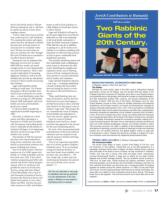
Two Rabbinic
Giants of the
20th Century.
Menachem Mendel Schneerson
Yisrael Meir Lau
MENACHEM MENDEL SCHNEERSON (1902-1994).
b. Mykolaiv, Ukraine. d. New York, New York.
The Rebbe.
Perhaps the most prolific rabbi of the 20th century, Menachem Mendel
Schneerson, known as the Rebbe, was the seventh and final leader of the
Chabad-Lubavitch movement of Chassidic Jews. Born in the Russian Empire,
young Mendel was a child prodigy who became a master of Jewish philosophy,
and also extensively studied math, physics, and secular philosophy at the
University of Berlin. With the rise of the Nazis, Schneerson and his wife,
Chaya Mushka, moved to Paris, where he studied mechanics and electrical
engineering. As the Nazis moved in on France, the Schneersons managed to
escape, eventually reaching New York in 1941. There, Schneerson volunteered
at the Brooklyn Navy Yard to assist the American war effort and, a decade later,
reluctantly inherited the leadership of the Chabad movement from his father-
in-law. At the time, Chabad was small, insular, and reeling after the Holocaust
from widespread decimation at the hands of the Nazis. During his four decades
running Chabad, Schneerson spread the movement outwards, helping turn a
small movement based in Brooklyn into an international outreach powerhouse
with over 3,000 Chabad synagogues, schools, and campus centers in nearly
100 countries and every U.S. state. In addition to the hundreds of volumes of
Schneerson’s teachings, and the hundreds of meetings he held with influential
(Jewish and non-Jewish) American and global leaders, thanks in large part
to Schneerson’s vision, Chabad has served as a bridge to Judaism for many
non-Orthodox Jews who eschew the traditional denominational titles.
YISRAEL MEIR LAU (1937-). b. Piotrkow Trybunalski, Poland.
The Consensus Rabbi.
The former Chief Rabbi of Israel, current Chief Rabbi of Tel Aviv, and
the Chairman of Yad Vashem, Yisrael Meir Lau is the 38th generation in a
reportedly unbroken family chain of rabbis. His father, Moshe Chaim, was the
last chief rabbi of the family’s town in Poland. He was murdered in Treblinka.
Yisrael, who was only a young child when the Nazis came, miraculously
survived Buchenwald thanks in large part to efforts by his older brother
Naphtali and another teenage prisoner. The Lau brothers moved to Israel in
1945 and, 16 years later, Yisrael received his rabbinic ordination. Over the
following decades, Lau first became the Chief Rabbi of Netanya, and then Tel
Aviv, and then all of Israel. Lau was known as a “consensus rabbi” for holding
appeals for Israelis across the Jewish spectrum. In 1993, he met with Pope
John Paul II, the first meeting between the Pope and an Israeli Chief Rabbi. Six
years later, Lau called for more cooperation among Jews, saying, “We always
knew how to die together. The time has come for us to know also how to live
together.”
Original Research by Walter L. Field Sponsored by Irwin S. Field Written by Jared Sichel
jn
December 6 • 2018
17