

views
commentary
continued from page 8
Taking the
Next Step
Howard Lupovitch, Adam Weiner and Jonathan Neumann
O
n Sunday, Nov. 18, the
Michigan Jewish Action
Council, along with
the Cohn-Haddow Center for
Judaic Studies at Wayne State
University, pre-
sented “The
Jewish Right-Left
Divide: Can We
Bridge the Gap?”
This dialogue was
the first step in a
process to bring
Dorene
rapport to the
Weisberg
Jewish commu-
nity.
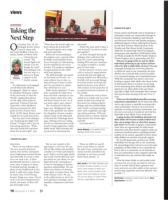
An enthusiastic and engaged
crowd filled Adat Shalom
Synagogue’s chapel to capaci-
ty. Jonathan Neumann, author
of the new book To Heal the
World?, explained positions
on the right of the political
spectrum. Professor Howard
Lupovitch, Cohn-Haddow’s
director, presented the left’s
point of view. Former Navy
SEAL LCDR Adam Weiner mod-
erated the two-part discussion.
The first part of the dialogue
was “Exploring the Right-Left
Divide.” It began with a pair of
interesting questions: “What
does the Jewish left not know
about the Jewish right?” and
“What does the Jewish right not
know about the Jewish left?”
The participants were conge-
nial and respectful.
Before the second dialogue,
the audience saw a special video
by Rabbi Lord Jonathan Sacks,
Seven Principles for Maintaining
Jewish Peoplehood, lest we be
divided. The audience displayed
its appreciation for the video
with loud applause.
The fifth principle was based
on the Book of Proverbs: “As
water reflects face to face, so
does the heart of man to man”
and “As you behave to others,
they will behave to you.”
Rabbi Sacks explained, “If you
show contempt for other Jews,
they will show contempt to you.
If you respect other Jews, they
will show respect to you. So, if
you seek respect, give respect.”
The second part of the dia-
logue was “Bridging the Gap.”
One of the questions was about
the altogether divisive condem-
nations made in the aftermath
of the horrific Pittsburgh shoot-
ings, vilifying and even calling
for the ex-communication of all
Jewish Trump supporters. Sadly,
Rabbi Sacks’ fifth principle did
not prevail in discussing the
aftermath.
What’s the next step? Is there a
way forward? Can the two sides
get together?
An issue emerged during the
dialogue that could form the
basis for a joint undertaking:
Ending BDS and anti-Semitism
on campus would be a worthy
goal for both sides.
On the internet, we have seen
calls to action by organizations
on both the left and right pro-
testing Airbnb’s new BDS policy.
(Airbnb will not accept listings
by Jewish renters in Israel’s dis-
puted territories, even while it
will continue to list properties in
occupied territories elsewhere in
the world).
The community-wide actions
called for in emails and on social
media include boycotting the
boycotters by ending property
listings and user memberships
with Airbnb, writing/emailing
them with complaints and sign-
ing online petitions. Will joint
protests lead to a better relation-
ship between the Jewish right
and left?
Let’s find out! ■
But we can commit to dis-
agreeing in a civil way. We can
still act like adults and carefully
consider our words and tempera-
ment. Before we hurl ugly insults
that could irretrievably hurt peo-
ple whom we care about, we can
think about the consequences
of forever damaging or destroy-
ing those relationships. We can
think twice before we demean,
taunt, gloat or shame those who
hold contrary views. We can,
as the rabbis teach us, strive for
more pleasant exchanges, more
empathy, compassion and listen-
ing.
Those are skills we can all
learn to get better at, and for
the sake of our community, our
nation and the cherished rela-
tionships in our lives, we had
better learn quickly. ■
Dorene Weisberg is co-president of the
Michigan Jewish Action Council.
continued from page 6
than done.
These are not ordinary times.
We are a severely fractured
nation. Our Jewish community
faces frightening external threats
and internally we aren’t as unit-
ed as we need to be. A bitter
presidential election is only two
years away, Congress is sharp-
ly divided and any thought of
peace in the Middle East at this
point is sadly just a pipe dream.
In many ways, if we’re being
honest, things are a mess. We are
in for a lot more disagreements
ahead, and many of them will
get downright nasty.
10
December 6 • 2018
jn
Mark Jacobs is the AIPAC Michigan chair
for African American Outreach, a co-di-
rector of the Coalition for Black and
Jewish Unity, a board member of the
Jewish Community Relations Council-
AJC and the director of Jewish Family
Service’s Legal Referral Committee.
Jewish content and friendly visits to hundreds of
individuals outside our communities through its
Jewish Community Chaplaincy and Outreach
and Holocaust Survivors and Families programs,
additional support to those suffering from demen-
tia and other memory-related processes at the
Dorothy and Peter Brown Jewish Community
Adult Day (in partnership with JVS) programs,
and prepares and subsidizes 22,000 kosher Meals
on Wheels annually for NCJW’s Kosher Meals on
Wheels Program (also in partnership with JFS).
Who are we going to hire to care for all the
individuals preferring to age in place and how
will we be able to afford their services? Although
congregate housing may not be the preference
or option for many in our community, the most
efficient way to provide daily care for our elders
is in communal settings, not in individual homes.
While the community may need to raise more
funding to support older adults who choose to live
in their homes, there is no reason we can imag-
ine for eliminating these efficient and affordable
options for our older adults in the near future,
especially in light of the anticipated silver tsunami
that may hit senior housing in the next 10 to 15
years.
Where are the identified naturally occurring
retirement communities? The JN states that elders
wish to age in place in naturally occurring retire-
ment communities. We know of very few local
naturally occurring retirement communities, and
the ones we are aware of would not serve the less
financially secure elderly of our community.
Is aging in place the healthiest alternative for
older adults who become socially isolated once
they can no longer drive or when their spouses
pass away? The benefits of aging in communities
where there are opportunities for daily human
interaction with others beside caregivers make our
residences beneficial options combating harmful
isolation of our seniors, especially for those whose
adult children are not there to provide support.
JSL has 869 apartments, and there are 18,000
individuals over the age of 65 in our community.
JSL acknowledges that it will never serve the entire
population of older adults in our community, far
from it. But as a community, we are fortunate to
have six communities on two campuses where life
is celebrated every day with the older adults we
serve.
What the future holds we can’t predict with
accuracy, but you can be sure that we will con-
tinue to wrestle with all these questions and
more and serve our older adults in the warmest,
most loving, supportive and most efficient ways
possible. ■
Kenneth Goss is president of Jewish Senior Life and Nancy
Siegel Heinrich is the CEO.