

PHOTOS COURTESY CORE INSTITUTE
jews
d
health
in
the
Regenerative
Answers?
The pros and cons of
easing joint damage with
injections of your own fat.
JOYCE WISWELL CONTRIBUTING WRITER
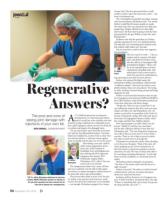
TOP: Dr. Jeffrey Michaelson withdraws fat cells from
a patient. ABOVE: Michaelson prepares an injection of
fat cells after impurities have been removed; the fat
cells will be injected into a damaged joint.
54
November 29 • 2018
jn
A
t 75, Judith Jacobson has no interest in
slowing down. So, when knee pain threat-
ened to curtail her active schedule, she took
action by trying a relatively new orthopedic proce-
dure called Lipogems, which uses her own body fat
to cushion and support her damaged joints.
“I’m an avid traveler, and I don’t like to be limit-
ed,” said the West Bloomfield resident. “Gel shots
helped me initially, but, as time went on, they were
less and less effective. I will need a knee replace-
ment eventually, but this buys me two to five years.”
After taking a year and a half to
study various regenerative proce-
dures, the CORE Institute in
Southfield, Novi and Brighton has
been offering the FDA-approved
Lipogems since January 2017.
Orthopedic surgeon Jeffrey
Dr. Jeffrey
Michaelson, M.D., calls it “just one
Michaelson
more tool in our tool kit.”
The Lipogems procedure (not a stem cell ther-
apy) uses a patient’s own fat cells to help repair,
reconstruct or replace damaged or injured tissue in
the joints like knees, hips and shoulders.
The process takes about an hour. First, the doc-
tor makes a tiny puncture and removes a small
section of fat from the midsection or love handles
— not enough, Michaelson quipped, for a bonus
tummy tuck. The fat is processed, then a small
needle is used to inject the tissue into a joint — the
knee, in Jacobson’s case.
The “remarkably not painful” procedure requires
only local anesthesia, Michaelson said. “You would
think it would [hurt] because people are awake
the whole time, but I am amazed at how little pain
people have. People will feel sore in their belly
afterward; I tell them they’re going to feel like they
got punched in the gut. Within a week, they start
feeling better.”
Jacobson, who had the procedure in October,
said she experienced “very, very mild discomfort.
My belly had a lot of bruising and it looked awful,
but it didn’t really bother me,” she said.
But not everyone is sold on these new regenera-
tive procedures.
“All of us want it to work — I do as a
surgeon and as a person with joint
pain,” said Robert B. Kohen, M.D.,
who has offices in Farmington Hills
and Madison Heights. “There is lit-
tle, if any, standard peer-reviewed,
randomized controlled trials. I get
Dr. Robert
asked about it half a dozen times a
Kohen
week. We need to be careful discuss-
ing expectations and what has been proven.”
Kohen, who stressed his high respect for
Michaelson’s abilities and integrity, called himself
“a midterm adopter” who’s just not ready to com-
pletely embrace these new procedures. “I’m trying
to strike a balance between being excited and being
skeptical,” he said.
Kohen is concerned that insurance does not pay
for it; Lipogems costs between $4,000 and $6,000 at
the CORE Institute, which Michaelson pointed out
is less than what stem cell clinics charge.
“People ask, ‘Why are you so much less?’ I am
not making my living on this; this is just one more
thing I can offer you,” said Michaelson, who vol-
unteers as executive vice president of the Fresh Air
Society of Tamarack Camps. (His wife, Jodi, sits on
the board of Congregation Shaarey Zedek, which
the couple and their four children attend.)
How long Lipogems can offer relief is not yet
known. “Ideally it would be ‘once and done,’
but the data collection still has to bear that out,”
Michaelson said. “The nice thing about using your
own cells is that you never have to worry about a
reaction. There is a lot of data to prove its safety,
but what we don’t know is its longevity.”
Michaelson recommends caution when deciding
to try these new therapies. “Most of the stem cell
clinics popping up are run by chiropractors, so
they hire nurses or physician assistants to do the
injections,” he said. “Be wary of clinics that offer it
for everything, including Parkinson’s.” It can’t help
bone-on-bone conditions or a destroyed joint, he
added.
Michaelson advises asking lots of questions,
“The days of ‘the doctor said it and the doctor is
right’ are gone.”
Kohen concurred. “My advice is to find a board-
certified doctor and have an honest discussion
about your expected outcomes.”
Jacobson said her decision to try Lipogems was
easy. “I think of it like a mechanical issue,” she said.
“If there is something that can be done, let’s go into
the shop and take care of it.” ■