

COURTESY LEONARD N. SIMONS JEWISH COMMUNITY ARCHIVES.
Looking Back
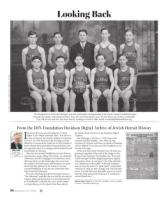
The champions! In 1929, the Olympics won the intermediate championship of the Jewish Center’s basketball league,
winning nine games and losing just three. Here, the victorious players pose. Do you know any of these champions?
If so, tell us who and how you know him by sending an email to Mike Smith at msmith@djnfoundation.org.
From the DJN Foundation Davidson Digital Archive of Jewish Detroit History
I
Mike Smith
Detroit Jewish
News Foundation
Archivist
74
t has been 80 years since Kristallnacht, “Crystal
Night” or the “Night of Broken Glass.” This refers to
a wave of extreme anti-Semitic violence in Germany
on Nov. 9-10, 1938. Because of the shooting of a Nazi
official by a German-born Polish Jew in Paris, hordes of
brown-shirted Nazi paramilitary troops and their civil-
ian supporters went on a rampage and devastated Jewish
communities in Germany.
They beat and arrested 30,000 Jews and sent them to
concentration camps, killing 100 of them. An estimated
7,000 stores and 267 synagogues were destroyed. And,
afterward, there was the broken glass that came from
the windows of Jewish homes and businesses, so many
shards that they glittered in the streets. It was later
coined Kristallnacht. It was also one of the first major
steps toward the Holocaust.
Of course, the Holocaust did not become known as
“The Holocaust” until after the war; and the two days of
violence, death and destruction was not characterized
as “Kristallnacht” until after the event. In this respect,
it is interesting to see the reports from those days in
November 22 • 2018
jn
the Detroit Jewish Chronicle in the Davidson Digital
Archives.
The front page of the Nov 11, 1938, issue of the
Chronicle had this headline: “New Wave of Anti-
Semitism in Germany and France as Result of Shooting
of Nazi Official.” It was just one of five headlines across
the top of the page.
In the next issue of the Chronicle, Nov. 18, there was
growing recognition of the scale of the danger to Jews
living in Nazi Germany. The headline was: “Roosevelt
Leads Outraged World in Registering Protest Against
Persecution of Jews in Germany.” One of the editorials
was: “Barbarism in the Saddle.” It decried Germany’s
descent from the status of a “great nation” and pleaded
with Jews to “keep up their courage” and “not lose their
nerve.” It would take more than faith and nerve to beat
back the Nazis and end the Holocaust. It would take a
second World War. ■
Want to learn more? Go to the DJN Foundation archives, available
for free at www.djnfoundation.org.