

jews in the d
SCAN THIS PAGE
FOR A LIST OF THE
BALLMER GRANTS.
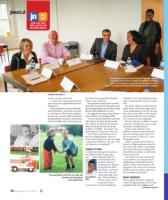
Philanthropists Connie and Steve Ballmer, left, talk with a group of
organization representatives including Jeff Edmonson and Katrina
McCree at the Commons, a coffee shop and coin laundry in Detroit.
Ballmer Group Detroit Executive Director Kylee Mitchell Wells is standing.
continued from page 12
say the city has come back.
As a kid, Steve says Detroit was far
more about the neighborhoods than
Downtown.
“My grandfather lived on Wabash
and Grand River. My mom was born
on 12th Street. Those were neighbor-
hoods; they weren’t really Downtown.
My grandfather moved to McNichols
near Greenfield. My cousins grew up
The young Ballmer in Oak Park: As a baby, with
his sister and in his firetruck
in the neighborhood.
on Outer Drive near Sinai Hospital.
That, to me, is Detroit.”
The question becomes how to think
about the renewal of Detroit given such
great things happening and some things
that are still problematic, he says.
He suggests driving up Grand River
from Detroit to Farmington Hills.
“You see all the important work that
still needs to be done for the people
who still live in Detroit,” he says and
takes out his phone to look up the
number: “673,000.” The mayor’s pro-
grams help 10-15 percent of the city.
Steve hopes reinvestment moves
into the neighborhoods, closer to
where most people live, and can make
a substantial difference. He says, “The
city deserves to comeback.”
COMING TO TOWN
To help determine grant recipients,
the Ballmers hired “local exper-
tise” — Kylee Mitchell Wells, 39,
of Southfield. She is
executive director,
working at the Ballmer
Group Detroit office
Downtown. A Detroit
native who “left and
came back eight years
Kylee Mitchell ago,” Wells worked in
Wells
several sectors, from
corporate finance
in Germany to Detroit’s Regional
Chamber, to the city during the bank-
ruptcy and nonprofit work at United
Way.
Her family still lives in their Detroit
family home, and she leveraged many
of her relationships in the city, she says,
from the mayor’s office to the commu-
nity, to learn effective ways of giving
out “resources of this magnitude.”
But the only way to address massive
economic mobility, she says, is neigh-
borhood by neighborhood.
Wells is also involved in the
Ballmers’ national leadership team
that sets strategic goals and priori-
ties for Detroit as well as L.A. and
Washington state.
Wells, a national urban fellow at
Baruch College’s graduate school in
New York and a fellow at Michigan
State University, says working with
the Ballmers has been “a whirlwind
and so much fun!”
One of the areas she introduced
to the Ballmers was the poverty in
neighboring suburbs like Warren,
Inkster, Pontiac and Dearborn. It’s
important, she says, to see common
problems and to explore opportuni-
ties throughout the region.
GRANT AWARDEES
Steve explains the three categories
of their inaugural grants: first, strong
nonprofits that serve children and
continued on page 16
14
November 22 • 2018
jn