

views
essay
Would My Grandfather Be
Allowed into the U.S. Today?
Would Yours?
A
bout a century ago, my grand-
father Morris Tobocman immi-
grated to Detroit from Poland
to pursue the American Dream. He had
almost no formal education, arrived
penniless and knew no English. Like so
many immigrants, he worked with his
hands (originally as a tinsmith) and did
well enough to put two
sons through architecture
school at the University
of Michigan.
It’s an American story
shared by tens of millions
of American families,
and it’s a story essential to
Steve
our nation’s and region’s
Tobocman
character and future.
Unfortunately, under new immigration
rules that the Trump administration
announced last month, that story may
no longer be possible and, as a result,
Detroit’s and Michigan’s economic future
lay in jeopardy.
The draft regulation would drastical-
ly change the rules governing “public
charge,” an existing, but extremely rare,
portion of immigration law that allows
immigration officials to reject legal
immigrants’ visa and green card applica-
tions for those who are unable to estab-
lish self-sufficiency.
The current “public charge” definition
is so narrow that the government almost
never rejects applications on those
grounds. The Trump administration’s
proposed expansion of the definition
would explicitly authorize immigration
officials to withhold green cards from
applicants who use any number of gov-
ernment aid programs to which they
are legally entitled (albeit on a restricted
basis), including food assistance, health
care and housing vouchers.
The proposed regulation allows offi-
cials to reject visa applications from
new immigrants because they believe an
immigrant might conceivably use one of
those government supports in the future.
Many observers believe the proposed
rule is an end run around the Congress
to vastly reduce legal immigration. The
8
November 8 • 2018
jn
Trump administration has indicated its
support for proposed legislation to halve
the number of legal immigrants allowed
into the U.S. — a reduction of approxi-
mately 500,000 new entrants per year.
The “public charge” proposal raises
serious questions about our national
character. Facts debunk the myth that
U.S. social service programs are over-
burdened by immigrants or that immi-
grants only come to the U.S. to live off
the generous social safety net. Already a
large number of social service programs
are out of reach of legal immigrants until
they have resided in the U.S. for five
years, while undocumented immigrants
are barred from almost any form of pub-
lic support.
In Michigan, according to the
Migration Policy Institute, immigrants
comprised 7 percent of the recipients
of welfare, Supplemental Security
Income (SSI), food stamps, Medicaid
or the Children’s Health Insurance
Program between 2014-2016 — an
amount roughly equal to their share of
Michigan’s population.
In Detroit, according to U.S. Census
data, immigrants are more likely to live
in poverty, more likely to be working
and less likely to receive any form of
public assistance. Forcing hard-working
immigrant families, who are a backbone
to numerous American industries, to
choose between receiving food stamps,
health care or affordable housing and
attaining a green card is a slap in the
face to the inscription at the base of
the Statue of Liberty and detracts from
President Reagan’s vision of an America
that “is a shining city upon a hill whose
beacon light guides freedom-loving peo-
ple everywhere.” It reflects a meanness
and me-first attitude that tarnishes our
history as a generous nation.
Make no mistake that a vastly expand-
ed “public charge” test would be used to
drastically reduce legal migration. Ask
any practicing immigration lawyer in
America today about how the Trump
administration is already aggressively
rejecting legal visa applications of immi-
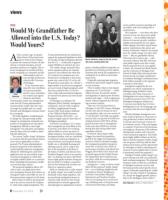
Morris Tobocman, seated on the left, and his
wife, Anna, standing behind him
grants, including skilled immigrants, on
grounds never tried by previous admin-
istrations that stretch the imagination of
existing law in an effort to turn immi-
grants away.
Drastically reducing legal migration
would have particularly negative impacts
on our economy.
There is ample evidence from Japan’s
experience of a “Lost Decade” — which
reflects 20 years of economic decline
and stagnation in Japan’s gross domestic
product and wages — that an aging pop-
ulation without migration has devastat-
ing economic impacts.
These are very real issues here in
Michigan. In the 2010 Census, Michigan
was the only state in America to have
lost population, after our own version of
a “Lost Decade.” And while our popula-
tion has had a net growth of 45,000 new
residents between 2010-2015, all that
growth has been due to immigration
(with more than 64,000 new arrivals
during that time having offset other
population decline).
In Detroit, where Mayor Mike
Duggan has stated that population
growth is the single most important
metric by which he should be judged,
the immigrant population has grown
more than 15 percent since 2010 (in
part because of policies and efforts that
Duggan, the Detroit City Council and
nonprofit agencies like Global Detroit,
the organization that I lead, have put
into play), while the overall population
has declined 5 percent.
Immigrants — many of whom would
likely fail the proposed “public charge”
test — are revitalizing neighborhoods
in Southwest Detroit, Banglatown,
and other communities along the
Hamtramck and Dearborn borders.
They are occupying once-vacant hous-
ing, rehabbing units, reviving dormant
commercial retail strips, providing
much-needed consumer spending and
tax dollars, and even creating jobs as
entrepreneurs.
New migrants — even those who have
received or may one day receive public
assistance — are incredibly important
drivers of economic growth, workforce
stability and prosperity for our region.
While refugees (and other special immi-
gration classifications like asylees and
victims of domestic violence) are exempt
from the “public charge” test, they often
arrive — like my grandfather Morris
Tobocman did a century ago — with-
out much evidence that they will never
need public support and, thus, would
fail the proposed test if it were applied
to them. Yet, research by Global Detroit
and the University of Michigan Ford
School of Public Policy documents that
the last decade of refugee resettlement
in Southeast Michigan contributed some
$250 million annually to the regional
economy in 2016 alone.
Immigrants targeted by the new
regulation are critical components to
Michigan’s aging workforce needs.
Currently, more than 16 percent of
Michiganders are senior citizens, near-
ly double the portion from 1970. Yet,
Michigan’s immigrant residents are
27 percent more likely than U.S-born
Michiganders to be of working age, not
to mention that they have higher birth
rates.
Already Michigan immigrants com-
prise nearly 20 percent to 30 percent of
crop production workers and between
15 percent and 25 percent of many ser-
vice industry sectors. (They also happen
to comprise 30 percent of the physicians
and surgeons, 28 percent of the software
development workers and 22 percent
of the mechanical engineers. And while
those highly skilled workers are far less
likely to fail the proposed “public charge”
test, the green cards they seek for their
relatives back home and the opportunity
for Michigan to build a welcoming envi-
ronment to attract global talent is severe-
ly threatened under this proposal.)
President Trump’s “public charge” pro-
posal will keep out, kick out and punish
hard-working immigrants. The proposal
threatens much of what has contributed
to Michigan economic recovery and
the future growth and prosperity of our
region. Drastically expanding the “public
charge” not only is harsh to immigrants,
it’s a recipe for sluggish growth, particu-
larly to the Michigans of the world. ■
Steve Tobocman is director of Global Detroit.