

jews in the d
Jewish Contributions to Humanity
# in a series
JERRY ZOLYNSKY
Two Jews Who
Stepped Up
To The Plate.
ings, which last about six hours and
attract between 15 and 25 teachers
each session.
When Mayerfeld suggested a goal
of training 1,000 teachers, Constant
initially thought the CEO meant in
one year, not three, as he intended.
“Since April 27, we’ve made great
progress in a short time,” Constant
said. “We are ahead of schedule;
we’re now on track to teach 500
teachers by the end of this year.
“Many districts are not very
diverse, and lots of teachers are very
excited to use this knowledge and
curriculum to educate their students
about more diverse beliefs.”
Training has gone so well that the
team now is offering Level 2 training
for teachers who want to go deeper
into the material. The first session
was held Oct. 25 at the HMC. Staff
members also are excited about
creating an online community of
Holocaust educators across the state.
TOUR MODIFICATIONS
For years, docent-led tours at the
Holocaust Memorial Center, whether
for students or regular visitors, have
been based on a script and a format.
Docents, who must prove they have
mastered the material before leading
tours, moved their groups chrono-
logically through the museum and
end with a talk by a local Holocaust
survivor. Annually, that means
65,000 individuals.
Much of the training had been
driven by a docent advisory commit-
tee. But with the approval of PA 170
and the increase in student tours,
changes have come for the HMC’s
stable of 70 docents.
“These professional volunteers are
so talented and so completely nec-
essary to our existence,” said Sarah
LINKEDIN
Sophie Klisman, Gita Greisdorf, Rae Nachbar, Esther Lupyan, George Erdstein and Paula Marks-
Bolton are among local Holocaust survivors who speak to tour groups.
Saltzman, HMC director of events.
“We’re asking them to make a very
hard transition, but I believe the
docents will be very happy with the
tour changes and really
personally engaged and
on board.”
New training
emphasizes tours
that are thematic and
highly interactive,
Sarah
with docents asking
Saltzman
open-ended questions
to expand the personal experienc-
es of visitors. And, by following
themes, tours can start anywhere in
the museum by threading the theme
from gallery to gallery. For example,
two groups now can share one sur-
vivor’s talk — one at the end of their
tour, the other at the beginning.
“We have to remember Holocaust
education has evolved … and really
focus on the best practices,” Bergman
said. “So, there are always going to be
changes happening here.
“We have to think about things
differently. It will be the same core
values — those don’t change — but
the way we get them across will
change. How do we make that
impact? That’s part of our continual
growth.”
Axelrod added, “We are adamant
about our visitors not being passive
recipients of information. It’s only an
experience if they are involved. Being
theme-based encourages people to
think, and that’s central to what we’re
here for. We want to develop critical
thinkers who make ethical decisions
and then act on them.”
Docent Michael Leibson, 70, of
Southfield, says the transition is still
in progress; but, like most docents
interviewed, his tour already is inter-
active.
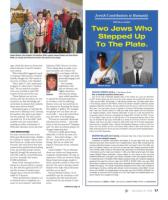
Shawn Green
Marvin Miller
SHAWN GREEN (1972-). b. Des Plaines, Illinois.
One of baseball’s greatest Jewish stars.
One of the most underrated baseball stars of the modern era, upon his retirement
in 2007, Shawn Green was one of only four active players with at least 300 home runs,
1,000 runs and RBIs, 400 doubles, a .280 batting average, and 150 stolen bases. Born
in the Chicago suburb of Des Plaines, Green was raised in Southern California, played
baseball at Stanford University, and was drafted in the first round in 1991 by the Toronto
Blue Jays. Two years later, he was a member of Toronto’s World Series championship
team. After two monster seasons in 1998 and 1999, Green signed with his hometown
Los Angeles Dodgers, where, between 2000-2002, he went on a tear that earned him
consecutive years in the top six vote-getters for league MVP. On Sept. 26, 2001, in honor
of Yom Kippur, Green sat out for the first time in 415 consecutive games. Also on that
day, he donated his day’s pay of $75,000 to a charity for survivors of the 9/11 terrorist
attacks. Less than a year later, on May 23, 2002, Green had one of the best single-game
performances in baseball history. Playing the Milwaukee Brewers, he had six hits, four
home runs, one double, and six runs scored. Green retired in 2007 with the New York
Mets, finishing second in home runs and runs batted in among all Jewish baseball players,
behind only Hank Greenberg.
MARVIN MILLER (1917-2012). b. Brooklyn, New York. d. New York, New York.
A savior for baseball’s players.
Considered by baseball commentator Red Barber to be (with Babe Ruth and Jackie
Robinson) among the most important men in baseball history, Marvin Miller revolutionized the
business relationship between owners and players. Born and raised in New York, Miller was,
due to his parents’ influence, pro-union from an early age. After studying economics at New
York University, Miller worked for the National War Labor Board, the International Association
of Machinists, and the United Auto Workers. In 1966, when Miller became head of the Major
League Baseball Players Association, owners wielded as much power as they had since
baseball’s earliest days. Free agency was virtually nonexistent, which meant players had little to
no bargaining power. Immediately, Miller initiated a gradual change with a collective bargaining
agreement that raised the minimum salary from $7,000 to $10,000. Within nine years, Miller
led the fight to abolish the reserve clause (which essentially bound players to their team) and
establish free agency. This change revolutionized baseball and every other major professional
sports league in America, creating parity between owners and players. During Miller’s 16-year
tenure at the MLBPA, the average player’s annual salary went from $19,000 to $326,000. His
knowledge of economics and his tenacity as a union head helped turn baseball players from
teams’ property into a valuable commodity.
Original Research by Walter L. Field Sponsored by Irwin S. Field Written by Jared Sichel
continued on page 18
jn
November 8 • 2018
17