

jews in the d
“We have to think about things diff erently.
It will be the same core values, but the
way we get them across will change.”
— RUTH BERGMAN
continued from page 14
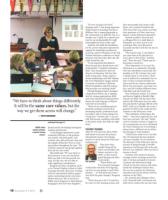
ABOVE: Robin
Axelrod conducts
a teacher training
session.
16
November 8 • 2018
jn
ducted and by developing training for
teachers and docents.
“A full-fledged department needs
somebody full time, so the position
was posted, with lofty goals,” said
Axelrod, who still works part-time and
has happily shifted her focus to train-
ing teachers throughout the state. “We
wanted a superstar and people applied
from all over the world.”
Mayerfeld said, “We were lucky to
find someone in our own backyard.
Ruth was able to hit the ground run-
ning. On day one, she was able to
make significant contributions.”
Bergman has been a longtime teach-
er for Detroit’s Melton School of Adult
Learning. Recently, she’s been working
with the international Melton organi-
zation, mentoring teachers and some
Melton directors. She is married to
Rabbi Aaron Bergman of Adat Shalom
Synagogue; they have four daughters.
“It’s very exciting to be here,”
Bergman said. “I was doing important
things before by teaching, but this is
different; this is impacting people in
the community in a different way, in a
broader way. I think it’s a natural next
step for me professionally. It’s really
meaningful and that’s really a gift.”
Axelrod, who built the foundation
for the current education department,
capped the leadership transition by
securing a spot for Bergman at the Yad
Vashem educators conference in Israel
this June, just three days after she offi-
cially started her job.
“It was important that Ruth be
there because they already know me,”
Axelrod said. “I wanted to introduce
Ruth. They should know she’s the
director of education. We have this
really strong and, I think, unprece-
dented relationship with Yad Vashem,
the Anti-Defamation League and the
University of Southern California
Shoah Foundation, and this partner-
ship provides our teaching model.”
Though Bergman hasn’t managed
a department before, she is tapping
into her strong organizations skills
and some educational administration
classes she took long ago at Hebrew
University in Jerusalem.
“Much of my consulting and pro-
fessional coaching work involves
developing leaders, professional and
lay leaders, and I’ve been doing it for
a long time,” Axelrod said. “I can say
with 100 percent confidence that Ruth
is the fastest study. Her skills are right
there.”
TEACHER TRAINING
After PA 170 went into effect, HMC
staff aimed to become the primary
educational resource for training
teachers to teach about the Holocaust
and genocide.
They knew they
couldn’t bring all the
state’s social studies and
history teachers to the
HMC, so they investi-
gated Skyping and other
social media.
Tim Constant
“When Robin and
Tim Constant [manager
of education research] were figuring
out how we were going to reach these
teachers … it’s that personal connec-
tion that’s the game changer,” Bergman
said.
“When they go to the U.P. and they
do a face-to-face training session, and
they meet people and connect with
them, we’ve created a bond for life.
They know they can contact us if they
have questions or if they want to go
deeper in their Holocaust education.”
Axelrod recalled a time she and
a colleague flew in a small plane to
Marquette in a fierce storm to do
a training. They were diverted to
Escanaba and then took the one taxi to
Marquette.
“One teacher said, ‘I can’t believe
you came here at all, plus the fact
you’re here in this storm,’” Axelrod
said. “Then she said, ‘Thank you for
knowing we need you.’
“How important is it to teach the
Holocaust to a community of people
who have absolutely no personal rela-
tionship to it? It’s a human story and
it all goes back to one person. There
were 6 million Jews murdered, but we
have to turn it around and help stu-
dents and all our visitors understand
that it was one person, one name, one
face, one life 6 million different times.
And that’s only the Jewish loss.”
Gina DeSimone teaches U.S. history
and honors English at Bendle High
School near Flint. She has been inter-
ested in the Holocaust since her early
20s and attends trainings offered at the
HMC. Early on at Bendle, she wrote a
grant for $1,500 so she could take her
students to the Holocaust center.
“The institution of learning is the
HMC — they have supported me, and
they have my back,” she said. “Robin
came to Genesee County in August to
do a training that was very well attend-
ed. These seminars are so enriching; I
always learn a different way to deliver
the message to reach students.
“I think there needs to be a law like
this. It’s important because students
can learn empathy. It’s not all about
the dark part of the Holocaust, but the
journey of going through a horrible
experience and having a life at the end
that you can celebrate. There are lots of
lessons to learn.”
Constant, who started in January,
arranges teacher trainings around the
state. A former principal at Crescent
Academy and Hamtramck High
School, he has the contacts and under-
stands the challenges teachers face.
He, too, has a passion for Holocaust
education and says he always took his
students to the HMC.
He, Axelrod and colleagues Aliza
Tick, Dunreith Kelly Lowenstein and
John Farris conduct the one-day train-