

health
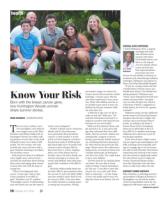
Seth, Jon, Brett, Lacey and Ellyn Davidson of
Huntington Woods, with their dog, Tessa
Know Your Risk
Born with the breast cancer gene,
two Huntington Woods women
share survivor stories.
ROBIN SCHWARTZ CONTRIBUTING WRITER
T
hey are wives, mothers, survi-
vors and fighters, each with her
own unique story to tell. Ellyn
Davidson and Melissa Mally, both of
Huntington Woods, live within walk-
ing distance of each other in the small
Oakland County city of about 6,200
people. The two women, who only
recently met, were each born with a
gene mutation indicating a hereditary
risk for breast cancer.
Both found out about it in different
ways, fought cancer and survived —
and both are passionate about sharing
their stories and urging other women
to know their risk, with the hope of
saving lives.
“When I was diagnosed with
cancer 11 years ago, I had no idea
I had a mutation in my BRCA2
gene,” Davidson, now 47, explains.
“Knowledge is power. Understanding
your risk means you can take steps to
avoid a cancer diagnosis.”
October is Breast Cancer Awareness
Month, and it’s clear that aware-
ness, particularly about hereditary
cancers, is sorely needed. A recent
article in Forbes Magazine revealed a
Pennsylvania study of 50,000 people
that found eight out of 10 people with
a known cancer risk gene did not
know they have it. Actress Angelina
Jolie is one of the famous faces of
heredity cancer; she had a double mas-
tectomy and surgery to remove her
ovaries and fallopian tubes after learn-
ing she had a mutation of the BRCA1
gene.
Like Jolie, Melissa Mally found out
she had a BRCA1 gene mutation when
she was just 25 years old. Sadly, Mally’s
aunt (her mother’s sister) died of ovar-
ian cancer in 2002. A few years later,
her mother decided to undergo genet-
ic testing and was positive. During
preventative surgery to remove her
ovaries, doctors discovered her mother
had Stage 1 ovarian cancer. She has
since been treated and is now cancer
free. That’s when Melissa and her sis-
ter decided to get tested. It turns out
Melissa has the gene mutation while
her sister does not.
“I didn’t let it take over my life or
make me feel sad,” Mally says. “We
took that information and used it to
empower ourselves and make the best
decisions for our own health.”
Mally met her husband, Shane, and
got married at 32. A year and a half
ago, they welcomed their first child,
Jonah. After he was born, Melissa was
meeting with a surgeon to discuss
having a preventative double mastecto-
my, something she’d been planning to
do, when doctors discovered she had
stage 1 breast cancer. She underwent a
lumpectomy, six rounds of chemo and
a double mastectomy, all during her
son’s first year of life. The couple hopes
to have more children.
“It’s been hard for us, thinking about
our future. We were able to freeze
embryos before I started chemothera-
py,” she says. “I was able to catch [the
cancer] very, very early and I think
that’s so important — to take charge
of your own health and be your own
advocate. Know your history. Get test-
ed.”
SURVIVAL RATES IMPROVING
S. David Nathanson, M.D., a surgical
oncologist and chair-
man of breast cancer
research with Henry
Ford Health System, says
there is a bit of good
news for patients. Breast
cancer survival rates
Dr. S. David
have
improved about 1
Nathanson
percent per year over
the last 30 years thanks to advances in
treatments and chemotherapy/radiation
techniques. Nathanson sees patients at
Henry Ford West Bloomfield Hospital.
“If you are a young woman who has
a family history of breast cancer, you
should know about it. You should start
asking questions,” Nathanson says.
“Genes can be inherited from both your
mother and your father. Any physi-
cian can order the gene test, which is
a blood test. If there’s a suggestion of
family history, it’s wise to see a genetic
counselor.”
Nathanson points out that Ashkenazi
Jewish women (of Central and Eastern
European descent) have a higher risk
of breast cancer just because they’re
Jewish. According to the Susan G.
Komen Breast Cancer Foundation,
about one in 400 people in the U.S.
has a BRCA1/2 mutation; but among
Ashkenazi Jews, about one in just 40
has the gene mutation.
Those who do have a higher cancer
risk are urged to get mammograms and
MRI screenings more frequently, start-
ing at a younger age, to try to increase
the odds of early detection. Preventative
mastectomy and removal of the ovaries
have been found to significantly reduce
the risk of breast cancer in high-risk
women. Hormonal therapy medica-
tions, like Tamoxifen, have also been
shown to effectively reduce the risk.
SURVIVOR TURNED ADVOCATE
Ellyn Davidson, a marketing executive
and president of Brogan & Partners in
Birmingham, was 36 and the mother
of three young children when she was
diagnosed with breast cancer in 2007.
continued on page 60
58
October 25 • 2018
jn