

arts&life exhibit
ALL IMAGES FROM THE COLLECTIONS OF THE HENRY FORD
Henry Ford
and the Jews
The Henry Ford hosts a fi rst-ever Jewish-themed
curator’s tour of its collection.
SUZANNE CHESSLER CONTRIBUTING WRITER
H
enry Ford’s public life of lumi-
nous invention and innovation
was darkened by issues of
anti-Semitism, but the museum that
carries his name holds and showcases
objects demonstrating momentous
accomplishments of the Jewish commu-
nity.
Both the anti-Semitism and the
accomplishments will be explored in an
afternoon program at the Henry Ford in
Dearborn. The event, “The Henry Ford:
Through a Jewish Lens,” was planned by
the Jewish Historical Society of Michigan
(JHSM), working with the museum over
two years.
The program starts with a talk by
Steven Watts, author of The People’s
Tycoon: Henry Ford and the American
Century, moves into a tour pointing
out continuing and pop-up displays of
Jewish-linked holdings, and concludes
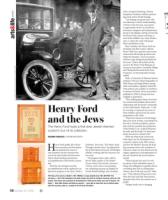
TOP: Henry Ford next to a Model T, 1921. MIDDLE: A recipe booklet from 1923. BOTTOM: This
secretary, c. 1720-1780, belonged to the Adler family, who lived in Frankfurt, Germany, since the 13th
century. Their home was ransacked on Kristallnacht in 1938 and the father was sent to Dachau. The
family — Ruth Adler Schnee and both her parents — were able to make their way to Detroit along
with this secretary, kept as a symbol of the life they left behind.
50
October 25 • 2018
jn
with a reception featuring a Detroit
Symphony Orchestra violinist perform-
ing music tied to Jewish heritage.
“I am hoping our guests leave with
two takeaways: a better understanding
of Henry Ford, the man, and a great-
er appreciation of Jews as Americans,
innovators, designers and entrepreneurs,
based on the displays and the stories that
the Henry Ford curators will share at
each of the exhibits,” says Anne Weiner,
who co-chairs the event with Jacqui
Elkus and Barbara Cohn.
Marc Greuther, the Henry Ford vice
president and chief curator, will join
Steven Watts for a question-and-answer
session that will include questions sub-
mitted by attendees. The tour portion
will have maps designed specifically for
the event. Tickets will include all-day
access to the Henry Ford Museum of
American Innovation, Greenfield Village
and “Rockwell, Roosevelt & the Four
Freedoms,” an internationally touring
exhibit.
Watts, a University of Missouri history
professor who has written biographies of
Walt Disney and Hugh Hefner among
other newsmakers, regularly visited the
Ford archives and complex in Dearborn
to advance his book, a four-year project
published in 2005 by Knopf and now
available in paperback.
“I’ll be talking about Henry Ford and
his controversial attitudes about and in
relationship with the Jewish community
in the United States,” Watts says. “I will
be covering, in a general way, some of
these problem aspects from his career,
particularly in the 1920s.
“There have been lots of Ford biogra-
phies, but most of them concentrated on
his role in American industry, particu-
larly with the assembly line production
of the Model T. I’m a cultural historian
by trade, and the books I’ve done have
always focused on cultural roles.”
While the Watts book reviews the
Ford impact on the development of a
consumer culture in the 20th century
and how the Model T became the lead-
ing consumer item in the evolution of
American values, he also delved into the
origins, significance and implications of
the anti-Semitism the tycoon demon-
strated.
“What separates the men I’ve writ-
ten about is their individual vision of
things and willingness to gamble almost
everything they had on making their
visions come to life and succeed,” Watts
says. “They believed 100 percent in the
ideas they had, and that characteristic
separates them from the normal run of
people.
“Despite Ford’s role in changing