
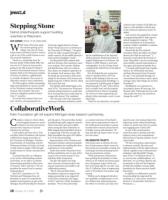

COURTESY TONY PAN
jews in the d
Tony Pan in a
research lab at
the Weizmann
Institute this
past summer
Stepping Stone
Detroit philanthropists support budding
scientists at Weizmann.
KATE SCHMIER SPECIAL TO THE JEWISH NEWS
W
hile many of his peers spent
the summer gearing up for
college, Tony Pan of Grosse
Pointe Farms traveled to Israel to work in
a lab at one of the world’s foremost scien-
tific research institutions.
Thanks to a scholarship from the
Borman family of Bloomfield Hills, Pan
was one of 19 American teens partici-
pating in the 50th annual Dr. Bessie F.
Lawrence International Summer Science
Institute (ISSI) at the Weizmann Institute
of Science in Rehovot, a global leader
in scientific disciplines, from cancer to
alternative energy to space exploration.
The ISSI program enables outstanding
high school graduates to spend a month
on the Weizmann campus conducting
research with scientists. This year’s
American delegation joined 54 others
from 17 countries.
“It was the best summer I have ever
had,” said Pan, who graduated from
University Liggett School in Grosse
Pointe Woods and now is a freshman at
the University of Michigan. “I am grate-
ful for the skills I acquired through sci-
entific research, the incredible journeys I
took and the friendships I made.”
For Bloomfield Hills residents Julie
and Eric Borman, Pan’s experience came
as no surprise. Eric’s parents, Marlene
and Paul Borman, who now reside in
Boca Raton, are longtime supporters of
the institute. Each summer since 1981,
the family has sponsored an ISSI schol-
arship for the winner of the Science and
Engineering Fair of Metro Detroit, which
Pan earned this year.
The family’s relationship began in the
early 1970s. “My parents saw Weizmann
scientists doing research at a world-class
level, showing that Israel could stand on
a stage with anyone,” Eric explained.
Over the years, they have supported
numerous Weizmann initiatives, includ-
ing the establishment of the Paul and
Marlene Borman Professorial Chair of
Applied Mathematics for Professor Adi
Shamir. In 2003, Shamir, a renowned
cryptographer, won the Turing Award,
considered the Nobel Prize in the field of
computing.
Eric developed his own connection
when he attended ISSI in 1979. He
fondly recalls sleeping in huts on cam-
pus and forming instant friendships. “I
was exposed to a global group of highly
talented people,” he said. “I have always
had a scientific bent, and the program
confirmed I knew where I was going.”
He went on to study engineering and
physics, before pursuing a career in man-
ufacturing.
“Based on my experience, my parents
wanted to give students of all faiths the
chance to rub shoulders with the best
in the world and experience Israel,” he
added.
Last summer, Pan applied his comput-
er programming skills to help improve
optical imaging for surgeons. “The
project introduced me to biomedical
research, which I would like to continue
in the future,” he said.
Beyond the lab, Pan explored
Jerusalem, Haifa, the Judean and Negev
deserts, the Dead Sea and more. “I
learned so much about the diversity of
Israel. Meanwhile, I saw how technology
and scientific research eased tension in
the region and improved people’s lives.
“I roomed with friends from Canada,
Mexico, the Netherlands and Israel,
and had a lab partner from Germany,”
he said. “I was reminded through our
conversations that science, music, sports,
amongst many other things, do not have
boundaries.”
Recalling his own experience in
the program almost 40 years ago, Eric
Borman said, “Weizmann lets you work
with people who have the potential to
change the world.” ■
CollaborativeWork
Kahn Foundation gift will expand Michigan-Israel research partnership.
C
onsider a future in which robots
work alongside humans to search
for disaster survivors and seniors
monitor their response to bacterial
infections in real time.
A $20 million gift from the D. Dan
and Betty Kahn Foundation will expand
collaboration among researchers at
the University of Michigan, Technion-
Israel Institute of Technology and the
Weizmann Institute of Science in Israel
to help enhance quality of life through
advancements in robotics and precision
health.
“In partnering with our colleagues
at two of the world’s leading research
universities, we are able to accelerate
the promising potential in these areas
of research,” said S. Jack Hu, U-M vice
president for research and a manufac-
turing professor.
Since 2011, researchers at U-M,
Technion and Weizmann have col-
laborated on nearly 50 competitively
funded research projects as part of the
Michigan-Israel Partnership for Research
28
October 25 • 2018
jn
and Education. The partnership, funded
by philanthropic gifts, supports research,
fosters innovation and spurs collabo-
ration among the three institutions in
fields ranging from biomedical sciences
to engineering. With this new gift, the
Kahn Foundation has given $25 million
to U-M for the partnership.
Representatives of the Technion and
Weizmann Institute expressed gratitude
to the foundation for enabling the three
institutions to work together.
Earlier this month, researchers from
all three institutions were in Ann Arbor
as part of the seventh annual D. Dan
and Betty Kahn Symposium.
The gift will support two large
inter-university research projects, the
annual symposium and smaller-scale
collaborative projects.
“The D. Dan and Betty Kahn
Foundation is pleased to support this
unique partnership as an outgrowth
of the Kahn Symposium that began
in 2011,” said Larry Wolfe, foundation
president. “We see the partnership
as a natural extension of Dan Kahn’s
vision and an opportunity for three of
the world’s great universities to pursue
transformative research advancements
in health, science and education. We
hope this gift will inspire others to sup-
port this cause.”
COLLABORATIVE PROJECTS
One project aims to advance the fron-
tiers of autonomous robotic science by
discovering new principles, creating new
technology and demonstrating innova-
tions in autonomous systems.
“While autonomous vehicles have
been pushing the boundaries of what
robots can do without any human guid-
ance, the greatest impact robots can
have is by being right by our side,” said
Alec D. Gallimore, dean of engineering
and a U-M professor of aerospace engi-
neering.
“Robots can be designed with phys-
ical capabilities complementary to our
own. Rather than replacing humans,
the robots we envision can make exist-
ing jobs easier, increasing productivity,
improving worker safety and allowing
workers to spend more time on creative
and engaging parts of their jobs.”
As part of the second project,
researchers plan to develop tools that
enhance privacy and computational
effectiveness in big-data analytics in pre-
cision health.
“We have tremendous opportunities
to advance scientific discovery and
implementation with the right technical,
clinical, regulatory and communication
strategies,” said Marschall S. Runge,
dean of the U-M Medical School. “If
we can increase multidisciplinary col-
laboration, we can bring cohesion and
momentum to this new but fragment-
ed field and establish a strong, stable
foundation for future precision health
discoveries.”
In addition to collaborative research,
the partnership has supported the
exchange of 15 early-career researchers
between U-M and either Technion or
Weizmann. ■